• Training
    • Injury Prevention
    • Training Tips
  • How To
    • Bike Fit
    • Gear
  • Nutrition
    • Nutrition Tips
    • Weight Loss
  • Repair
  • Reviews
  • Stories
    • Funny Stories
    • Jokes
    • Quotes
    • Videos
    • Funny Videos

I Love Bicycling

I Love Bicycling is a website that is geared towards cycling for beginners with road cycling tips, training articles, nutrition tips, weight loss, how to’s and bike repair articles.

How To

  • Bike Fit
  • Gear

Race Day Checklist — Everything You Might Need

April 15, 2016 by Wade Shaddy

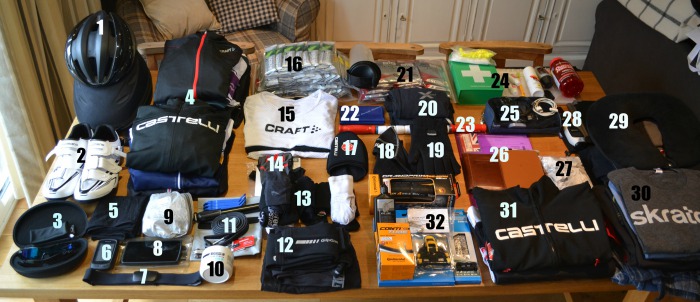
 race day checklist
 Cyclists spend time and effort training hard for a specific event or events but often give little or no thought to what they need for race day even though it’s just as important. There are many variables in cycling that are hard to prevent and once the race begins there are many things that can go wrong. So take the time to prepare a race day checklist in the areas that you can control.

Don’t Panic

Readying for your first bike race (or you’ve been doing it forever) is stressful. Don’t be that person who panics, then slams unorganized junk around the back of the car at the last minute. If you can focus on what’s important, you perform better. A race day checklist can help you to do just that.

Race Day Checklist

 Keep it handy. Check it before you leave home:
  • Bike
  • Helmet
  • Appropriate jersey
  • Underlayer in cool weather
  • Padded shorts
  • Shoes (something you can’t borrow at the last minute)
  • Socks (Tall socks or thermal socks for cool weather)
  • Sunglasses (real easy to forget when you leave home for a race in pre-dawn darkness)
  • Gloves (fingerless for warm weather, full for cool)
  • Frame pump
  • Spare tube
  • Tools

Nutrition and Hydration

  • Full water bottle(s)
  • Food; gels, bars, or whatever suits you — you should know by now what works for you

Red Tape

  • Drivers license
  • Racing license or rider release print-out from website
  • Membership card (if applicable)
  • Race flyer and directions
  • Money, cash, or check (many races don’t use credit cards that you can swipe)

Meds

  • Prescription medications
  • Antacids and/ or over the counter acid blockers such as Ranitidine (add to your underseat pack if you feel you might need them on the ride)
  • Ibuprofen, aspirin or your choice of over the counter pain meds (you never know what’s going to happen out there)
  • Medical/First Aid kit (bandages, ointment)

Not Deal breakers, But Advisable

  • Safety pins (for your race number)
  • Floor pump (to top off your tires before a race)
  • Sunscreen/lip balm depending on conditions
  • Weather-resistant shell (this should be in your race gear if weather is threatening)
  • Clean clothes for after the race
  • Towels
  • Baby wipes — get rid of race gunk (sunscreen, dirt, grit, sweat) before getting back in your car
  • Extra water or sports drink in cooler
  • Snacks or food such as sandwiches if you have a long drive home
  • Camera — you’ll be glad you snapped some photos
  • Toilet paper — you never know, especially if you’re racing mountain bikes and Porta-Johns often run out.

Register Early

Some races aren’t sanctioned and may or may not require a license, but most races are governed by organizations such as USA Cycling. To enter these races you’re required to purchase a racing license. You can purchase a one-day license at some events. If you plan to race regularly, it can benefit you to purchase an annual license, which costs less per race, permits you to race year-round, and supports the sport of cycling. Whatever the type of race, registering early helps you avoid late fees and long registration lines the day of the race.

Overnighters

Reserve accommodations months ahead of time if you’re spending the night particularly if it’s a big event. Lodging close to the race site can often get you a special rate. Don’t forget to verify your reservations at least two weeks ahead of time.

The Week Before

One week before your scheduled event, go through the race day checklist and figure out if there is anything you don’t have that needs to be purchased.  Things like tubes, sunscreen, gels, or foods. By doing this in advance, you alleviate the last minute panic of rushing around and trying to find an item before the race.

Mechanicals Shouldn’t Happen

Your bike should be in perfect working order and this should be part of your race day checklist. It should shift and brake perfectly. The tires should be new or nearly new. All the parts should be tight, properly adjusted, and lubricated. Racing puts bikes to the test beyond what you normally put them through and you don’t want to get knocked out of a race due to a mechanical. If you’re not handy with bike repair, let a mechanic do it. You shouldn’t have a mechanical issue during a race if you’ve done your maintenance properly.

Visualize Yourself

 Visualization can be an integral part of your race day preparation. When you lay down the night before, take a moment to “visualize” the entire race in your mind. See yourself dressed in all your gear. See the positive outcomes that lead to achieving your goal, as well as seeing yourself responding to any challenges which will come your way as part of your race.

Get There Early

Arrive early at races to be able to relax and acclimate to the atmosphere. Most racers try to arrive at the race site one or even two hours before the start of the race. This gives you enough time to sign in or register, change clothes, pin your race number on, warm-up and use the bathroom. It also allows time for fixing any minor mechanical issues that need attention. (It’s easy to knock something out of whack on your bike when transporting it to the race.)

Pre-Ride Option

For shorter, more technical courses, you may want to arrive the day before to pre-ride the course. For endurance events with lots of miles, let the opening miles of the race serve as your warm up.

Pre-Race Jitters

Remember that pre-race jitters is common and if you don’t get them you’re not normal. But knowing that you have all the bases covered helps to relive pre-race jitters and when you do get them, focus on converting them into adrenaline when the gun goes off. Have fun out there. Bike racing is like nothing else. When it gets in your blood, you’re in for the ride of your life.
Bicycle Chainrings – A Guide

March 29, 2016 by Wade Shaddy

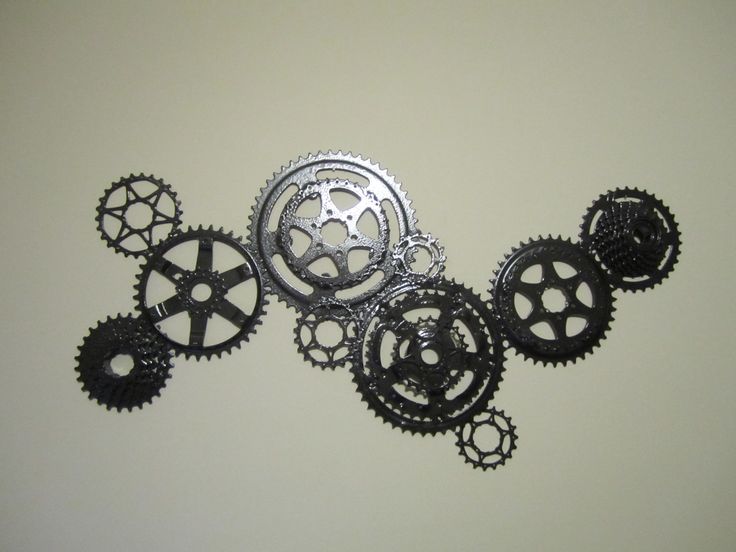
bicycle chainrings

Chain ring, or chainring, is cyclist lingo for front gears. Bicycle chainrings optimize your power by utilizing gear ratios for different output on different terrain. Gear ratios are complicated and even engineers using complicated formulas don’t always agree on proper application of the chainring. For the average rider, it’s for the most part personal preference — within reason of course, cross-chaining is a no no and what works or doesn’t work for you is what’s really important.

Big Ring

Some cyclists like to push the big ring all the time but it’s often more an exhibit of bravado than its efficiency. If you have the muscle and power to cruise all day in your big ring, that’s your business and you have every right to do it.

Small Ring

On the other end of the scale, some riders scoff at the small ring, believing it’s there only to climb the steepest of hills. But there’s no reason why you shouldn’t use it whenever you feel like it, that’s what it’s there for.

Same Ratio

Pushing the big ring on a given gear in the back can have exactly the same ratio and effect as riding in a smaller ring on a different gear in back. It’s been proven by engineers and physics. So what’s the difference?

They Feel Different

Some cyclist contend that bigger gears just feel better. It could be that it’s spreading the chain load, thus reducing friction. However, spinning at a more moderate pace in smaller gears is probably done by the majority of cyclists and produces a better chain line that will invariably be nicer to your drivetrain, your legs, and prolong your bikes longevity, not to mention your own.

Leverage Ratio

Bicycle gears work on leverage ratios, pairing a chainring at the front with a cog in the cassette at the back. The wider the ratio, the more speed you can achieve at a given pedaling cadence. A smaller ratio means less leverage on the rear wheel and thus easier pedaling.

Obvious Differences

Its obvious to all cyclists that using different diameter gears results in a higher speed, lower speed, or a more pronounced effort from an inefficient cadence. Most cyclists don’t put a lot of thought into why this is so, probably because it’s so obvious when you switch gears.

It’s Reversed

Chainrings are bolted to your crankset, and the pedals attach at the end of the crank arms. The more teeth, the harder it is to pedal. All cyclists should know by now that smaller gears in the back allow the bike to go faster and larger gears make it to go slower with more power. It’s reversed for chainrings — bigger gears make you go faster, smaller gears make you go slower, with more power.

The Math

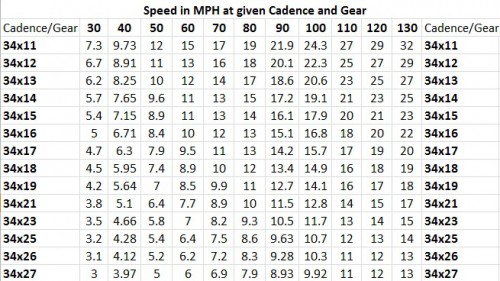
If you want to get techy about it, use this chart for fun a guide but be forewarned, it will likely make your eyes glaze over and be of no real practical use to you unless you’re an engineer, or good with algebra. Before cyclocomputers existed, the way to calculate your speed was to count the number of times you pedaled in a given period of time to determine your cadence. You then needed to know what gear you were in which you could then roughly calculate how fast you were going. You would need to memorize parts of this table first however.

Three Choices in Bicycle Chainrings

Today’s road bike typically has a choice of three chainring set-ups, with two of them dominating — the standard double and the compact-double. The third choice however — the triple — also has a very special place in the cycling world for those who wouldn’t ride with anything less.

The Double

Standard double chainrings usually come with 53 teeth on the big ring and 39 teeth on the small ring. The double has been used for years before anyone even thought of anything else.

Compact Chainrings

The compact is exactly what the name implies. The gear ratios have been compacted from a standard double. One of the most common chainring sizes for compacts are 50-tooth for the large ring and 34-tooth for the small ring. Other combinations are 50-36, 52-36 and 48-34 but these are less common.

The Triple

The triple generally has the benefit of lower gearing for more efficient climbing. Standard gearing for a triple might be 50-39-30.

Bottom Line

The bottom line is that compact cranks climb steeper hills better than standard double chainring configurations. Taking it a step further, triples offer even lower gears for climbing. However, compact chainrings are the lightest in weight of the three choices.

Can I Change Rings?

Can you change rings for personalized riding — yes and no. Crank arms have specific bolt circle diameters, or BCD, which must be matched up with the corresponding chainring BCD. Standard double cranks usually have a 130mm BCD and typically won’t work with anything smaller than a 38 small ring. Compact cranks on the other hand, have a 110mm BCD which can accommodate chainrings as small as 33-tooth.

The 52-36 Combination

You can put slightly larger chainrings on a compact crank. A 52-36 combination is particularly popular choice among some cyclists who want a happy medium between top-end speed and climbing ease.

Oval Chainrings

Recent bicycle chainring designers have brought back the oval-shaped chainring, that was thought to have been discredited. The studies are mixed to say the least, but recent testing by professionals have revived the odd-shaped rings. Oval chainrings have been reported to improve the feel and smoothness of your pedaling action, reduce dead-spots, and improve the activation of your glutes and hamstrings. Claims were also made that non-round rings help to delay the onset of muscle fatigue in the quads. Experts agree that when set up properly, you can’t feel the oval shape. Aside from a tendency to drop the chain, oval-shaped chainrings may just be one of the next innovations in chainring technology.

Go For It

So the answer is yes, you can personalize your bicycle chainrings if the bolt patterns fit and the chain and derailleur will accommodate it. In most cases, if your chosen chainring combination won’t work, there’s always an alternative to it that will probably work just as well. Don’t be afraid to experiment with it. Changing bicycle chainrings is one of the easiest ways to change the performance, comfort, or efficiency of your bike. Go for it.

Road Bike Gear Speed Chart

March 29, 2016 by Adam Farabaugh

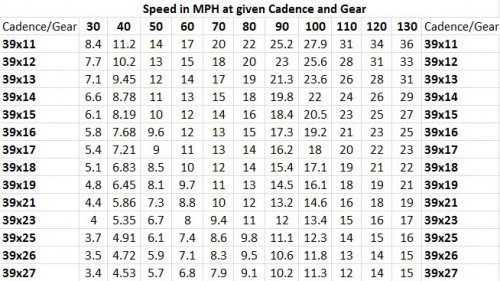
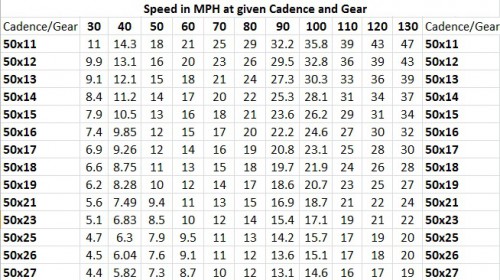
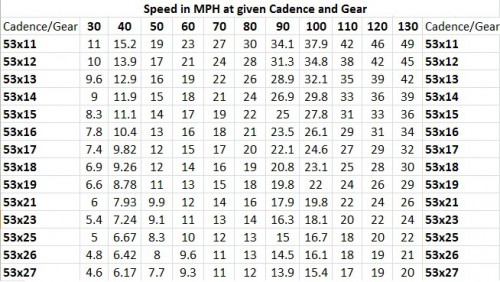
Seeing how fast you can go in a given gear at a given cadence on this road bike gear speed chart can show you what speeds you are capable of on the high end and low end. Going up a climb you may need a smaller ratio while on a flat section or downhill, you may need a larger gear ratio.

Road Bike Gear Speed Chart

The following speeds are calculated using a wheel size of 700c and a tire diameter of 25mm. If your tire size is slightly smaller, the speeds will be ever so slightly lower while the larger the tire, the speed will be ever so slightly higher.

speed chart 34 tooth chainring

Speed chart 39 tooth chainring

speed chart 50 tooth chainring

speed chart 53 tooth chainring

Bike Gear Ratio Chart

March 29, 2016 by Adam Farabaugh


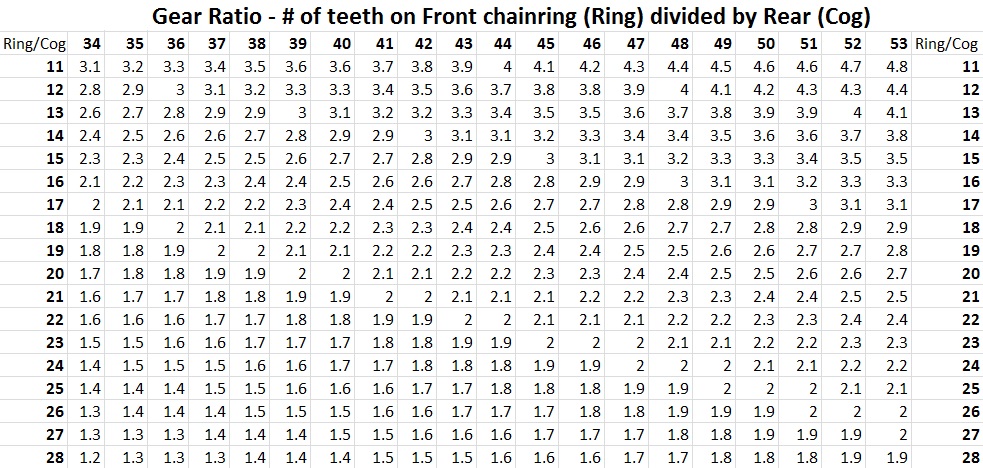
Gear ratio’s in the bike gear ratio chart are determined by dividing the number of teeth on the front chainring by the number of teeth on the rear cog. A larger number indicates a large gear that is harder to turn over and is used for higher speed. A smaller number is easier to accelerate and can still be pushed on steep climbs. As you can see, the same ratio can be achieved whether you are riding in the large chain ring or small by altering the cog in the rear.

Bike Gear Ratio Chart

bike gear ratio chart

What are Bicycle Disc Brakes

March 2, 2016 by Wade Shaddy

bicycle disc brakes

Friction has always been the best way to stop a moving object. Brakes create that friction. Today’s bicycle disc brakes are a modern marvel of refined, contemporary engineering. It provides cyclists with confidence and reliability. Is it for everyone? The answer lies in what you expect from a disc brake and how well you maintain it.

History of the Bicycle Disc Brake

It was the mid 1970’s; the mountain bike had not yet reached any kind of popularity and almost every bike was a road bike with rim brakes. Disc brakes were nothing new though, as they had been on cars for many years. In about 1975, the first disc brakes were placed on a road bike — but it didn’t stay there long.

Sacrifice and Benefit

Rim brakes worked just fine. They were lighter, less expensive, easier to work on and bike shops or sporting goods stores had parts for them. In short, the benefits of the disc brake were outweighed by sacrifices as far as road bikes of the 70’s were concerned. The real need for a disc brake didn’t exist until the introduction of the mountain bike a decade later.

Application of the Disc Brake

The difference is in the application. Mountain bikes rely on disc brakes not because they work better — but because they work better on mountain bikes. Mountain bikers prefer disc brakes for obvious reasons. They can bash their rims out of true and the brakes don’t rub. They can ride through mud, sand or grime and the brakes don’t clog up. There’s no issues with pebbles getting stuck in brake pads and damaging the rims. When it’s wet, the pads still grab almost as if it were dry.

More Stopping Power

Disc brakes, and especially hydraulic disc brakes, do provide more stopping power than rim brakes. However, a feather-light rim brake has more than enough stopping power for a typical rider on a road bike and disc brakes add weight. Most road riders want to go faster, not stop better.

Bicycle Rim Brakes

Rim brakes work by means of generally a rubber compound brake pad, attached to the bike’s frame, positioned directly over the rim of the wheel. When the brake lever is squeezed, the pad pushes against both sides of the rim generating friction to slow the bike down and bring it to a stop.

Bicycle Disc Brakes

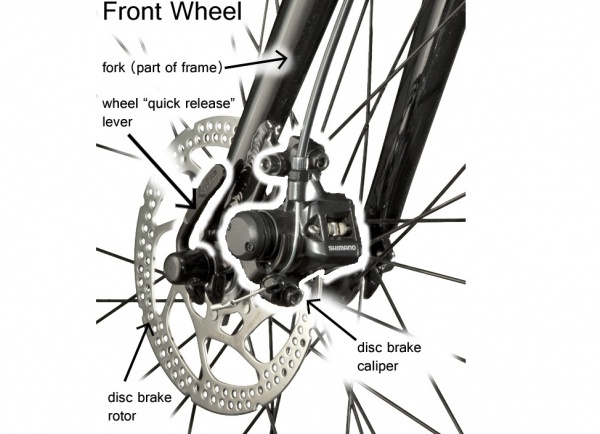
The  rotor — the shiny disc on a disc brake setup — spins with the wheel. Calipers are attached to the fork and rear stays of the bike and are equipped with the brake pads. When the brakes are applied, the calipers squeeze the pads against the disc instead of the rim.

Disc Brake Advantages

  • Work if your rim is bent or damaged
  • Don’t wear rims out
  • Work better in wet, dirty, and muddy conditions
  • Rotor is easy to replace when worn or damaged
  • More stopping power
  • Look cool

Rim Brake Advantages

  • Weigh less than rim brakes
  • Lower cost
  • Longer pad wear, more pad options, easy to replace
  • Parts are cheap and available everywhere
  • Offer better finesse in stopping particularly advantageous in cyclocross

Cable Actuated versus Hydraulic Disc Brakes

Disc brakes come in two varieties; cable actuated or mechanical,  and hydraulic.

Cable Actuated

Mechanical disc brakes rely on cables and housing like a traditional rim brake. Bike companies often use cable actuated disc brakes for simplicity and serviceability. Mechanical disc brakes are much less expensive than hydraulic brakes. The biggest downside is how hard you have to pull the brake lever compared to a hydraulic lever for the same amount of stopping power.

Hydraulic Disc Brakes

Hydraulic disc brakes don’t use cables but instead use fluid-filled chambers and tubing — similar to the brakes on your car — to push brake fluid. Brake pads are housed in the caliper and are forced into the rotor by hydraulic fluid. Because hydraulic fluid does not compress or flex like a cable, hydraulic systems are considered higher performance than mechanical systems and offer better, seamless stopping power.

Cable vs. Hydraulic Servicing

Hydraulic disc brakes are more difficult to service than cable actuated disc brakes. If you develop a fluid leak in a hydraulic line or fluid chamber out on a ride, brakes can begin to fade and at some point fail. There’s no way to fix them on the road or trail. Servicing hydraulic brakes can be an expensive procedure that can require a professional if you’re not mechanically inclined to do it yourself.

Disc Brake Maintenance

There are too many varieties of disc brakes for a single generic maintenance chapter — but they all require similar maintenance procedures. Consult your manufacturer’s suggested maintenance procedures for your specific disc brake.

Warped Rotor

The disc brake rotor is a crucial part of the system. It must be perfectly flat and straight to work properly. If it’s bent or warped it either will need straightened to not rub on the pads or will need replaced altogether.

Bleeding Lines

When hydraulic brakes feel soft or spongy, it’s usually the result of air in the hydraulic lines. An easy way to test if your lines need bled is to stand your bike upright on the rear wheel and pump the brake levers five to ten times. If the lever starts to pull all the way to the bar, it means that there is air in the line and needs bled. Bleeding a hydraulic system is a routine procedure for removing trapped air from the lines and calipers.

Replacing Fluid

Fluid replacement is required when hydraulic fluid becomes contaminated with dirt and moisture. The fluid might be mineral oil or standard brake fluid; check with the manufacturer for the specific type of fluid to be used. Different types of brake fluid should never be mixed.

DIY Bleeding or Replacement

Bleeding lines and fluid replacement can be done at home with the proper equipment and know-how. If you’re unsure about it, take it to a professional.

Caliper and Pad Adjustment

Uneven pad wear is a common reason why you need to adjust your disc brake calipers. It can be done two different ways or a combination of both. If the caliper is obviously crooked, it’s possible to nudge it a bit in either direction by simply loosening the two bolts that hold the caliper to the frame or fork and centering it on the rotor. As your pads wear down, pad adjuster bolts on the caliper move the pads closer to the rotor as needed or at regular intervals.

Pad Replacement

Bicycle disc brake pads are a consumable item.  They wear out and require replacement. They may last a few seasons or only a few months depending on how you ride and how much. Some mechanics recommend replacing pads when the exposed surface of the pad is thinner than a dime. If pads are allowed to wear too thin they will damage the rotor and it can put you in danger. It can take only a few minutes of exposure from a worn out pad to completely destroy a rotor. In short, inspect your brake pads often and replace when necessary for better performance to save money in the long run and to prevent injury.

Generic Pad Removal

To change brake pads, it’s first necessary to remove pressure on hydraulic systems. It’s done on hydraulic brakes by removing the reservoir cap first. Depending on models, a cotter pin is then typically removed from mechanical and hydraulic alike. Some models have additional bolts to loosen. The pads may pop out of the caliper from the top or bottom, and they slip back in the same way.

Additional Cable Adjustment

Mechanical disc brakes have additional barrel adjusters on the cables themselves to take up slack from the cable. Giving them a few turns counterclockwise tightens the cable moving the pads closer to the rotor for better braking.

Give it a Checkup

Proper function of bicycle disc brakes relies on basic things that work together and must be properly adjusted. Have a look at them visually. Spin the wheel. Check the rotor itself for warp and damage. Look for side-to-side wobble. Check to see if the caliper is centered on the rotor. Check pad thickness and caliper position. Sight along the rotor to see how much brake pad you have left. Note how much daylight you have between rotor and pad, and note the thickness of each pad.
  • The rotor must be straight and smooth
  • The caliper mechanism must be properly aligned with the rotor
  • Pads must be positioned correctly in the caliper
  • There must be enough “pad” left to adequately stop the rotor before any damage occurs
  • The lever mechanism– cable or hydraulic — must push the pads tightly against the rotor with “lever” to spare, ie. the lever doesn’t pull all the way to the handlebars

Take Your Time

Don’t do anything half-assed when working on your bicycle disc brakes. If you decide to tackle it yourself, take your time and do it right. If you don’t feel up to it, get your local shop to do the job for you whether it be bleeding your brakes, adjusting them, or changing pads or cables.

What is a Hybrid Bike?

February 26, 2016 by Wade Shaddy

what is a hybrid bike

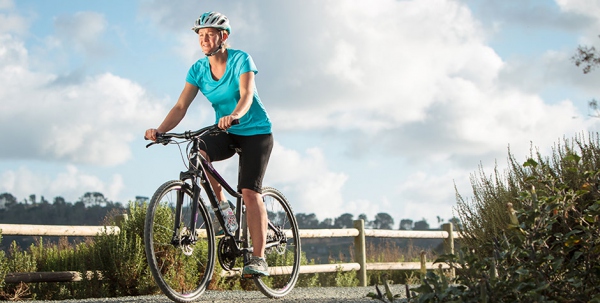
It seems that hybrid machines are everywhere. If you’re new to cycling, you may have heard the term “hybrid”, associated with bicycles. But what is a hybrid bike? Is it better than a road or mountain bike? Something to try out for fun? Is it one you might want to add to your growing collection of bikes? It might be.

The All-Purpose Bike

Bike-shop owners face this problem on a daily basis; someone wanders in without a clue as to what type of bike they are looking for. The answer depends on what kind of biking you do — long-distance, trail riding, road riding, cruising or all of them put together. Generally speaking, a hybrid is an all-purpose bike that can do a little bit of everything.

What is a Hybrid Bike

A hybrid bike is a blend of a standard road bike and a mountain bike, taking the bits of both types to create a machine that can adapt to different terrains and surfaces. The hybrid is a casual approach to almost any terrain.

Geometry of a Hybrid Bike

Unlike road bikes with aggressive, strict geometry made for speed, lightness, and aerodynamics, hybrid bikes have a more relaxed design. A hybrid is designed to relieve stress on your shoulders and neck with a more upright position. This means a shorter top tube with a taller head tube to give a more upright riding posture. Some hybrids also feature a top tube that slopes downward from front to rear, which makes it easier to get on and off, no matter what kind of gear you’re wearing.

Handlebar and Shifters

Road bikes have drop bars that make you reach relatively far forward. Hybrid bikes have flat handlebars similar to mountain bikes. This type of handlebar adds to the upright riding position. It also means that hybrids are equipped with mountain-bike style shifters and brake levers, which are easier reach and operate.

Wheel Size

Hybrid bikes often give you a choice in wheel size. Larger 700c size wheels found on road bikes give the hybrid more of a road bike feel. Traditional 26-inch mountain bike wheels offer a lower center of gravity that might be more appropriate for a mountain bike trail. But both sizes can adapt to both disciplines, due in part to the differences in tires.

Tread Design

Hybrid tires are designed with a rough tread on the outside, and a smooth parallel tread on the inside to deal with varying terrain while offering lower rolling resistance.

Tire Width

The most common width for road bike tires is 23mm. A much wider tire between 2.0 to 2.5-inches is typically used for mountain biking, Hybrid bike tires are somewhere in the middle. Hybird tire width typically runs between 28mm on the narrow side, to the much wider 47mm– which is just under 2-inches. Generally speaking, the wider the tire, the cushier the ride. Narrower tires give you less rolling resistance. Wider tires allow for better handling in gravel or dirt and lessen the likelihood of getting a flat. The main disadvantage to wider tires is weight, which most hybrids are not overly concerned about.

Suspension Options

Unlike road bikes, which now almost all come with a carbon fork, the hybrid bike offers choices. Go with a carbon fork for more road applications. Go with a steel or aluminum fork like the rest of the frame for more traditional all-purpose riding. Suspension forks are available if you plan on using the hybrid off-road. The choice is yours.

Gearing Options

Hybrids don’t follow strict guidelines for gearing options. If you primarily want your hybrid for road riding, select a gearing option like a road bike with higher gears in back. If you plan on using your hybrid for gravel paths or the occasional hill climb on dirt, look for lower gearing. If you plan on touring with a heavy pack or panniers low gearing is also a big plus. Hybrid bikes are available with a triple chainring up front for some seriously easy gears for climbing hills, or a compact double like traditional road bikes. Most often, the gearing tends to lean more toward a mountain-bike set-up.

Who Can Benefit From a Hybrid

Aches and pains commonly associated with road bikes can go away on a hybrid. Common complaints such as neck, shoulder, and backache can benefit from the upright position on a hybrid. This makes hybrids a good choice for seniors, those who might have injuries, or other health related issues.

Summing up the Hybrid

Here’s a quick summation to “What is a hybrid bike?” and the benefits of one:

  • A hybrid can go off and on road, expanding your choice of weekend riding and commuting routes.
  • A hybrid can have a selection of fairly wide tires, which aids comfort and allows for various levels of off-road riding.
  • A hybrid’s horizontal bars provide a more upright riding posture.
  • Hybrids typically have gears more similar to a mountain bike, so riding hills shouldn’t be a struggle.
  • A Hybrid’s shifters and brake levers on horizontal bars are easy to reach.
  • Most standard hybrids are fitted for racks and mudguards, making it a popular choice for commuters.
  • Hybrids package quality and a variety of features at an affordable price. For a cyclist who rides slightly rough trails, flat city roads, bike paths, and the occasional sidewalk, the hybrid meets most purposes halfway.

New to Cycling

If you’re new to cycling, and not sure exactly what you want from a bike, a hybrid can help you decide. For the most part they are affordable options to full-on mountain or road bikes and they give you the option of trying out both disciplines. After you’ve ridden for a few months, you’ll likely know what you like, and then you can target your next bike purchase accordingly.

3 Wheeled Bike For Adults — Best 5 For Your Riding

February 12, 2016 by Wade Shaddy

When you say 3 wheeled bike, you probably think about the tricycle that you rode as a child. However, contemporary 3 wheeled bike models are designed for adults. Some of them have little in common with the trike from your childhood, while others are almost exactly like the smaller versions.

Common Transportation

You’ve probably seen a traditional upright 3 wheeled bike on TV or in movies, or perhaps on your travels if you have visited any Middle Eastern or Eastern countries. The 3 wheeled bike is as common a mode of transportation as any other type of vehicle.

The Older Crowd

More older riders than ever are now riding recumbent trikes. As the price has come down, more younger buyers are trying trikes, but the 50-plus crowd continues to lead the trend. According to the AARP Bulletin, some manufacture’s have estimated that at least 75 percent of 3 wheeled bike customers are over 50. It only makes sense; Recumbent trikes benefit riders who experience conditions common in older people.

Advantages of The 3 Wheeled Recumbent Bike

  • Spreads the weight: Standard upright bicycles or trikes,  focuses your body weight on two small sit bones, the hands, and the feet. A recumbent bike, with its reclined seating position focuses weight on the rider’s bottom, back, legs and feet, effectively spreading the weight.
  • More aerodynamic: 3 wheeled recumbent bikes have a lower level of gravity and a triangular shape to cut through the wind. This results in less drag and as a result it is less taxing on the arms or legs, depending on the model you have.
  • Speed: Having the body positioned so low to the ground really makes a huge difference in speed, especially in windy conditions.
  • Balance: For many older riders, or anyone else for that matter, not having to worry about balance is a big plus.
  • Adaptability: Can be adapted to people with disabilities.

Potential Downfalls

  • Hard to see in traffic. Flags can help you overcome it.
  • On hills, you can’t stand up to gain leverage or power. Gearing should allow for you to overcome this.

Advantages of  The Upright 3 Wheeled Bike

  • Better visibility in traffic. The higher seating position allows more visibility above car hoods and other obstacles.
  • Step through design for easy mounting and dismounting
  • Bicycle stores love you, much more availability of parts for easy repair. Also are easier to work on.
  • Typically more cargo area.
  • Built to last.

Potential Downfalls

  • Less efficient than a recumbent.
  • Upper body weight is placed on the rear end and hands the same as a normal bike.
  • Typically built cheaper than a recumbent.

A Lot of Choices – The Best 5

With what seems like hundreds of different configurations, styles, prices and types of 3 wheeled bikes out there, it’s almost counterproductive to state that any bike is better than another. It depends on your individual needs. With that in mind, here are some different options:

Greenspeed GT3 Folding Recumbent 

Small trike with a lot of personality. Designed to be easily transported so you can fold it up to fit in your car, or take up less space in storage. It is quickly folded with only a 6mm hex wrench and one quick-release for the frame hinge.

What to Use it For

This bike is great for weekend warriors, commuters, or even assisted touring. Available in small and standard sizes, it’s easy to find one that fits. With a weight limit of 265 lbs, it accommodates most people with ease. $2,690

Terra Trike Tadpole Rover   

The Rover has probably introduced more people to a 3-wheeled bike than any other recumbent trike on the market. It’s restored health and happiness to thousands of owners who never thought they would be active again. The Rover is perfect for any type of rider – young or old, large or small.

Internal Gearing

The Rover employs the NuVinci N-360 hub. It works with a continuously variable shifting system to give the rider minute control over the ride. It is a zero maintenance, zero learning curve, zero intimidation hub that makes learning to ride a 3-wheeler easy.  There is no derailleur or fixed gears to worry about, and it doesn’t matter if you are pedaling or not to shift. All the rider has to do is twist the shifter on their handlebar and the hub increases or decreases the gearing immediately to what feels best for the rider.
$1,499 with the NuVinci Hub.

Mobo Triton Pro 20 

Easy to ride for adults and kids with easy adjustments. Think of it as a more affordable version of the tadpole design. Sturdy and stable. $499.00

Mission SOLO Low Step Adult Tricycle  

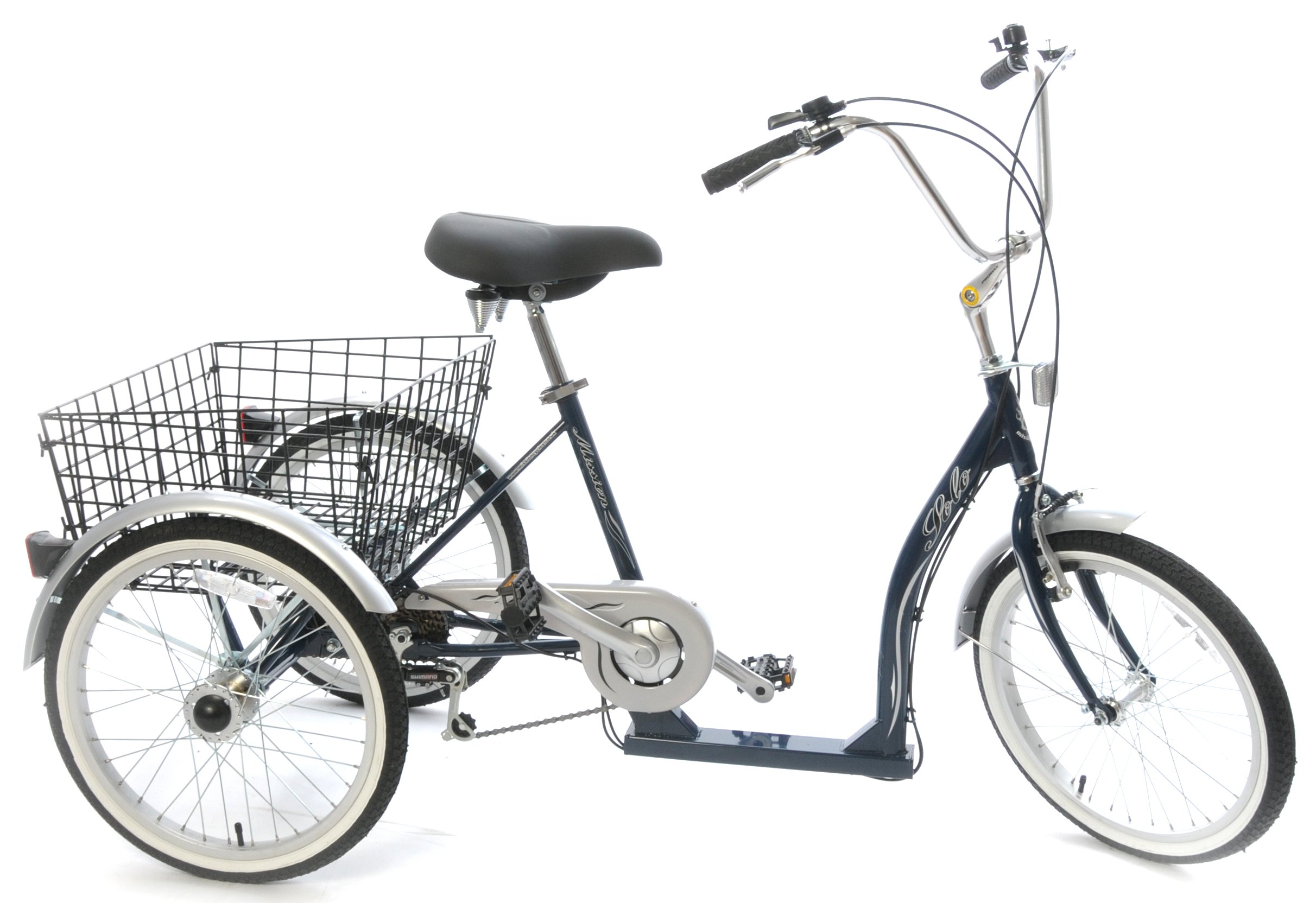
The new Mission SOLO has been specially designed with a low step over of only 6 inches from the ground making it easy to mount and dismount. It’s proven to be very popular with the elderly and physically challenged. The Mission SOLO helps to raise the independence of disabled people and achieve a greater sense of self-worth. It’s ideal for those little shopping trips with a large basket on the rear to carry groceries. $820.

Schwinn Meridian Single Speed Adult Tricycle  

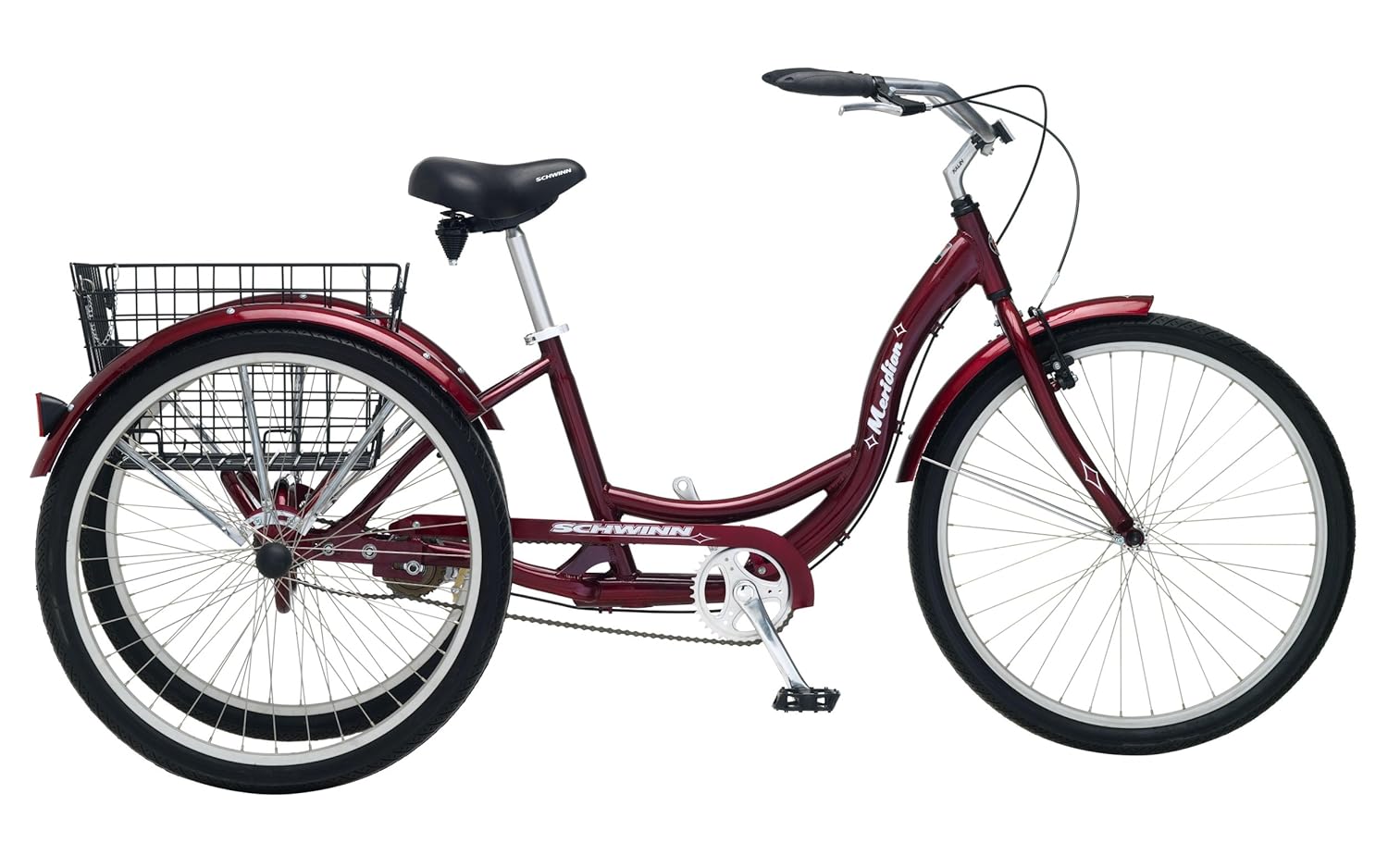
This is the basic 3 wheeled bike for beginners which might remind you of the trike you had as a child. It’s also the most affordable at only $269.

10 Cycling Mistakes a New Cyclist Makes

February 11, 2016 by Wade Shaddy


cycling mistakes

We’ve all made these cycling mistakes when we started riding but you don’t have to. And if you find you’re doing one of these, you can quickly fix it before your next ride. Fixing some of these cycling mistakes will help save your life while others will just help you look good in your new found passion.

#1 – Riding Like You’re Visible

It’s a newbie mistake that can get you hit by a car; the assumption that cars can see you. There are few things in life that you should assume without verification, your visibility on a bicycle is not one of them. Always ride like you’re invisible.

Scan Your Surroundings

Constantly be aware of traffic coming up from behind by checking over your shoulder and listening. It’s not always possible to monitor your surroundings 360-degrees but do your best. If possible, make eye contact before making any sudden moves if possible, particularly across intersections.

Increase Visibility

Take steps to increase the probability that motorists see you by wearing bright colored clothing during the day, and lights at night…..More on fashion later.

#2 – Riding in the Wrong Lane

Everyone has seen it; newbies riding peacefully down the wrong side of the road opposite the flow of traffic. This is wrong for two reasons:

One: you could be hit by a car on the same road coming at you from straight ahead of you. Cars have less time to react when they see you and can’t take take evasive action because they’re approaching you faster than normal because you’re going towards them rather than away from them. Also, if you do happen to get hit, the forces are greater because it is two objects traveling toward each other rather than both in the same direction at differing speeds. 

Two: Cars turning from an intersection are not looking for traffic — you on a bike — coming from the wrong direction. They will turn right into you.

#3 – Riding Too Far to The Right

Newbies often ride very close to the curb because they’re worried about being hit from behind. But if you take a look at where the car is, you’ll see that the driver is looking down the road for traffic. They’re not looking in the bike lane or the area closest to the curb. Drivers typically look down the middle of the lane for other cars.  The farther left you are the more likely the driver will see you.

Move Out There

If you’re new to cycling, move to the left. Stats support the concept and say that you’re far more likely to get hit by a car coming at you in an intersection than a car from behind which can see you more clearly.

#4 – Group Ride Without a Clue

Learning to ride in close proximity to other riders takes practice. You’re in trouble from the start if you attempt a group ride without first knowing what’s expected of you. Newbies who don’t know the drill put the whole group in danger. They may not know the gentle buzzing of your front tire into someone’s rear tire can cause both of you to go down hard, not to mention the riders behind you as well.

Ride With Friends

Ride with a few experienced friends to get the feel for it ahead of time. Talk to them and have them tell you what to do and not to do with just the few of you. Have them teach you how a paceline works and what all is expected of you. Don’t tag along on a multi-person group ride until you’ve got the basics of group etiquette down.

#5 – Starting Out Too Aggressive

Newbies sometimes decide to tackle 30 or 40 miles on the first day. As with any new form of exercise, you need to ease into cycling. Chances are that you can make a longer ride, but the crippling, unexpected soreness can discourage you from cycling altogether, or worse, It can lead to injuries.

Start Small

Start small. Bike 1 or 2 days a week for a few miles, maybe even ten. A good indicator is when you realize that your rear-end isn’t sore.

#6 – Getting Cocky

Nobody likes a show-off. Even if you have a moderate or high level of fitness, hot-rodding is a no-no. It’s a newbie mistake that shows a lack of confidence in your own ability — and it doesn’t fool anyone. A good example is the newbie who takes both hands off of the handlebars at the same time. This show-off gesture is only appropriate for pros when they win the big race — and it gets them in trouble at times.

Look Ma, No Hands

Keep two hands on the bars at all times. Ride with respect to the environment, other cyclists, pedestrians, and motorists.

#7 – Wrong Clothing

Wearing pants is common among commuters and newbie cyclists. Don’t do it without restraining your pants legs with a pants band or don’t wear pants at all. Cyclists have plenty of horror stories about catching a pant leg in a chain or chainring. It doesn’t have to happen that way.

Embrace Lycra

Embrace Lycra. Lycra is tight, it’s designed to be slick enough to allow you to be comfortable on the seat and with the pedaling motion without your shorts or pants catching on your knees. T-shirts are another item to discard for riding. Jerseys are made with an athletic material and are light, airy, with pockets for everything. Get the right gear.

#8 – Wearing Underwear

Almost all newbie cyclists do this one; wearing underwear under Lycra shorts. It might be considered uncouth to skip the underwear, but underwear bunches up under cycling shorts and can really cause you pain. Lycra is designed to be worn without underwear.

Be a Swinger

Just do it. You’ll never understand how comfortable Lycra is by itself until you try it.

#9 – Fashion Faux Pas

Newbies might not care about cycling fashion but that doesn’t mean that they should ignore the rules of road cycling fashion.  These are rules that you can only learn through time spent around other cyclists, or by getting on first-name terms with the staff at the local bike shop of course.

Wearing Long Socks

Socks that cover most of your calf just look stupid when riding a road bike. Cyclists of all kinds wear short socks only. When your calves start to bulge, you’ll want to show them off. Wear short socks.

Wearing Baggy Shorts

Newbie mountain bikers who might have crossed over to road biking might still be thinking that it’s fine to keep wearing baggy shorts. It looks funny, like you grabbed the wrong bike. While baggy shorts are perfectly acceptable for off-road riding, the exact opposite is true for road riding.

#10 – Not Wearing a Helmet – The Biggest of Cycling Mistakes

A lot of the time cyclists will see what other riders are doing and try to emulate it because it looks cool. In some cases this is OK, such as adopting a bright colored sock, saddle, and handlebar tape combo, but one thing you should never adopt is riding without a helmet. Riders will do this because they think it looks cool but you should always wear a helmet, even if it’s just down the street to the grocery store quick. You never know when something might happen and being seen without a helmet on just makes you look stupid. Wear one. Always. It will save your life.
Ten Best Fat Bikes and Their Advantages

February 10, 2016 by Wade Shaddy

 Think of the fat tire bike as the monster truck of the cycling world. You might have seen one before; a bike that looks like it has car tires. To put it mildly — they’re FAT. They look ungainly, and for the most part they are. Bearing in mind that the over-the-top fat tire bike is not designed for speed or responsive handling, the fat tire bikes look really cool and they’re a blast to ride in conditions that a normal bike would go nowhere with. Following a brief run-down are ten of the best fat bikes out there right now. Have another one you’re a big fan of? Let us know in the comments below.

Fatties in Competition

Fatties have been around for more than a decade but have only captured the mainstream cycling world’s attention over the past couple of years. It’s due in part because of their versatility and the growing popularity of extreme adventure riding and racing. For example; hundreds of competitors ride fat bikes over the challenging Arrowhead 135 course every January in Minnesota. If you’re interest is peaked, there are a lot more racing and events out there just waiting for you and your best fat bikes.

Wide Tires

Standard mountain bikes typically have a tire width of about 2 inches. Fat bike tires are about double that — or more even. The massive tires can also be ridden at dramatically lower pressure. The width allows fat bikes to float on loose, non-solid surfaces where any other bike would just sink in and go nowhere.

Low Pressure

Mountain bike tires range from about 25–65 psi, but the gigantic fat tires can handle pressures as low as 10 psi or even less. Lower pressure allows the tire to grip the ground under the rider’s weight, drastically increasing the contact area of the tire thus increasing traction even of loose surface such as snow or sand where the fat bike is at home.

All Terrain

For other conditions, such as sand or soft snow, the extra width and low pressure allows the rider to float more easily over the softer, more unstable surface. The tires react to snow-packed and icy surfaces gliding through icy corners that can send you hurtling to the ground on a standard mountain bike. As an added benefit, the squishy tires also make for a much more comfortable ride on any surface as it’s a built in suspension.

The Best Fat Bikes For You

Now that you know a bit more about fat bikes here are ten of the best fat bikes for you to consider for a totally different riding experience.

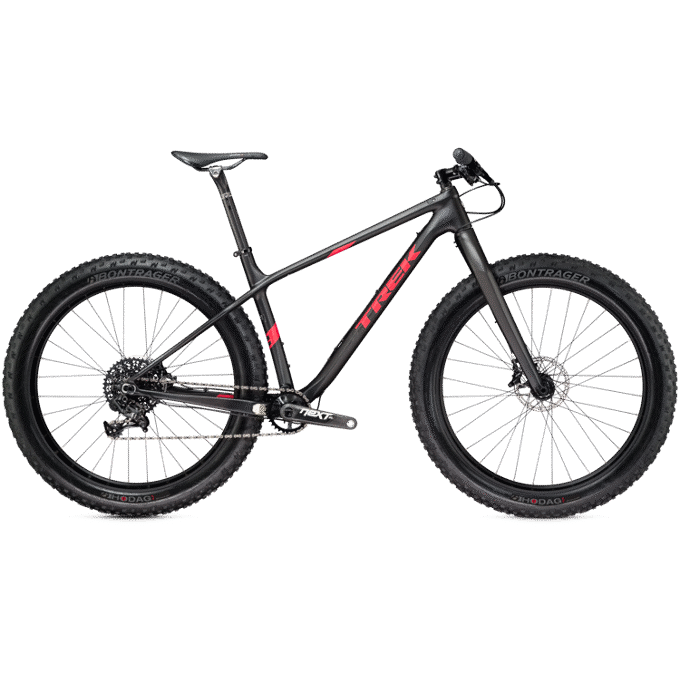
Trek Farley  Farley 9.8

The Trek Farley may just be at the top of the food chain, both in performance, looks, and price. It also accommodates one of the widest tires out there at 5 inches.

  • Carbon or Alloy frame
  • Tubeless tires
  • Rockshock Bluto Fork
  • Up to 11 speeds

With up to six different models of the Trek Farley the models range from about $1,200 to about $4,800.

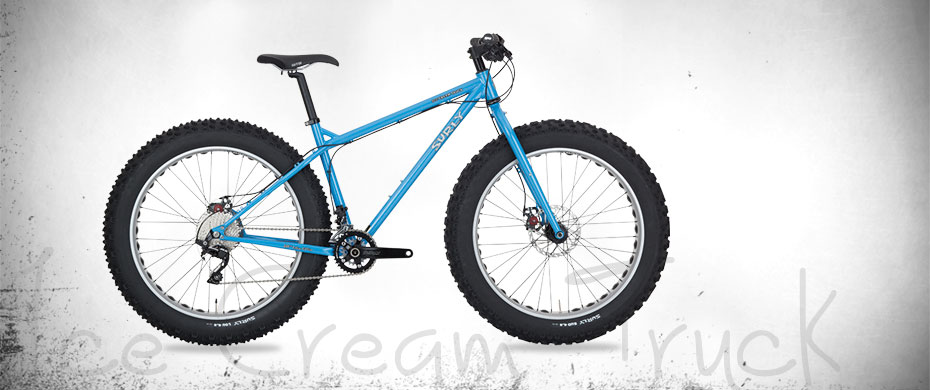
Surley Ice Cream Truck  
The Ice Cream Truck is near the top of the best fat bikes list primarily because it has one of the largest, most voluminous tires out there at 4.8 inches. And it’s eye candy.
  • 4130 chromoly steel tubing
  • Shimano SLX CS-HG81-10-speed cassette
  • Six frame sizes from extra small to xxLarge
  • $2,700.00

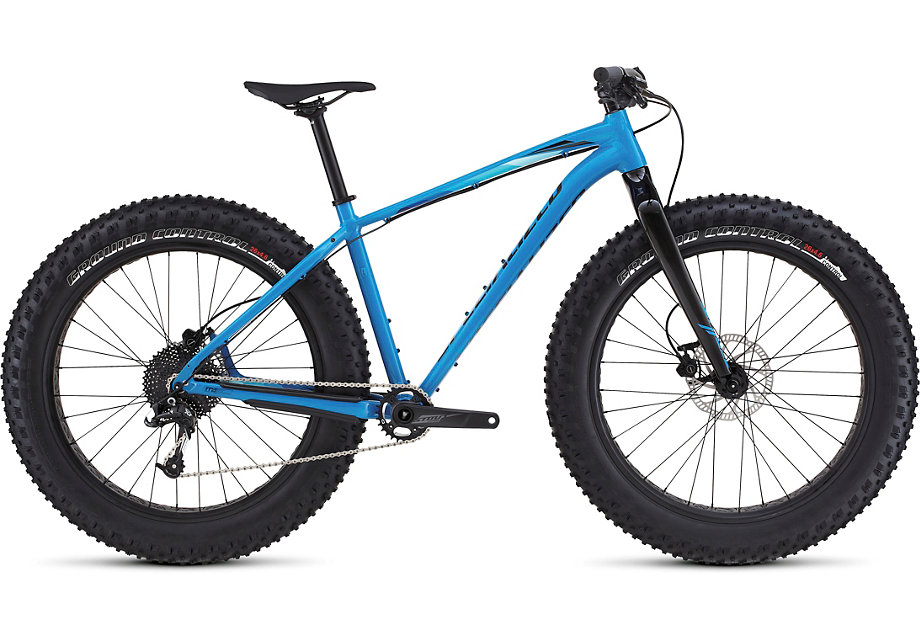
Specialized Fatboy  

A worthy first-time fat bike, with only slightly less width at 4.6 inches.

  • FACT carbon fiber fork
  • M4 alloy frame construction
  • SRAM X7 Type 2.1, 10-speed
  • $ 1,699.00

Felt Double Double 30  

Tires getting smaller at 4 inches in width, the Double Double is at home for daily use on any surface.

  • Aluminum Frame
  • Custom hydroform fork
  • Shimano 10-speed
  • $1,999.00

Borealis Echo XX1 fat bike  

The echo is performance-oriented, with clearance for 4.8 inch tires.

  • Full carbon frame
  • Fully guided internal cable routing
  • SRAM XG-1195 cassette
  • $4,750

Turner King Kahn  

The Kahn, with over five inches of travel and a massive foot print, allows a rider to stick lines only available to mountain goats and downhill pro’s in the past. When traction is virtually unlimited, a rider can push through limits. You only need to know one thing: This fat bike is full-suspension since Turner only makes full suspension bikes

  • $5999

Cannondale Fat CAAD 1  

The bike for those who ride in every season on every surface. Fans of the “lefty” fork will recognize this unique design on the Fat CAAD.

  • Aluminum Frame
  • SRAM components
  • 4.8-inch tires
  • Bike specialty — mowing things down
  • $3,730

Canyon Dude CF 9.0 EX  

With an innovative carbon frame weighing in at an incredible 1550 g, this is one of the lightest fatties out there. The Dude may look fat but don’t let that fool you – nothing stands in its way.

  • SRAM drivetrain
  • 4.0-inch tires designed for a faster ride than other fatties
  • Rockshock fork
  • $4273.13

Genesis Caribou Caribou

Not tied-down to specific single-season use, and much more than a just ‘snow bike’, the trail-orientated geometry and fat tires lend themselves well to year-round use.

  • Chromoly steel frame
  • Shimano and Samox drivetrain
  • 4-inch tires
  • $ 1852.42

Moonmen #MOO  click em to make em big

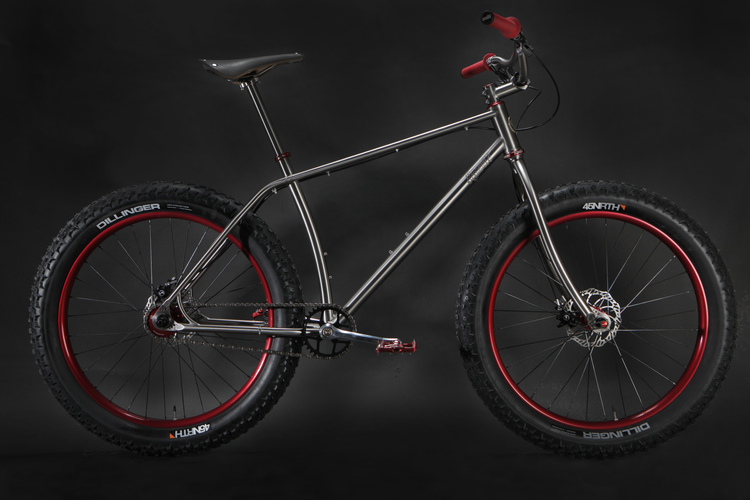
This bike is all about playing. Moonmen bikes are foremost about the joy of riding, especially when you’re floating over a fluffy snow, bike packing across the desert, or taking a podium at your local race series. This bike company is so new, that reviews are for the most part, unavailable. It also has so many different options, that listing even part of them is not fair, but here are the basics:

  • Single Speed
  • Titanium
  • $3600 and up

Finding The Best Road Bike Saddle For You

February 8, 2016 by Wade Shaddy

best road bike saddle

The majority of cycling articles focusing on bike fit don’t fully address saddle fitting. Fitting a road bike saddle works best when you start with the right size bike, or at a minimum, a bicycle that is close enough to your correct size to be comfortable and efficient.  Finding the best road bike saddle should focus primarily on the contact points between the cyclist and the saddle assuming that your bike fits you.

Don’t Compromise When Searching For Your Best Road Bike Saddle

Bicycles are symmetrical. The human body is not. A saddle that is not right for your body and butt can compromise your position on the bike as well as your comfort. One saddle may be great for one rider while being the worst option for the next. A general rule of thumb for saddles is that it fits when it disappears, meaning that you’ve forgotten all about your saddle and don’t even know it’s there.The only thing on your mind is the ride and the scenery.

One Exception

An exception to this general rule of thumb is if you have been in the saddle all day for miles and miles. At this point, you’ll likely take note of your saddle. The thing is, if it didn’t fit, you wouldn’t have ridden this far.

The Finger Test

Changing a saddle can take up to 15 minutes per seat when choosing and testing saddles.  This means that many cyclists skip the hassle and make a seat choice by pressing a finger into it, testing it’s firmness or lack of softness.

Widely Advertised

Another option widely employed is simply choosing a saddle based on the one that is most advertised. This might actually work for the majority of cyclists, as most high-end saddles are tested and proven to be comfortable for the wide majority of riders. This is more down to chance however. You get what you pay for, both in time spent deciding and money.

Gender or Not

Keep an open mind as you search for the best road bike saddle. Most bike shops start you out by indicating saddles that are specifically designed for men and women with most women’s saddles being wider towards the rear. But some men find that women specific saddles are actually really comfortable and ideal for them. At the same time, some women realize that a men’s saddle is the better choice for themselves also. Gender specific is worth taking a look at, but choose the saddle that’s the most comfortable for you.

The Cutout

A popular design for bike saddles includes a cutout in the center of the saddle to relieve unwanted pressure in sensitive areas. A good-fitting saddle may not need a cut out if the support is in the ideal area for you. It varies from person to person but in general, male or female, it means not too much pressure in the front or in the center of the saddle. A cutout design may prove the most comfortable but at the same time, don’t discount saddles without a cutout before trying them first. You might be surprised as to which feels best.

Saddle Width

Saddle width has been a source of controversy for many years. A comprehensive study sums saddle width up like this:”Stresses within the perineum are reduced when saddles are sufficiently wide to support both ischial tuberosities”. (Your sit bones). You should find a saddle that is wide enough for your sit bones by measuring them and choosing the right width.

Back in the Saddle

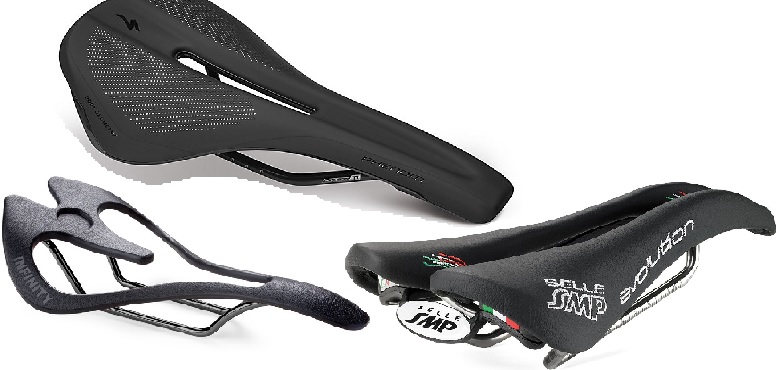
With all that information fresh in your head, here are a few options for your best road bike saddle starting off with narrow and ranging toward wide.

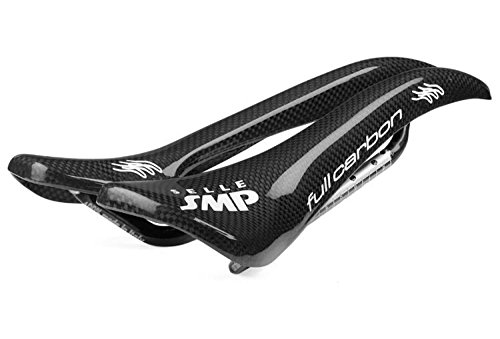
Selle SMP 

This full carbon model is at the top of the list. It’s designed for cyclists looking for the lightest weight possible. It sports a completely free central channel, eagle-beak nose and raised design that gives these models an aerodynamic touch. They are suited for smaller sized people with narrow pelvises.

Selle SMP Evolution 

A good saddle for racing, and cycling in your free time. It’s a   composite model with minimal padding. It relies on foamed elastomer padding where the ischial tuberosities (sit bones) and rear rest. The minimal padding also makes it particularly suited for thinner cyclists with narrow pelvises.

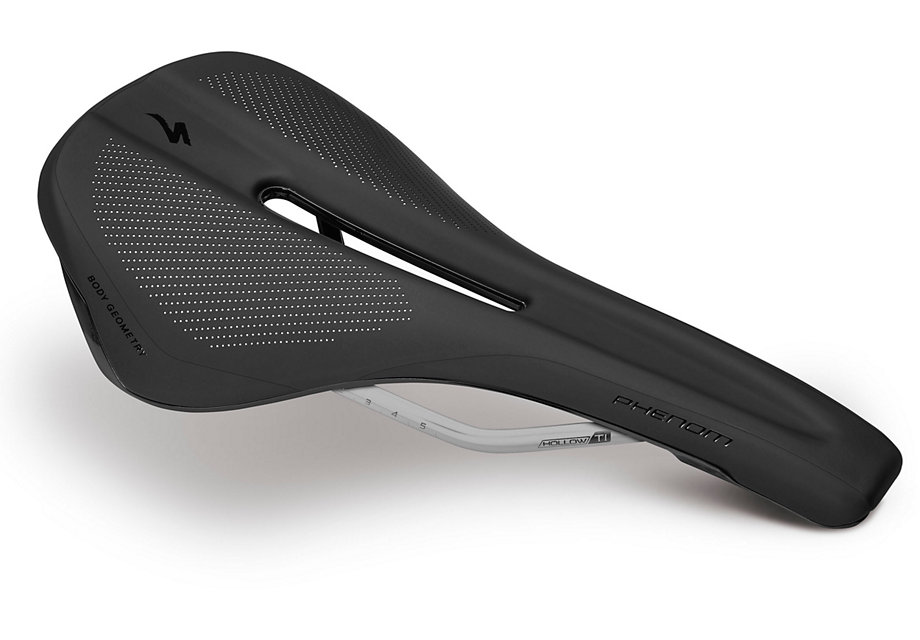
Specialized Phenom Expert 

The Phenom Expert is designed with ‘adaptive edge’ construction. It allows the outer edge to conform to your body for a custom fit. Lightweight, stiff and efficient, this saddle features hollow titanium rails and the perfect amount of padding for those long grinds in the mountains.

fi’zi:k Road Arione R5 K:IUM
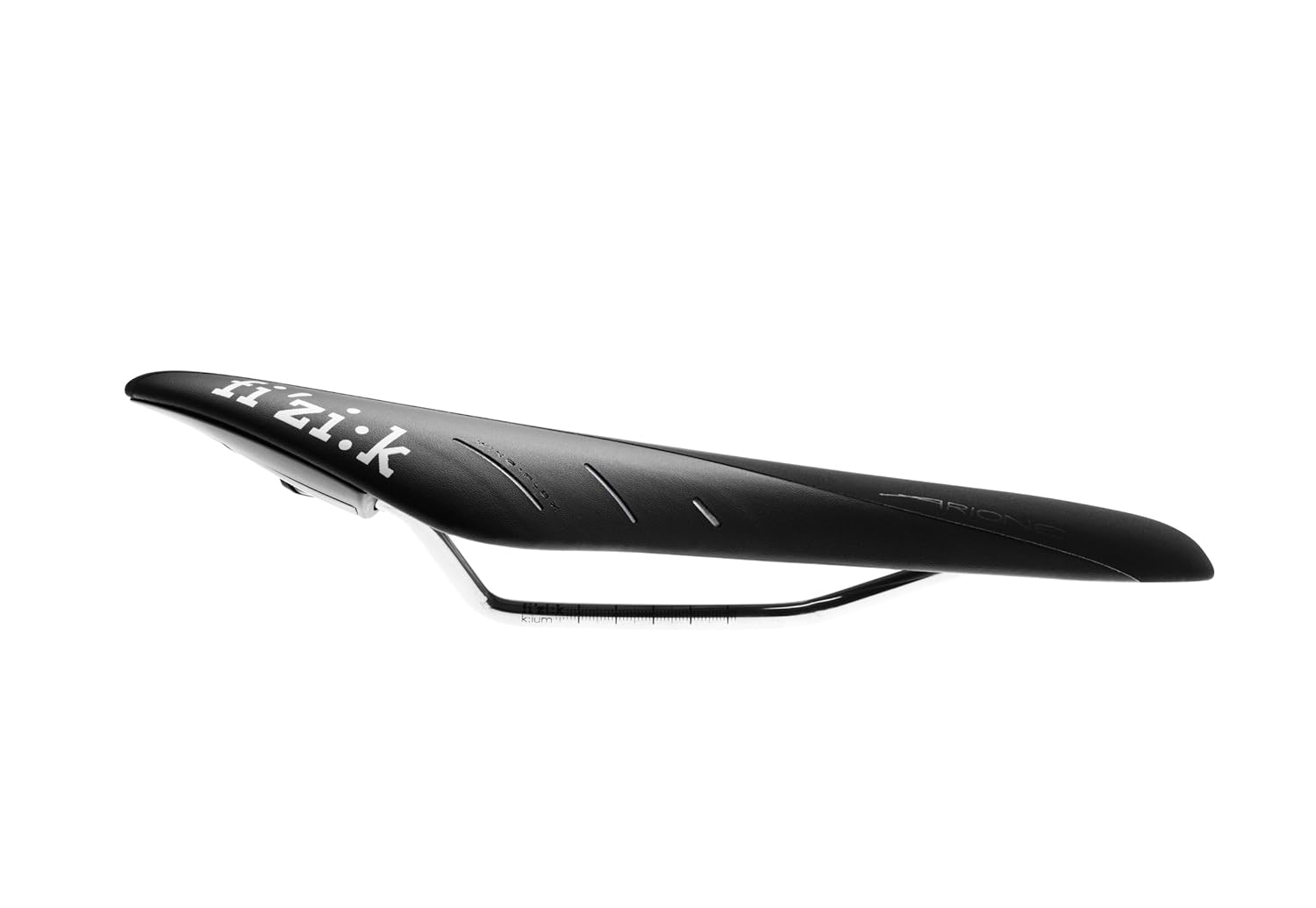
The Arione R5 features a Carbon Reinforced Nylon base and Wing Flex technology. This saddle is made for competition. It aids in high-performance because it takes into account that cyclists have varying degrees of flexibility, and human flexibility is in direct relation to riding behavior when cycling. Popular with pros such as Sir Bradley Wiggins and Geraint Thomas, this saddle has no cutout, and they like it.
Infinity N-Series Infinity N-Series Bike Seat
Bare bones saddle — it looks like a skeleton — this saddle is perfect for the cyclist who wants all the performance with none of the frills. One of the lightest saddles on the market, weighing in at just 210 grams, the N-Series Seat is made of injection-molded nylon. Its has two purposes: Comfort and Performance. Don’t let the odd look of the saddle deter you; it’s built to withstand the rigors of even the longest rides.
« Previous Page
Next Page »
  • Facebook
  • Tumblr
  • Twitter

Latest Articles

JOIN Cycling: A New Training Platform for Cyclists

May 27, 2024 By Eric Lister

cold exposure

The Benefits of Cold Exposure for Cycling & Life

June 13, 2023 By Eric Lister

hill climb

The Ultimate Hill Climb Training Guide

May 31, 2023 By Eric Lister

shoulder pain cycling

How to Treat & Avoid Shoulder Pain While Cycling

April 12, 2023 By Eric Lister

psoas stretch

The Importance of the Psoas Stretch for Cyclists

April 6, 2023 By Eric Lister

cycling neck pain

The Ultimate Guide to Cycling Neck Pain: Causes and Solutions

March 21, 2023 By Eric Lister

Useful Info

  • Contact
  • Finally, A Global Cycling Club That Is Focused On Community And Love Of Cycling!
  • Privacy Policy
  • Share Your Story!
  • Terms And Conditions Of Use
  • Welcome to I Love Bicycling
  • What Happened When I Stretched Every Day For a Month

Recent Posts

  • JOIN Cycling: A New Training Platform for Cyclists
  • How to Hang Bikes in Your Garage: 4 Inexpensive Options
  • Gravel Bike Vs. Road Bike: Which One Is Better For You?
  • The 6 Types of Mountain Bikes & How to Choose the Best One for You
  • What Is a Touring Bike Good For? 5 Benefits We Know You’ll Love

Search I Love Bicycling

Connect with Us

  • Facebook
  • RSS
  • Tumblr
  • Twitter

Copyright © 2026 · Magazine Pro Theme on Genesis Framework · WordPress · Log in