• Training
    • Injury Prevention
    • Training Tips
  • How To
    • Bike Fit
    • Gear
  • Nutrition
    • Nutrition Tips
    • Weight Loss
  • Repair
  • Reviews
  • Stories
    • Funny Stories
    • Jokes
    • Quotes
    • Videos
    • Funny Videos

I Love Bicycling

I Love Bicycling is a website that is geared towards cycling for beginners with road cycling tips, training articles, nutrition tips, weight loss, how to’s and bike repair articles.

Training

  • Injury Prevention
  • Training Tips
  • Training Camps

12 Week Training Plan for Your Gran Fondo or Century Ride

March 13, 2016 by Adam Farabaugh

 training plan for grand fondo or century1

  • Are you preparing for a gran fondo or century ride?
  • Do you want to not only finish but finish strong and have a great ride?
  • Are you looking to improve your fitness and become a better all-around cyclist?
  • Are you looking for a structured plan that gives you day-by-day workouts while allowing you to move them around your schedule?
  • Do you want more than just a training plan but a plan that makes you a better, well-rounded cyclist?
  • Do you want to not only gain fitness but also strengthen your core to improve comfort as well as performance on the bike?
  • Do you want to improve your handling ability with weekly skill’s practices?
  • Do you want a very affordable training plan that gives you a lot of value?
  • Do you want a training plan right now that you could start today?

If you answered yes to any of these, you’re in luck. The I Love Bicycling “12 Week Training Plan For Your Gran Fondo or Century Ride” will give you the outcome you’re looking for with a lot of added benefits.

First – What Is It?

It is a 12 week, day by day training plan that walks you through what to do for a ride and why that specific ride and intervals will help to improve your overall cycling fitness. It will build and challenge you while giving you the adequate rest you need to recover and get faster. Additionally it includes weekly core strength workouts along with a weekly skills practice to improve your cornering, braking, and overall bike handling ability regardless of where you are currently at. Also included are tips to improve your nutrition, hydration, how to dress properly for the weather, recovery, stretching, and how to best be prepared for your event. It is a training plan that will make you a better all-around cyclist.

What Should You Expect?

With this plan, you should expect to commit 5 days a week to riding. Rides will range from 1 hour in the beginning to 6 hours toward the end of your training plan. These will include easy rides, rides with varying intervals to quickly improve your fitness, and long endurance rides. You should expect to put about 6 hours per week toward riding on the low end, to about 12 hours per week on the high end. The rides are of this length to ensure that you are properly prepared for your big ride. Ride times of less than this begins to make it very difficult to be fully prepared for a gran fondo or century ride. The rides can be moved around to fit your personal schedule which is explained how to do to still achieve the same results. You should also expect to improve your overall cycling knowledge as it will teach you proper nutrition, hydration, how to dress properly for the weather, recovery, to include a stretching routine, and how to best be prepared for your event.

What If You Don’t Have An Event Planned?

It’s alright if you don’t have an exact event planned. You can start the plan and see how it’s going and then look for an event around when you’re slatted to finish. If you’re just looking for a structured program to improve your fitness and cycling ability, that’s great too. This plan will do just that and will give you a lot more additional benefits.

What If I Don’t Think I’m Fit Enough To Start The Training Plan?

It’s recommended that you have a base fitness level of riding a few days a week and be able to complete a two hour ride. If you’re not quite to this point, that’s OK. Included is a 4 week preparation plan to get you riding and improve your fitness to the level required to begin the “12 Week Training Plan For Your Gran Fondo or Century Ride“.

When Should You Start The Training Plan?

You should start the “12 Week Training Plan For Your Gran Fondo or Century Ride” exactly 12 weeks before your event. The “event” is included in the training plan on the weekend of week 12. This means you should aim to start exactly 12 Mondays (the training plan starts on a Monday) prior to your event.

Why You Would Follow The “12 Week Training Plan For Your Gran Fondo or Century Ride” Instead Of Getting A Coach

Having a coach can be valuable in the right situation. However, they can be expensive and you may not need the one-on-one interaction. You also may want to become better as an all-around cyclist, not just improving how fast you can ride. This training plan can give you the results you want with additional benefits without the cost of having a personal coach.

Why You Would Follow The “12 Week Training Plan For Your Gran Fondo or Century Ride” Instead Of Buying Another Online Training Program

There are a number of other online training programs but the majority don’t offer a well-rounded approach to improving your riding. They just give you workouts to do and that’s it. The “12 Week Training Plan For Your Gran Fondo or Century Ride” not only gives you focused workouts but also tips, a weekly core strength workout, and a weekly skills practice to improve your bike handling ability. Additionally, this training plan tells you why you’re doing what your’re doing and how it helps you.

moneybackgurantee

100% Money Back Guarantee

You can buy the “12 Week Training Plan For Your Gran Fondo or Century Ride” risk free as if you are not completely satisfied we will give you your money back up to 30 days from when you buy. We are confident in our training plan and want you to get out of it what you expect and if you don’t, you don’t deserve to pay for it. Just email us and we will refund your money.

How The Downloadable PDF Training Plan Is Delivered To You

The “12 Week Training Plan For Your Gran Fondo or Century Ride” is delivered to you instantly upon purchase via a downloadable PDF file. The file is approximately 1.4 MB and 103 pages long.

Price

The downloadable PDF “12 Week Training Plan For Your Gran Fondo or Century Ride” costs $27.

Here is the introduction to the training plan and a few photos of what to expect. 

Dear Cyclist:

Welcome to the I Love Bicycling Training Plan for a Century or Gran Fondo.

Taking your cycling from a casual level of riding for an hour or two, to being able to complete a century or gran fondo is no easy task. Luckily you found us. We aim to take you through a twelve week training plan where we not only give you the workouts that build as the week’s progress, but also why you’re doing the workouts and why it works.

Additionally, we aim to not only improve your fitness level but all aspects of your riding from bike handling, to nutrition and hydration, to core strength exercises. Cycling is not a “do one thing and get better” sport. It’s the combination of all the little things.

We start off with giving you a couple rides a week to ease into the training plan and then increase the duration and intensity while combining it with adequate rest. Each week will include on the bike skills practice along with core strength exercises. We base the workouts off of duration and perceived effort which you can then combine with heart rate if you are using are heart rate monitor. (Definitely recommended.)

Before each weeks plan, we include a section on an important tip, skill, or knowledge point that we think you should know to help your riding in general and to prepare you for your century or gran fondo. You should focus on that thing that week so it naturally becomes part of your riding and isn’t something you have to think or stress about.

Without further ado, here is your 12 Week Training Plan For Your Century or Gran Fondo. Three months is a long time but it will go by quickly. Follow the training plan as closely as you can and you’ll be ready for your event.

             –  The I Love Bicycling Team
TP1
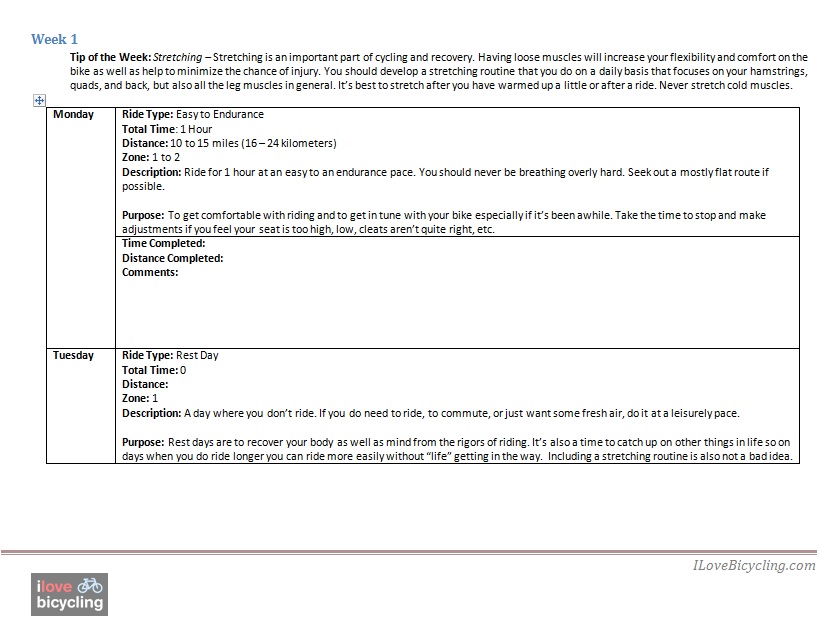
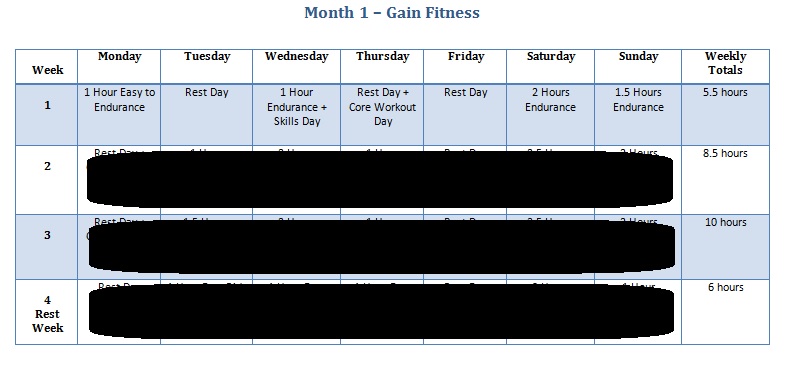
You can expect a monthly overview with a brief description of each days workout prior to the detailed description of each day. Additionally, each week is structured to hit a targeted number of weekly hours.
Week1.1
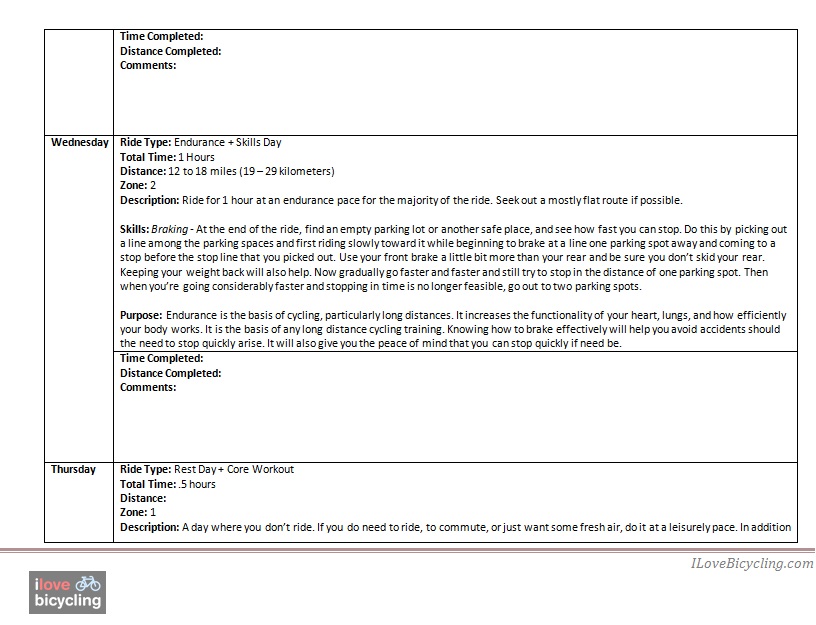
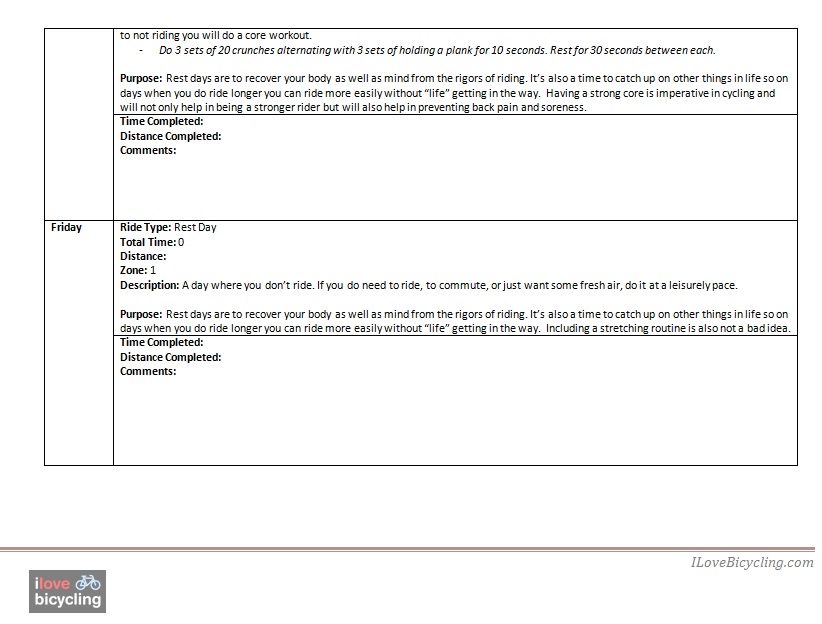
Each week starts off with a useful tip ranging from hydration, to recovery, to how to dress and eat properly. Each day is broken down into the type of ride you will be doing, the total time, the approximate distance you should hit, the training zone you should be in, the exact description of the workout, and the purpose of the workout and why it works. Additionally, each day includes a spot to keep track of your workouts.
Week1.2
Each week includes a skills day where you practice bike handling skills ranging from braking effectively to cornering to descending among many others.

Week1.3

Week1.4

heart rate chart - 30
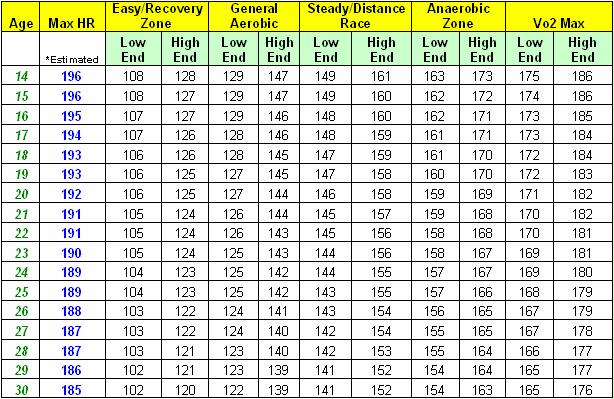
The workouts in the training plane are focused around “zones” which are approximated using your age and maximum heart rate. The charts in the plan make finding this convenient and easy.
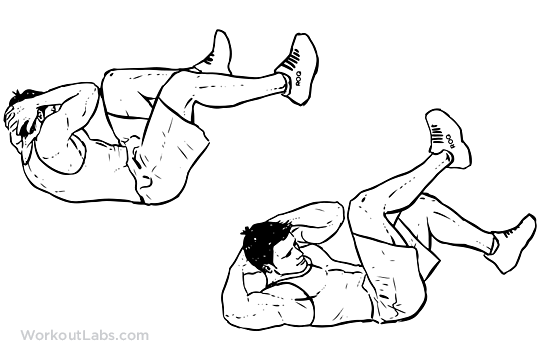
Bicycle_Crunches_Air-Bikes1
Each week also includes a core strength workout along with an intro of how to properly do each exercise. The plan isn’t just cycling; it’s everything to make you a better well-rounded cyclist.


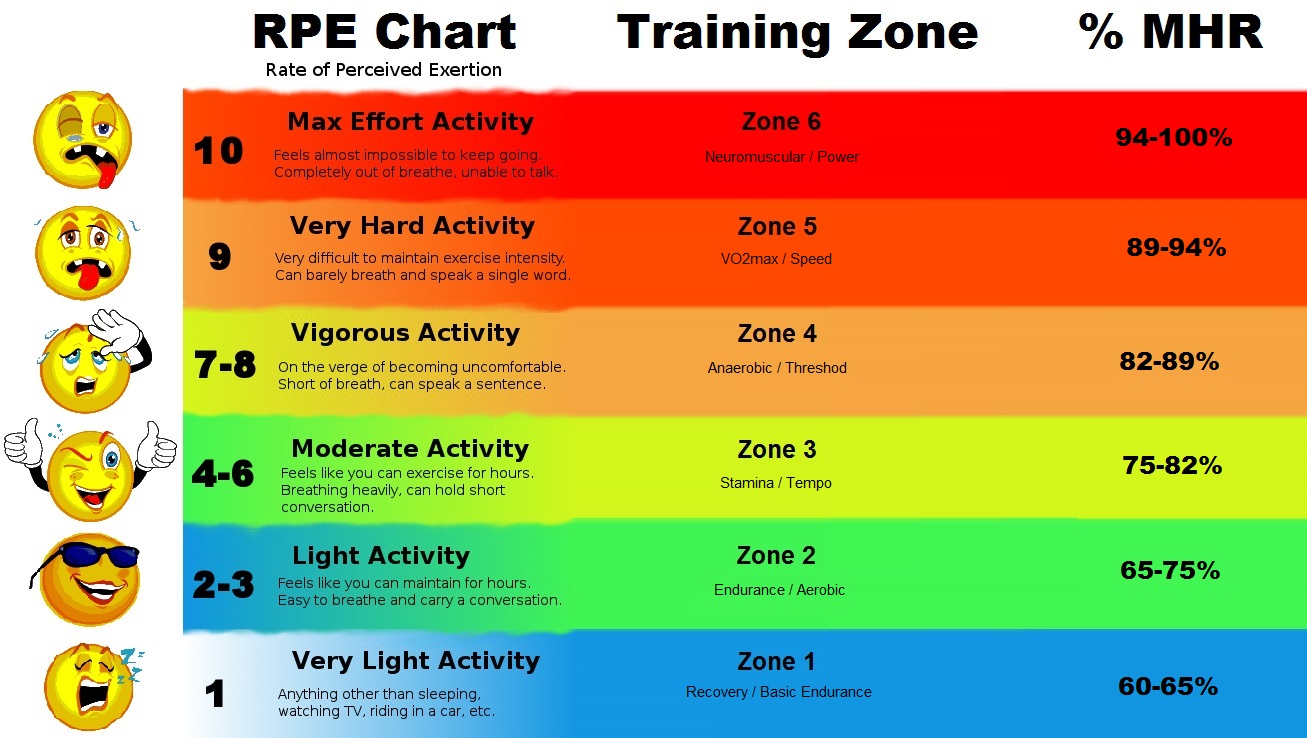
Zones
The training zones within the plan are based around perceived exertion and heart rate if you do have a heart rate monitor. If not, no problem. This chart is an easy reference for how hard you should be riding.


What Is a Gran Fondo?

March 11, 2016 by Wade Shaddy

what is a gran fondo

You’ve probably heard about the Gran Fondo by now — but what is a gran fondo? Any Italian can tell you what a Gran Fondo is but you probably won’t get a straight answer from most American cyclists but it’s no real surprise. The first real “Gran Fondo” in North America was held only a few years ago. Many of today’s  “Gran Fondos” have nothing but the name in common.

What is a Gran Fondo?

It’s like a marathon for cyclists. The riders at the front compete for the win, the riders in the middle go for a personal record, and the riders in the back aim to beat the cut-off time. So what is a Gran Fondo? A Gran Fondo is a personal challenge where each participant does his or her best.

Bike Racing Versus Fondo

Unless you’re a trained athlete, racing is not a good participation sport. Traditional bike racing differs from a Gran Fondo in one specific area. If you get dropped from the bunch you ride back all by yourself. You’re either in or you’re out.

It’s All About the Clock

A Gran Fondo is designed to solve the participation issue by making a bike race more like a marathon. Rather than racing against other cyclists, you use the Gran Fondo to challenge yourself against the clock. The distance is usually tough enough to make you proud of simply finishing.

Timing Chip

A real Gran Fondo has a competitive element — all riders are individually timed with a timing chip and the event provides the rankings based on time from start to finish. The rider is timed against the clock and then compared to the other competitors to determine placement. Technically speaking, if you don’t have a chip, you’re really not riding in an authentic Gran Fondo, no matter what it’s called.

Routes and Standings

Gran Fondo events typically range from between 30 to 100-mile routes (48-160 kilometers). The 100-mile routes are where the titles are earned and the rules are simple. Each 100-mile route has four chip-timed sections. The lowest cumulative time of all four sections decides the day’s winner across any of 10 categories. Individual event placings are equal to points for series standings. First place on day one takes one point, second place two points, etc. Cyclists must attend at least three events to qualify for a title and standings are determined by adding the three lowest scores together, with the lowest score winning.

No Maps

The full route of a Gran Fondo is required to be marked in such a way that it can be ridden by someone without a cue sheet and is not familiar with the area. Gran Fondo organizers provide distance signs that indicate length and gradient of key climbs. If you are given or in possession of a cue sheet or map to orientate, you are not riding in an authentic Gran Fondo.

Gran Fondo is a Closed Course

Difference in course control also means that a real Gran Fondo is much more expensive than an organized group ride. In Italy for example, course control is done by volunteer marshals. In North America, only police officers are allowed to direct traffic and closing roads is expensive.

Lights and Stop Signs

While thorough road closures are desirable, they are rarely possible. Moderated traffic is very important to providing cyclists the right of way. In North America, every traffic light and stop sign has to be manned by a police officer in order to overwrite traffic rules in favor of the rider. If you have to stop at lights and stop signs, you are likely not riding in an authentic Gran Fondo, no matter what they call it.

Three Key Elements

Authentic Gran Fondos are few and far between in the United States. If you want to get picky about it before you register, ask the organizer to provide the three key elements of timing, controlled traffic, and course signage.

More Like a Party

Technicalities aside, the American version of the Gran Fondo is more like a party than a competitive event. It is sometimes referred to as a cyclosportive. It does however incorporate some of the authentic Gran Fondo characteristics depending on the planning of the event.

Common Similarities

You should expect generic Gran Fondos to have a mass-start and fall somewhere between a race and a casual group ride. It should be complete with with race numbers, aid stations, and course marshaling. Only a few participants will realize a realistic chance at crossing the finish line first. Others will be content to just complete the distance. Racing licenses are typically not required and insurance should be provided through event organizers and covered in registration fees.

Charity Rides

Unless you have your heart set on an authentic Italian Gran Fondo, you’re more likely to get a North American version. Charity organizations have embraced the Gran Fondo concept as a way to raise money for cancer, diabetes, and a wide range of other causes.

Go For It

Now that you know the answer to “What is a Gran Fondo”, what’s the harm in taking a scenic, challenging ride in the country with hundreds or thousands of other cyclists ranging from pros to eighty-year-old cyclists? Mix in mechanical and medical support, feed zones with sandwiches, fruit and drinks, traffic control and enthusiastic supporters; you can’t miss with any Gran Fondo. The organizers of any kind of Gran Fondo are to be applauded for bringing organized cycling events to the masses. If you get a chance to sign up for one — do it.

training plan for grand fondo or century1
Buy it Now: I Love Bicycling’s “12 Week Training Plan for Your Gran Fondo or Century Ride”

What is Creatine Phosphate?

February 29, 2016 by Wade Shaddy

what is creatine phospate

Biochemistry and cell biology aren’t things most cyclists get excited about, but a working knowledge of exercise metabolism is very relevant in cycling. Exercise metabolism consists of the pathways and energy systems employed to convert food to energy during cycling. So what is creatine phosphate? It’s part of that system.

What is Creatine Phosphate?

What is creatine phosphate? Creatine is an amino acid (methyl guanidine-acetic), produced by the liver, kidney, and pancreas. Creatine is naturally found in your muscles, red meat, and fish. Creatine phosphate or phosphocreatine, is a phosphorylated creatine molecule that serves as a rapid release reserve of high-energy. It’s used in muscle cells to store energy for sprinting and explosive exercise. Creatine shuttles high-energy phosphate from mitochondria (our power producers) to sites of muscle contraction.

Muscle Power

An energy-rich muscle has lots of creatine phosphate, whereas a fatigued muscle has little creatine phosphate. When extra creatine phosphate is stored in your muscles, you have that extra backup energy that helps you over the top of the hill or to power you through that last sprint to the finish line.

The ATP Connection

Understanding the function of creatine requires a basic knowledge of biochemistry. In a nutshell, creatine is part of a process that utilizes ATP.

Powered by ATP

Without going into too much detail that will make your eyes glaze over, ATP or adenosine triphosphate  is quite simply the energy source molecule for all biological activity. When your muscles contract, it’s ATP that powers the activity. When cells grow and divide, that process is powered by ATP. However, ATP is not stored to a great extent in cells. So once muscle contraction starts, the making of more ATP must start quickly.

Three Phases of ATP

Since ATP is so important, the muscle cells have several different ways to make it. These systems work together in phases. The three biochemical systems for producing ATP are, in order:

  • using creatine phosphate
  • using glycogen
  • using aerobic respiration

Using Creatine Phosphate

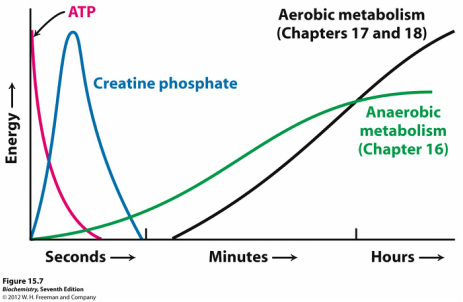
All muscle cells have some (not much) ATP within them that they can use immediately – but only enough to last for about 3 seconds. Because of this, all muscle cells contain and utilize creatine phosphate which is broken down to make more ATP quickly. Creatine phosphate can supply the energy needs of a working muscle at a very high rate, but only for about 5 to 6 seconds. Other studies have up to ten seconds.

Here’s Where it Fits on Your Ride

  1. The first moments of a sprint or steep hill, your muscle cells use the ATP they have within them.
  2. When that’s exhausted, your muscles switch over to the creatine phosphate stores to provide energy.
  3. If you still haven’t made it to the top of the hill or passed the next competitor, the glycogen system kicks in which then passes it on to aerobic respiration which is the release of energy from glucose in the presence of oxygen.

Rate and Volume

The daily turnover of creatine is about 2 grams for a 70 kg (155 lb) person. About half of the daily needs of creatine are provided by the body synthesizing creatine. The remaining daily need of creatine is obtained from your diet. Meat or fish are the best natural sources. For example, there is about 1 gram of creatine in half a pound of raw meat.

Creatine Loading

Dietary supplementation with synthetic creatine is the primary way athletes “load” the muscle with creatine. Daily doses of 20 grams of creatine for 5-7 days usually increases the total creatine content in muscle by 10-25 percent. Loading is typically done at this larger dose. Daily supplementation is much lower.

The Research

Research into creatine phosphate training has relied mostly on creatine with supplements rather than naturally occurring creatine. The results are based on extremely fast spin-ups such as a sprint, where at any moment a competitor can take off, sprinting away, requiring you to react quickly and jump along with them.

Are Supplements Good or Bad?

In their quest to run farther, jump higher, and outlast the competition, many athletes have turned to a variety of performance-enhancing drugs and supplements. Creatine is the most popular of these substance as it’s believed to enhance muscle mass and help athletes achieve bursts of strength. Creatine powder, tablets, energy bars, and drink mixes are available without a doctor’s prescription at drug stores, supermarkets, nutrition stores, and over the Internet.

The Claims

Supplement advertisers claim that supplemental creatine improves strength, increases muscle mass, and helps muscles recover more quickly. This muscular boost may help you to achieve bursts of speed and energy, especially during short bouts of high-intensity sprints. However, scientific research on creatine has been mixed. Some studies have found that while it does help improve short term sprinting, there is no evidence that creatine helps with endurance cycling.

Creatine and Glucose

Studies show that there is evidence that not all subjects respond to creatine supplementation. One study reported that subjects who experienced less of a change in resting muscle creatine did not appear to benefit from creatine supplementation. However, more recent studies indicate that taking creatine with large amounts of glucose increases muscle creatine content by 10 percent above when creatine is taken alone.

That Weight Thing

Creatine pulls water into your muscles which causes water-weight gain and makes muscles appear larger. Weight gain of about 0.8 to 2.9 percent of body weight in the first few days of creatine supplementation occurs in about two-thirds of users. Unless you have a specific concern—like hypertension that requires treatment with diuretics—it’s typically not considered a medical issue.

Cyclists and Creatine

Creatine is by far more popular in the gym than it is on the road. The bulk of it is used by weightlifters, assuming that the short bursts of power needed to lift weights can benefit from creatine. For cyclists, it’s up to you whether you need it or not. Some athletes treat it like a vitamin. A dose of 5 gram per day and you should be within the range of healthy supplementation. But as with any other change in diet, health or supplementation, always consult with a health care professional.

A Calorie Counter to Calculate Calories Burned When Cycling

February 16, 2016 by Adam Farabaugh

calculate calories burned

Use this calorie counter to calculate calories burned when cycling. Select how fast you’re riding, your weight in pounds, and your duration in minutes to calculate calories burned while cycling.

How Calories Burned While Cycling Are Calculated

To calculate calories burned cycling the first metric needed is the intensity of which you are riding. Simply, the harder you ride the more calories you are going to burn in a set amount of time. The second aspect to how many calories you burn when cycling depends upon your weight. First, the more weight you have to propel forward, the more energy that is going to be required. Secondly, an increased body mass requires more energy even when you’re at rest because there are simply more muscles cells, and cells in general, that require energy. The final aspect to calculate calories burned is the amount of time you are riding. The longer you ride, the more calories you will burn.

More is Better? Or High Intensity?

An interesting fact of physics and calories burned is that if you ride 1 mile in 3 minutes at maximal effort, you will burn the same amount of calories if you were to ride that same mile in 10 minutes at a leisurely pace. Higher intensity gives you a “better bang for your buck” in that you can burn more calories in a shorter amount of time. However, when riding and working out in general, you can’t go hard all the time. You need to balance longer, lower intensity workouts with shorter high intensity workouts.

Calculate Calories Burned Everyday You Ride

Use the calorie counter to calculate calories burned while cycling each day you ride. Keep track and see if you can continue to increase the number of calories you burn cycling each week. Using a journal to keep track of your calories burned along with what you did for a ride is a great option.

Cortisol and Cycling – The Stress Hormone

January 29, 2016 by Wade Shaddy

cortisol
Twenty years ago, the average person didn’t know what cortisol was or what it did. Cortisol, also known as hydrocortisone, is a steroid hormone — a steroid that acts as a hormone. Contemporary cyclists know that cortisol can make a difference in performance and health. Cortisol and cycling can both be influenced with low, normal, and high levels of stress and physical exertion with corresponding positive and negative effects.

Cortisol and Cycling – Muscle Demand

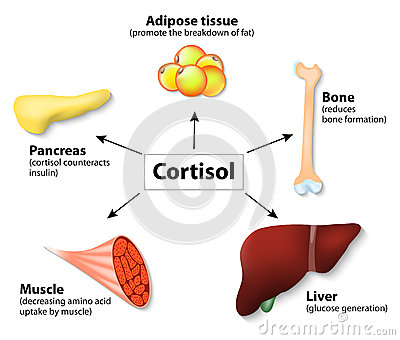
Cortisol is released from the adrenal gland. One of the main jobs of cortisol is to increase the glucose concentration in the blood to make more energy readily available to muscles. It increases at the onset of exercise and remains elevated throughout exercise when the muscles create a demand for energy. Cortisol helps to regulate energy by tapping into the body’s fat stores and delivering it to the working muscle and/or breaking down proteins into usable carbohydrates in the liver.

Positive Effects of Cortisol

  • Regulates blood pressure, blood sugar, and insulin levels.
  • Aids fat, carbohydrate, and protein metabolism.
  • When you get stressed, cortisol levels spike to give you the energy and strength you need to fight or flee. It’s a survival mechanism.
  • It suppresses the onset of acute inflammation if you get injured.

Natural Fluctuations

Cortisol levels fluctuate throughout the day and night. It peaks at about 8 AM and reaches it lowest point around 4 AM. While it is important that your body secretes extra cortisol in response to stress or high intensity exercise, it is also important that cortisol levels return to normal.

The Stress Hormone

Often referred to as “the stress hormone“, cortisol influences, regulates, or modulates many of the changes that occur in the body in response to stress and exercise. Acute, high intensity, resistance exercise is associated with increased cortisol levels. A blood test after a high-intensity ride should show high levels of cortisol in your blood.

Stress Happens

Stress also occurs from psychological, physiological, and/or physical reasons. When under stress, the body responds by increasing cortisol. Cortisol’s effects on the body are fundamentally beneficial, except when we are subjected to too much stress. Then it can become too much of a good thing.

Negative Effects of High Cortisol

An elevated cortisol level can indicate overtraining in cyclists. Too much cortisol is also associated with muscle loss and the acquisition of belly fat. High cortisol symptoms include:

  • Blood pressure rises as vessels constrict
  • Gastric acid production increases in the stomach
  • Insulin cannot do its job of regulating blood sugar
  • Blood sugar levels rise
  • You crave carbohydrates and more food
  • The immune system is suppressed
  • The release of the DHEA hormone (Dehydroepiandrosterone) is curtailed

Bad for Muscles

High levels of cortisol can break down muscles — the catabolic effect —   and is associated with a decrease in muscle growth. Thus reducing high levels of cortisol is ideal for any cyclist to achieve tissue growth and positive adaptations to exercise training.

Cortisol is Anti-Inflammatory

Cortisol is a potent anti-inflammatory agent. Inhibiting inflammation allows body tissues to continue receiving their full blood supply. Low cortisol levels can negatively affect a cyclist’s ability to recover from injury. Naturally low cortisol levels could indicate that the rider is suffering from a severe illness.

Pro Cycling and Low Cortisol

Cortisol and cycling and how levels are regulated is managed by The Movement for Credible Cycling (MPCC); a voluntary membership organization composed of a number of World Tour and Professional teams. According to the MPCC, when a cyclist returns a test showing low cortisol levels, that rider should not compete for a period of eight days on the grounds that doing so would endanger his or her health.

It Happens

Chris Horner is a professional cyclists, and previous winner of the Vuelta a Espana, a 22 day race during which cyclists must cover about 2,100 miles with only one or two days of rest in Spain. Horner had to withdraw from the race the year after he wone because of cortisol levels below the threshold stipulated as healthy. Lars Boom is another example, he returned low cortisol levels in an anti-doping test before the Tour De France.

Its Basic

Because some of the highest cortisol surges occur during and after exercise, endurance athletes and cyclists are exposed to more cortisol than even many of the most stressed-out non-athletes.

Good to Bad

Cortisol turns from good to bad when chronically produced in excess, such as when a cyclist over-trains. In the over-trained cyclist, high cortisol levels may have negative health effects, but even then high cortisol levels are just one of many imbalances seen in cyclists who work too hard and don’t rest enough.

Simple Advice to Control Cortisol

  • Take regular, planned breaks from intense training
  • Consume enough calories from non-processed foods to prevent depletion
  • Consume carbohydrates and protein after exercise sessions
  • Don’t isolate yourself – spend time with friends and family
  • Regularly participate in a stress-relieving activity like yoga or meditation
  • Avoid excessive amounts of aerobic endurance training (unless training for endurance event)

Sleep is Key

Sleep is the most important thing when it comes to reducing cortisol and restoring the adrenal glands. Work towards 7-8 hours of uninterrupted sleep between 10pm and 6am and keep a normal sleep schedule if possible.

Diet Right

Incorporate eggs, oily fish such as salmon and tuna, lean meat,  flaxseed, citrus fruits, berries, fortified cereals, dark leafy greens, and create a high fiber diet with plenty of lean protein. Eating five small meals a day can help to lower your cortisol levels, relieving your body of hunger stress, and help with food cravings often associated with high levels of cortisol.

Starch and Sugar

Decreasing your starch and carbohydrate consumption can help to level cortisol. Eliminate sugar. It’s difficult to do this at first as cortisol increases your desire for sweet food and carbohydrates. When the sweet tooth hits you, satiate it with fruits.

The Average Cyclist

Cyclists typically know their bodies well, and even small changes are noticed right away. As a cyclist, you don’t need to worry too much about cortisol ruining your life. Just train smart, eat right, get enough rest, and your hormones should take care of themselves.

Shut Up Legs

January 28, 2016 by Wade Shaddy

shut up legs

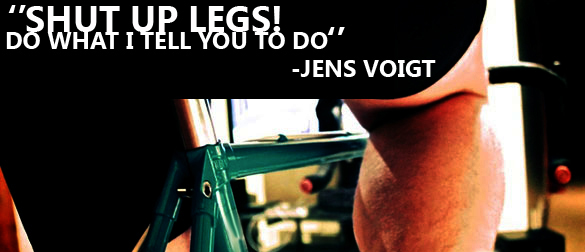
Jen’s Voigt  is one of cycling’s superstars. His inspiration to keep attacking for the win, no matter how much it hurts, inspired the phrase,”shut up legs.”  But is it always the best approach for mere mortals? The majority of average cyclists might be better served by listening to what their legs are trying to tell them.

Competitive Spirit

Cyclists are competitive at heart, driven to get the best out of themselves. If they have poor results, such as getting dropped on the local group ride, they feel bad about it and start planning on how to get faster. The usual conclusion is to train harder and longer to get more strength and endurance. It might not always be the best approach.

When You Should Listen to Legs

Listening to legs is important for several reasons: The signals they give you can be an indicator of overtraining, diet or chemicals in your legs, among other things.

Slow Legs

Slow, heavy legs and slow heartbeat could be a sign of overtraining. Understanding energy demands can help you understand why it’s often a question of listening to what your legs are telling you.

Dead Legs

Dead or slow legs basically means that if you ride too hard on every ride you will become exhausted. Over a period of weeks you become over trained. Enthusiasm will wane, riding will feel like a huge effort, and your legs will feel dead. “Shut up legs”, might not be the figure of speech your dead, slow legs want to hear.

Lacking Diet

It’s also good to evaluate your diet to make sure you’re eating enough calories and getting the proper nutrients. Low-calorie diets and nutrient deficiency can lead to dead legs as well. If your legs are fatigued and aren’t keeping up with your cardiovascular system, it may be a sign that something in your regimen is out of balance.

Hastened Training

Cyclists tend to hasten training, to get it all done quickly, but there is no shortcut to getting an aerobic base other than endurance hours. If you continue to train hard and fast, it can lead to dead legs—your breathing is fine, but your legs are unable to take you any faster due to fatigue. Also remember, the harder the effort, the shorter the ride. Don’t try to fit all the hard training in during a short amount of time, especially when your legs are tired and they’re telling you they need rest.

Waste Product

Listen to your legs if you feel a burning, somewhat intense pain. Lactic acid in the muscle is often the cause of leg pain. The  accumulation of lactate (it’s a separate chemical) as a waste product has brought down many cyclists in the form of cramps or overall pain. During a very intense and continuous ride, the production rate of the lactate exceeds the rate of its evacuation. At this point you will likely start to feel muscle fatigue, and pain.

Listen and React

Shift to a lower gear immediately to reduce the load on your muscles. Avoid a sudden stop; listen to what your legs are trying to tell you. Reduce your pedaling rate gradually and let the muscle get used to a lower load. Only then can you stop riding completely. If you stop immediately, your legs are going to feel super sore.

When All Else Fails

When all else fails, think about anything else other than your tired legs as telling them to shut up might be counterproductive. Set targets in the distance,  a treeline, the end of a stretch of blacktop, an intersection of highways, a town, so that you’re moving towards something and making the distance more manageable.

When It’s OK to Say “Shut Up Legs”

Other leg issues might include times when you’re legs might be talking too much. Bonking, interval training and the delayed onset of pain are good examples.

Legs Don’t Bonk

Don’t confuse leg issues with bonking. Generally when you bonk, you feel completely exhausted and have a hard time summoning energy to move. It usually doesn’t involve your leg muscles hurting though. Your legs can certainly end up sore, but a true bonk is not having the energy or desire to move your legs. In this instance, shut up legs is fine, it’s your energy and glucose levels talking to you.

Interval Sessions

Some professional cyclists recommend that approximately 75-to-85 percent of your training sessions should be centered around endurance work. If you’re riding 20 hours a week like elite athletes do, then that’s 16 hours at endurance pace. That still leaves 4 hours a week of interval training sessions. Shut up legs is fine for short intervals. Shutting them up, and allowing brief pain are muscle fibers breaking down. The end result is that they grow back bigger and stronger.

Delayed Pain

Cycling leg pain that appears several hours after the ride is typically also caused by microscopic tears in the tissues of the leg muscles. After the onset, it can  last for another 48 or 72 hours. This is normal, especially after a long and intense ride, particularly if you’re not used to it. The direct reason for pain is inflammation and temperature rise in muscles. Listen to your legs, if it’s unbearable after a ride, consider checking with a health care professional, and use whatever over-the-counter pain reliever and anti-inflammatory that you’re comfortable with to shut up your legs.

Get Comfortable with Your Legs

Give and take is the answer to leg issues tied directly to your training, diet, and cardiovascular system. Generally speaking, listen to all aspects of your body —  it’s easy for cyclists because they are typically in tune with their bodies, and treat it as an entity.

Training Tactics

One professional tactic is to implement easy days or rest days, just spinning the legs gently. Don’t even think about power output. Give your body a chance to heal and regroup. The gentle exercise will help the muscles in your legs to get the blood flowing and to take on nutrients and flush toxins.

Lungs are Not The Issue

Humans are one of the few mammals to have overbuilt lungs. Humans only require two thirds of their lung capacity to fully oxygenate blood. So taking in enough oxygen is rarely a problem.

Muscle Versus Speed

Don’t  leave out selective gearing to allow an even cadence no matter the terrain or weather conditions. Many cyclists like a cadence of about 90rpm’s to stay below their lactate threshold.

Life and Pace

Too many cyclists fall into the trap of deciding their pace before they ride off. If you’ve had a hard week at work and you haven’t had enough sleep, then you might not be able to complete a fast ride. Your cycling pace isn’t set in stone – if today needs to be a slow, steady ride, you can do your fast ride again when your legs don’t feel as sluggish.

Benefits of Listening to Your Legs

If you can cultivate the patience to listen to your legs and ride at an endurance pace correctly, then you should see the benefits in terms of more power, a better feeling , and better overall response to riding hard.

Winter Base Training – Slow and Steady

January 25, 2016 by Wade Shaddy

base training

What you do this winter can make a difference in your upcoming cycling season in April or May. Base training is different for everyone because of different areas. Some can ride outside all year, and some can’t. All winter base training has one thing in common: the miles. In fact, the phrase “base training”, should really be called “base miles”, because that’s the true focus of base training.

The Base

Think of base training as the “base” of your sport. In cycling that base is mileage — that’s it. Basic mileage done regularly at a slower pace than you probably expected. Building anything worthwhile takes time. Use the short days to build your base and you’ll be ready to pick up the pace come warmer weather.

Discipline to Train Slower

Base training might be one of the hardest concepts for a cyclist to understand and implement. It can seem counterproductive to ride slower in order to gain performance later. It’s difficult for cyclists, because they’re so competitive, to take a step back from the intense training of the warmer weather months. But if you have the discipline to train more slowly you’ll gain an aerobic advantage while everyone else is still hammering away. It will pay dividends in improved fitness down the road.

Aerobic in Nature

We often recognize professional cyclists with bulging, well-cut muscles — that’s not base training. Base training focuses on what you can’t see, improved lungs, heart, and circulatory system. In a nutshell, base training is mostly aerobic in nature. Summer training can then utilize the improved aerobic system to it’s fullest, building bigger, faster muscles. It’s like a building; the bigger and stronger the base, the bigger and heavier the structure above can be. If you have a weak base you can’t build very much.

Oxygen Transport

The more base work you do aerobically in the presence of oxygen, the more efficient you are. Base training promotes aerobic improvements that produce muscular adaptations to improve oxygen transport to the muscles. Additionally, it improves the rate of lactate removal and increases energy production and utilization. These types of adaptations occur slowly over time.

Conversation is Key

Cyclist generally agree on a simple principal to define base training: If you can carry on a conversation while riding, you’re riding at an acceptable base-training level. If you need to take a breather from talking when riding you’re riding too hard. Back off.

Heart Rate Monitor

Wearing a heart rate monitor is a more scientific approach to base training. Put one on and warm up for about twenty minutes at a moderate pace before consulting your monitor. The Sally Edwards Zone model is widely accepted among cyclists. It recommends cycling at between 60 to 70 percent of your maximum heart rate for optimum base training.

Pulse by Hand

If you’d rather not use a heart rate monitor, or don’t have access to one, you can do it by hand with a thumb or finger on an accessible vein somewhere on your body. Check your pulse rate by counting the beats in a set period of time — at least 15 to 20 seconds — and multiplying that number to get the number of beats per minute. That might be tricky to do when cycling, but you get the rough idea.

The Breakdown

The equation breaks down like this: Say your maximum heart rate is about 190bpm (beats per minute). 114 beats per minute equals 60 percent of your maximum heart rate. Riding at and around this pace is at the low end of your endurance zone and is perfect for base training.

Glycogen and Carbs

Riding at this intensity means you stay active without becoming fatigued. It teaches your body to burn fat instead of glycogen. Glycogen is how your body stores carbohydrates in your muscles,but glycogen is somewhat limited, even when fully topped off it will only last for between 30-90 minutes if you’re cycling at high intensity. Cycling for extended periods requires your body to use fat as an energy source. However, in order to burn fat, your body needs at least some carbohydrates so it’s important to keep eating on a base ride.

Basic Zones

Winter base training is zone one to zone two, recovery and endurance pace. When warmer weather arrives, you can up it to zone three which is the tempo zone when you work on holding a consistent high pace. Zone four is threshold training — finding your limits. Zone five is V02, and getting more demanding. It’s intensity that you can hold for three to eight minutes. Training in zone five is very fatiguing and typically burns your legs. Zone six, the anarobic, and zone seven, the neromuscular zone, you are reaching your limits, breaking down muscles to build them bigger.

Indoor Versus Outdoor

The majority of cyclists, if not all, love riding bikes outside, but that’s not always possible. Indoor trainers are inherently boring, but once you’ve committed yourself to the indoor trainer and doing some time on it, you’re already half way there and have beaten the stigma of boredom, hopefully.

Indoor Base Training Advantages

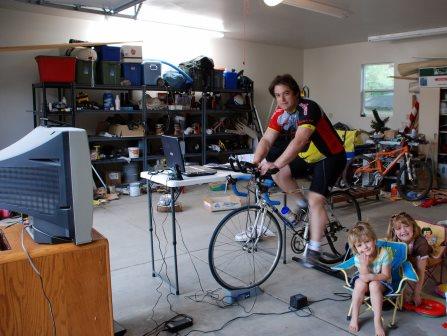
Base training on an indoor trainer can provide the benefits, and with the right frame of mind, can even be enjoyable, since there are no real distractions. No cars, no wind, no hills, no dogs; all of the things that can get in the way of a focused base training session. Another advantage: hours of steady riding can be punctuated occasionally with short bursts or intervals of harder efforts that can be difficult wtih ice, snow, or inclement weather. But don’t overdo it with intervals, remember, it’s all about the base.

The Cycling Detraining Effect

January 19, 2016 by Wade Shaddy

detraining

Detraining is a fancy word for losing fitness, a scientific term for doing nothing. Also known as deconditioning, it happens when you slack off. How fast it happens depends on how fit you are, what level you are cycling, your age, your diet, and what other activities you are doing.

Reasons For Detraining

It might be because you get sick. It might happen because your job gets in the way. It might be that you’re suffering from a lack of motivation, emotional issues or an accident. Then there’s the weather. Unless you like riding in wet conditions, it’s going to keep you off your bike. Icy or snowy roads can be downright dangerous. If that weren’t enough, winter is the time of year when upper respiratory tract infections such as coughs, sore throats, colds and flue tend to be everywhere.

Unplanned Rest Periods

Detraining is not planned rest periods from higher riding intensity and volume. Detraining is the unplanned 3 day, 5 day, 10 day periods or even longer when you can’t, or don’t train.

Your Body Changes

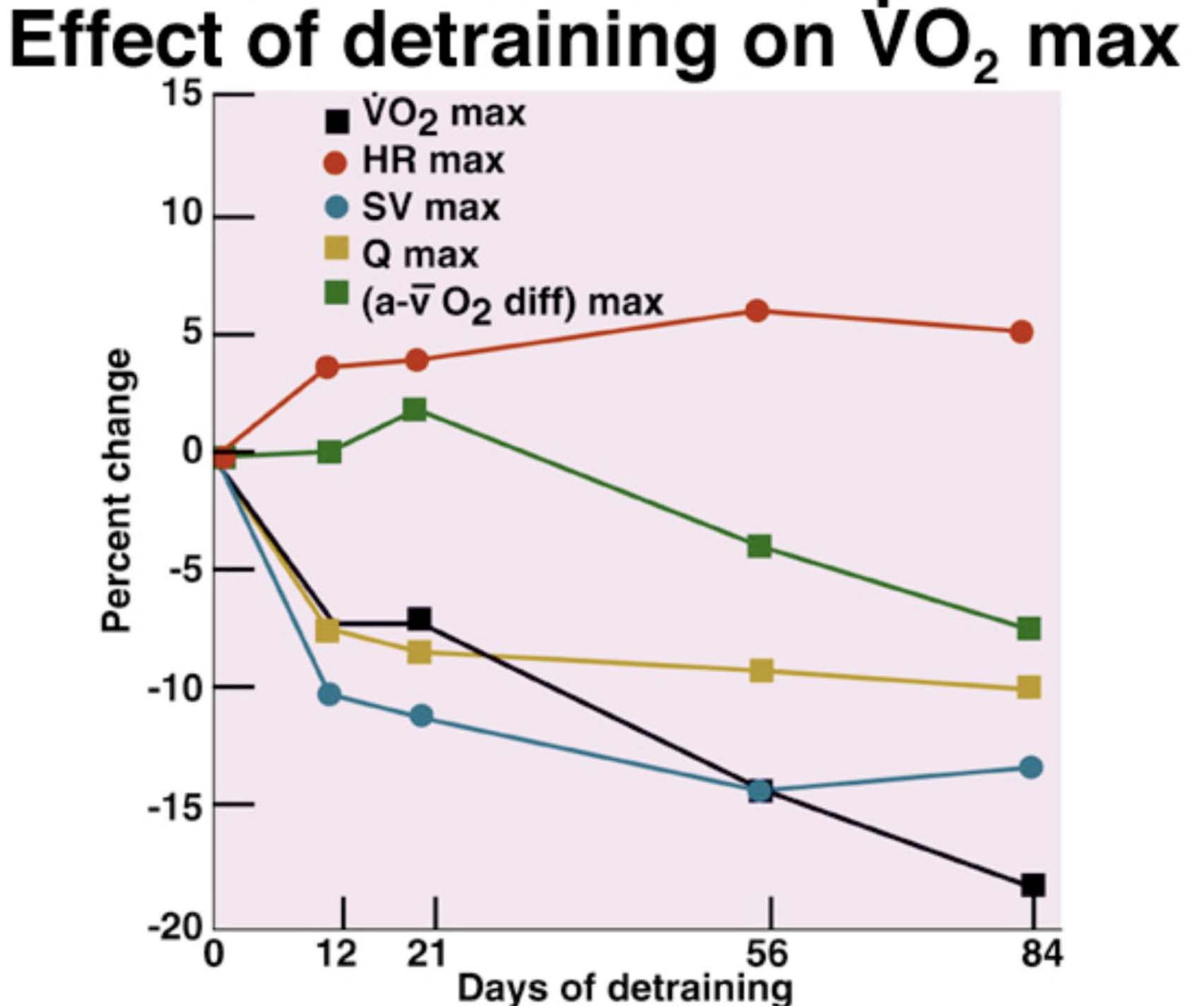
Physiological changes take place when you stop cycling. You begin to lose cardiovascular gains; your heart’s ability to pump blood as efficiently drops. Your muscles capacity to process oxygen drops off and your body’s enhanced ability to use carbs for fuel begins to fade. Also disappearing are hard-earned improvements in blood pressure, blood cholesterol, and your blood sugar levels also start to rise. When you stop cycling on a regular basis,  you also lose gains in muscle fiber and size.

Safe Period

You have a safe period of about four days with no large detraining consequences. After that the detraining effect hits surprisingly fast.

Three Days

Your fitness has already begun to decline after three days off the bike, however, the losses at this stage are very small. If you had been training hard prior to the last three days, this small break may even enhance your cycling fitness because of beneficial rest. During the recovery phase your muscles have time to recover fully, muscle carbohydrate stores become topped off, and damaged muscle fibers have time to repair themselves.

One Week

Changes really begin to occur after one week out of the saddle and result in fitness losses. Aerobic capabilities drop off by about 5 percent. Your blood volume can be reduced by five to twelve percent.  This means a decrease in the amount of blood your heart can pump in terms of the amount of blood pumped per beat and total blood volume per minute. Your muscles also begin to lose elasticity.

Ten Days

Performance in endurance and fatigue are affected, specifically cardiovascular and muscular endurance. Your body’s ability to use oxygen, VO2 max, drops by four-to-ten percent in well-trained cyclists. Less oxygenated blood is pumped with each beat.

Two to Three Weeks

Maximal oxygen uptake, VO2 max, the prime measure of your aerobic fitness, will have declined from somewhere between four to twenty percent. Part of it stems from reduced cardiac output in that the muscle mass in the pumping chambers of the heart can decrease by almost 20 percent after three weeks of inactivity.

One Month

Substantial alterations are taking place in your muscle biochemistry after one month. All of the detraining changes outlined above now continue to get worse and changes in muscle are now becoming prominent. By now, your muscle capillarisation will have returned to your pre-training baseline.

Two to Three Months

Your heart is noticeably less muscular after two months of inactivity. The thickness of the muscle walls that comprise the pumping chambers is reduced by as much as twenty-five percent. The muscle mitochondria, the power producers, are also becoming less efficient at using oxygen to produce energy in your muscles. This efficiency can decline by twenty-five to forty-five percent up to twelve weeks after you quit riding your bike.

The Missing Data

There’s surprisingly little published data or research on the actual fitness losses during an extended period of detraining. The lack of data is to be expected as it’s very difficult to recruit a group of cyclists who take training seriously, and then ask them to stop training for a month or more while their hard-earned fitness ebbs away.

Get Back On

So, how long will it take you to regain your level of fitness when you start cycling again? It’s hard to predict for each individual but after a three-month hiatus, a week or two of training will not return you to your peak condition. The sad part is, if your layoff was long, it may take you nearly as long to retrain as it did to become fit initially. It will be a bit abbreviated as your body already has been accustomed to that level of fitness so getting back to there is slightly easier.

Regulate, Regulate

If you’re forced to abandon your normal cycling routine for more than two weeks, attempt an abridged cycling schedule, even if it’s one ride per week, rather than stopping altogether. If you don’t have time for a good ride, you can break it up into several shorter rides. One option is to do two or three short sessions a week of high-intensity interval training. One-minute sprints of cycling, alternating with one-minute rests for a total of 10 minutes. Research shows that this can be a good way to maintain aerobic fitness, without significant detraining effects.

Anything is Better Than Nothing

If you have stopped exercising because of an injury, such as a broken bone or ruptured tendon, you can slow the detraining effect by working unaffected muscle groups, such as exercising the opposite arm or leg. Anything is better than nothing. Be safe out there and stay on your bike if at all possible.

Getting to Grips with Indoor Cycling Training

January 11, 2016 by Lee Agur

indoor cycling training

When you are training for a big event, finding the time to fit in some quality riding can be frustrating, especially in the winter. Late sunrises, early sunsets, and terrible weather conditions all work to take away cycling opportunities (as well as motivation!), making the desire to train impossibly low. But there is a solution to the winter cycling blues – indoor cycling training! It may seem like a crazy concept, but many coaches actually implement indoor cycling routines into off-season cycling workouts (as well as during the season) as indoor cycling equipment can open up a new world of training when you just can’t get outside. Indoor cycling training equipment works to focus specific exercises, techniques and disciplines and they can help to accurately control workload too, so the benefits are virtually endless. Getting to grips with indoor cycling training doesn’t have to be complicated, so let’s take a look!

Rollers

Rollers are an age-old solution to cycling indoors, allowing your bike to ride continuously without actually moving forward.  Rollers consist of three round cylinders that are mounted on bearings, and these are fixed onto a frame. A belt then connects one of the rear cylinders to the front cylinder, to allow the front wheel of the bike to spin at the same speed as the back wheel. You simply place your bike onto the rollers and ride.

Rollers are a great indoor cycling tool if you are looking to sharpen your bike-handling abilities because your bike is not actually affixed to the machine! This means that you must rely not just on perfect balance, but on skillful steering too. Some cyclists opt to add a fan or magnetic unit to rollers to create resistance, as there isn’t a lot of resistance generated by the rollers alone.

Types of Trainers

Wind (or turbo) style trainers typically have two fans with slotted blades. These slots work to churn the air, effectively mimicking the natural resistance that you experience when riding a traditional bike. Many cyclists feel that keeping indoor cycling training as close to the real thing is better for synchronicity and motivation, but almost as many cyclists are turning to magnetic trainers for the ability to adjust resistance.

Magnetic (or mag) trainers use powerful magnets and a non-conductive disk to produce resistance when you cycle indoors. Performance magnetic trainers typically have six resistance settings, from low to high, and are controlled by a handle bar-mounted lever that you can adjust. Many magnetic training units have incorporated small, precisely weighted flywheels in order to create a slight coasting sensation for cyclists who prefer a more realistic road feel.

The great thing about magnetic trainers is that the resistance generated when you ride increases in direct proportion to the speed in which you ride. This may be less realistic than riding a real bike, but strong resistance will both elevate your heart rate and exert your body, which will help to raise your overall endurance and fitness levels. When fitted with a flywheel, they can also help you to determine, and work through, the dead spots in your pedal stroke.

Fluid trainers are another option to increase the resistance on the rear wheel while cycling indoors. Fluid trainers use, exactly that, fluid, inside a drum that has fan blades that turn through it. The advantage with fluid is that it can offer a higher resistance and a smoother feel especially under high loads.

Using the Right Bike

As enormous pressures will be generated by each of these types of trainers, it is best to use an older bike to train indoors if possible. The bike you use is likely to rust, the headset will get grooved and many more problems can occur, so be sure to set up your bike in the same way as the one you ride for the best results.

Indoor Cycling Training Workouts

As with any form of exercise, always spend a few minutes warming up and cooling down when you use your indoor trainer. Before you get to grips with indoor training:

·       Use a fan (or ride in the coolest part of your house) to avoid overheating

·       Always fill your water bottle before you start your workout

·       Don’t spend more than two hours at a time on your trainer

For general conditioning:

After you have warmed up, raise your riding cadence to 85 to 100 rpm. Work to maintain your heart rate at no more than 85 percent of your maximum.

For climbing strength:

Put your bike into a low gear or increase the resistance on your trainer (for mags only), to a level that will force you to drop your riding cadence to around 60 to 70rpm. Maintain this cadence for a few minutes before going back to your normal cycling rate. Repeat this throughout your training session.

For speed work:

To boost your anaerobic capacity, work on your trainer in intervals. You can work to structure interval programs, similar to those that you may use during an outdoor cycle exercise routine, to really increase your capacity for speed.

One of the most common excuses for not riding indoors is boredom. Yes, indoor cycling training can be boring but there are a few ways to better pass the time. One is simply to ride with other people so you have someone to talk to while you both get a good workout in. Whether riding with someone or on your own, incorporating intervals will break up the time and make it go faster. Entertainment wise, choose upbeat music to keep you motivated or an engaging podcast that keeps you entertained. Bike racing films or old races can also be fun to watch and added motivation. Keep it consistent and you’ll arrive outside in better shape than you thought was possible with a long, cold winter.

The Metric Century – It’s All About The Base

January 7, 2016 by Wade Shaddy

Metric Century

Century riding is a rite of passage for cyclists. The completion of a century ensures your place among cyclists. But if you’re not ready for a full-blown century of 100 miles, there’s an option. The the 100 kilometer metric century, or 62 miles, is well respected among cyclists. It’s an achievement to be proud of.

Metric Century Mileage

You’ve seen versions of centuries advertised for charity, pledge or group rides. There are typically options for quarter centuries ( 50 miles) half centuries (50-miles), metric century (62 miles), and the standard century (100 miles). Technically speaking, a true metric century is just over 62-miles when converted from kilometers to miles, but the majority of cyclists refer to metric centuries between 60 and 65-miles.

Metric Centruy History

The metric century is of European descent, where they’ve been actively participating in cycling long before it became trendy in the United States. As long-distance riding became popular in the United States, the metric was boosted to 100 miles, and became known as the Imperial century. Cyclists outside the United States still refer to it as an Imperial century.

Perfect Distance

Sixty miles — 100-kilometers — is just about the perfect distance for your first long-distance cycling challenge. You can claim to have accomplished a metric century with almost as much gusto as a 100-mile century. It gives you the confidence to add the extra 40 miles at a later date, leading up to a full-blown “Imperial” century.

Stay Active

With the colder months there’s no excuse for not preparing for a metric century and depending on where you live, you could easily be ready for a metric centruy in April, weather permitting. Get started now by building your base, watching what you eat, and staying active in cycling.

Endurance is the Objective

Going fast isn’t the objective for your first metric century; endurance is the key. Building endurance allows you to get more out of riding in general. Cyclists who go straight into speed and interval training get fast on the bike but may fail when it comes to distance riding without an adequate base.

Time Table

If you participate regularly in other aerobic activities, it’s possible to ready yourself for a metric century in less than few months. Start with the metric, and by that time, you’ll know if you’re heading in the right direction if you wish to tackle the full century.

It’s All About The Base

Base training is the foundation upon which you build for a metric century. It should be the single most important part of your training. Many cyclist never reach their full potential because they neglect this critical phase. Building your base is about preparing your body for the effort you will be placing on it when tackling your first metric. A foundation of steady miles allow you to make harder efforts later in the year.

Fitting enough riding in can be a challenge but shorter rides at a steady pace not only help to build your base, but allow you to burn more fat. Short, consistent riding helps to build capillaries that deliver oxygen-rich blood to your muscles. The result is a base that allows you to ride longer. After a few months of riding consistently, you’ll be able to maintain an average speed and heart rate that was unthinkable earlier in the year.

Daily Motivation

Daily riding is a good place to start, but it’s not always possible to squeeze out a ride after work. Start by reminding yourself that you plan on riding as soon as you get home. Fight the urge to sit down after work, you’ll never get back up. Take off work clothes as soon as you get home. Put on your cycling gear and knock off at least 5 to ten miles, 5 or 6 days a week, with at least one 20 miler or more on the weekend, if not two 20-milers. As you get closer to the metric launch date, bring it up to 30 or 40 miles at least once a weekend. Plan on skipping at least one day a week, but no more than two. Monday is a good day to skip to recover from the longer rides of the weekend.

The Stationary Option

Stationary bikes are an option for base training in cold, snowy, or wet weather, but stationary bikes can be boring. It’s always better to ride outside when possible. Outdoor riding gives you skills and builds a fitness base you just can’t get on a stationary bike.

Break it Up

During your continuous, everyday rides, break-up easy pedaling with short intervals of harder effort to get your heart rate up. Do it as many times as you are comfortable with, but don’t overdo it. It’s the accumulative hours of steady riding that enhance and build your base, not interval training.

Heart Rate

Building an endurance base of steady mileage on the road accomplishes physiological changes in your body. There’s no need to push your heart to its limits. If your heart rate is 65-80% of your maximum, the hardest your heart can beat, for at least 20 minutes, you’re doing fine. The lower intensity pace that you ride at doing base training allows you to train longer.

Duration Timetable

There’s no magic number for how long a base-building period should last for a metric century. Continue on for four to six weeks, or until you feel you’ve hit a plateau. A good ballpark figure is between 6 and 12 weeks. Start increasing your rides by about ten percent each week until you can do two 30-mile rides on two consecutive days before deciding on a launch date for your first metric.


« Previous Page
Next Page »
  • Facebook
  • Tumblr
  • Twitter

Latest Articles

JOIN Cycling: A New Training Platform for Cyclists

May 27, 2024 By Eric Lister

cold exposure

The Benefits of Cold Exposure for Cycling & Life

June 13, 2023 By Eric Lister

hill climb

The Ultimate Hill Climb Training Guide

May 31, 2023 By Eric Lister

shoulder pain cycling

How to Treat & Avoid Shoulder Pain While Cycling

April 12, 2023 By Eric Lister

psoas stretch

The Importance of the Psoas Stretch for Cyclists

April 6, 2023 By Eric Lister

cycling neck pain

The Ultimate Guide to Cycling Neck Pain: Causes and Solutions

March 21, 2023 By Eric Lister

Useful Info

  • Contact
  • Finally, A Global Cycling Club That Is Focused On Community And Love Of Cycling!
  • Privacy Policy
  • Share Your Story!
  • Terms And Conditions Of Use
  • Welcome to I Love Bicycling
  • What Happened When I Stretched Every Day For a Month

Recent Posts

  • JOIN Cycling: A New Training Platform for Cyclists
  • How to Hang Bikes in Your Garage: 4 Inexpensive Options
  • Gravel Bike Vs. Road Bike: Which One Is Better For You?
  • The 6 Types of Mountain Bikes & How to Choose the Best One for You
  • What Is a Touring Bike Good For? 5 Benefits We Know You’ll Love

Search I Love Bicycling

Connect with Us

  • Facebook
  • RSS
  • Tumblr
  • Twitter

Copyright © 2026 · Magazine Pro Theme on Genesis Framework · WordPress · Log in