• Training
    • Injury Prevention
    • Training Tips
  • How To
    • Bike Fit
    • Gear
  • Nutrition
    • Nutrition Tips
    • Weight Loss
  • Repair
  • Reviews
  • Stories
    • Funny Stories
    • Jokes
    • Quotes
    • Videos
    • Funny Videos

I Love Bicycling

I Love Bicycling is a website that is geared towards cycling for beginners with road cycling tips, training articles, nutrition tips, weight loss, how to’s and bike repair articles.

Stories

  • Funny Stories
  • Jokes
  • Reviews
  • News

Bike Commuting – How to Make Money With It

January 2, 2016 by Wade Shaddy

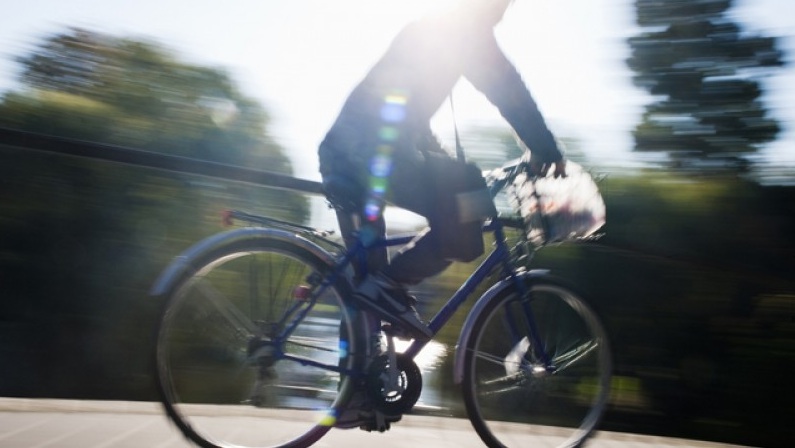
bike commuting

What if you put a jar on your table. Each time you ride your bike to work instead of driving your car, you add money to the jar. Suppose you abandoned your car altogether. Bike commuting can save you a lot of money.

Not Enough People Bike Commuting

According to the Alliance for Walking & Biking’s 2014 Benchmarking Report, 91.6 percent of Americans commute by car to work. That compares to 5 percent who use public transit, 2.8 percent who walk, and just 0.6 percent bike to work. What’s wrong with this picture?

Bureau of Labor Statistics

The average American household spends over $9,000 a year to own a car, making it the second-largest expense after housing, with commuting by car typically requiring the most miles traveled. Cost studies are based on the accumulative cost of five categories – maintenance, fuel, tires, insurance and depreciation. The Bureau of Labor Statistics reports that Americans spend more on transportation than on food.

The Huffington Post Stats

Huff Post Business says that Americans spend over $2,000 a year for gas alone. Insurance adds up to an annual average of over $1,000 dollars. Your car’s depreciation lifts $3,571 a year from your wallet.

The IRS Stats

The IRS calculates that driving a car costs 55 and a half cents per mile. If your commute to work is ten miles from home, your commuting cost per day is just over $11. or $1110.00 over the course of 100 days.

Cars Versus Bikes

Every mile you drive in your car costs you money. It’s wearing out your tires, brakes, engine and drivetrain. It’s using up motor oil,   breaking down belts and other parts that will eventually need replaced. Bikes need maintenance as well, but are much simpler, cheaper machines. The less you drive, the more you save.

Insurance Rates

If you chose to keep your car and become an occasional commuter, reducing the number of miles you drive can have a direct impact on your auto insurance rates. Insurance rates are partly calculated based on the number of miles you drive. Insurance companies typically give you a discount for less miles traveled.

Personal Testament

“Transportation costs can often be a blind spot for families looking to save,” says Bruce McClary, vice president of public relations and external affairs for the National Foundation for Credit Counseling. In general, look to where you spend a lot to save a lot.

Ditch One Car

“Many individuals and families simply take for granted the two-car, driving-to-work arrangement that’s the norm for American households and often don’t consider alternatives like public transportation, carpooling, or bike commuting,” McClary says. Mclary ditched only one of his two cars, and simply by biking to work it has netted him a monthly savings of $128.91. After commuting to work for four years and eight months. Mclary reported that he saved $7,219.

Sierra Club Checks In

The Sierra Club, in cooperation with AAA, reports that the cost of owning a bicycle per year is $308. American cyclists save a whopping 4.6 billion a year by not driving. This is an average figure of course depending on what type of bike you ride, how far to work, and how much you spend on bike maintenance. Do your own calculation with Kiplinger’s personal calculator.

League of American Cyclists

Elizabeth Murphy is the communications director for the League of American Cyclists. “Biking certainly offers a cheaper way to get to and from.” She says. “Driving five days a week is really eating into my budget. So why don’t more people bike to work? Because of the way many roads are set up to cater to cars, riding to work can seem intimidating if you’ve never done it before,” she adds.

Find a Route

Murphy says the first step is figuring out what route you will take to work. From there, you can pick out a bike that will work well on the terrain where you’ll be riding. Murphy recommends finding a biking mentor who can help you find cycling-friendly roads and help you build the confidence you’ll need.”Finding a friend can be really helpful in doing that first ride,” Murphy says. “Once people sort of realize, ‘Hey, I did this. I can do it,’ it’s a pretty simple transition.”

The Time Element

You’ve heard the old argument “time is money,” and you might think that it takes more time to get where you’re going on a bike but it depends. How much time depends on where you’re at, and where you’re going. For example, in some locations, bigger cities for example, you can actually get to many destinations as quickly or even faster on a bicycle than you can in a car because of shortcuts though parks, utilizing bike lanes and paths, and taking more direct routes through areas you otherwise wouldn’t drive through. Take it a step further and think about all the time spent sitting in your car in traffic jams, while that bike messenger or commuter whizzes past while you’re sitting idle in traffic.

Health Concerns

Cycling is far better for your health than driving a car. The exercise you get while riding a bike has long-term health benefits with short-term energy benefits. If you’re healthier, you stay out of the doctors office and everyone knows how expensive that is. Healthier people also sometimes get lower insurance rates, which should also be a part of the equation.

The Variable

It’s one thing to calculate stats, and some people argue that because of  low population density in some areas and scattered employment, commuting by bike isn’t always a viable option for millions of American workers. Weather is another factor, but there is all kinds of gear available for cool or inclement weather.

Give Bike Commuting a Chance

It’s sufficient to say that millions of workers live in large cities, suburbs or communities close to work. If you’re one of those people, biking to work is a viable alternative to driving. If you own a car only for commuting, becoming a bike commuter might be an option that can save you money and encourage you to ditch your car completely. By bike commuting you will have better health, more money in your pocket, more energy, and the pride that comes from getting to work under your own power.

Happy New Years From I Love Bicycling!

December 31, 2015 by Adam Farabaugh

Happy New Year

Happy New Years from I Love Bicycling!

We hope the New Year brings great people, great adventure, and fantastic experiences with a healthy dose of cycling to help fulfill all of them and your New Years Resolutions.

From all of us, Happy New Year!!


Women Cycling – The Pink Movement

December 25, 2015 by Wade Shaddy

Women Cycling

Pink has become a staple in women’s awareness. Pink helmets, pink hair, and pink stickers on cars. But the pink campaign hasn’t always extended itself to cycling to such a degree. A recent study found that only 24 percent of all cycling trips made in the U.S. were by women. Other countries, Germany for example, has a statistic of 49 percent women cyclists. Getting more women cycling is an important issue not only in the sport as a whole but also in that so many women are missing out on what could be a valuable addition to their life.

Women Cycling – Why More Women Should Ride

Cycling is one of the most rewarding things women should do more of. Age and activity level has nothing to do with it, even the smallest effort pays off. Here are some reasons for women to get out there, and give the body and mind some real benefits.

Looking Good

Nothing promotes your attitude like looking your best. Glowing skin is just the beginning. A Stanford University study found that regular cycling can reduce symptoms of aging by promoting oxygen flow from increased aerobic exercise. The oxygen-rich blood delivers nutrients to skin cells, and flushes out harmful toxins. Cycling has also been reported to optimize collagen production, which reduces fine wrinkles.

Improves Immunity

You’re more likely to contract bugs if you spend all day working in a closed building. Going outside on your bike and breathing fresh air helps to keep you out of the doctor’s office. Research done by the University of North Carolina states that women who cycle for 30 minutes, five days a week called in sick half the number of sick days than their sedentary co-workers. The study concluded that the exercise done while cycling aided the immune system by keeping cells more active, making them ready for a fight with nasty viruses.

Cardio Benefit

Cycling allows you to add fitness into your day when you don’t have time for a workout. Workouts, as beneficial as they are to muscles, don’t always aid the cardiovascular  and respiratory systems to the extent of cycling. Cycling can add a very effective cardiovascular benefit. A study from the British Heart Foundation reported that cycling only 20 miles a week may reduce your risk of heart disease by half. You can cycle 20 miles a week by simply riding to and from some of your regular errand runs, or by commuting to work once or twice a week.

Cholesterol and Weight

Another way that cycling can help you is by lowering cholesterol, primarily because it helps you to lose weight. Carrying too much weight tends to increase the amount LDL in your blood; that’s the cholesterol that’s been linked to heart disease. HDL cholesterol, the kind that your body benefits from, can be increased by regular cycling. Just two months of regular cycling is enough to raise your HDL numbers by 5 percent, according to the Mayo Clinic.

Brain Matters

A study done by the University of Illinois reported that improving your cardio-respiratory fitness by  5 percent led to a 15 percent improvement in test scores. The study indicates that the boost in blood flow to the brain is the key. Blood flow is also a key player in  reducing cognitive decline, forgetting things, and lowering the risk of dementia and Alzheimer’s. Getting on your bike can also do wonders for solving mental blocks. The increased flow of oxygen stimulating the neurons is responsible for problem solving and creativity.

Low Impact

Even though you’re not lifting weights like you might do in a gym, your muscles get a boost from cycling too. Cycling strengthens your thighs, hips and rear end. If your ride includes hills, your arms and upper body benefit as you stand up on the bike. Low-impact cycling is gentle on your joints and helps preserve cartilage. That’s particularly beneficial for why more women should ride who suffer from strained muscles, foot and ankle issues, knee troubles, back pain or impact-related injuries caused by running, jogging, walking or lifting weights.

Digestion Issues

Regular cardiovascular exercise such as cycling helps to strengthen abdominal muscles. Getting your heart rate up on a regular basis fires up your gut by stimulating the right muscles needed to push digestive waste through your body. Experts at Bristol University found that regular cycling helps to decrease the amount of time it takes food to move through your large intestine.

Expecting Cyclists

Old-school doctors would likely advise against women cycling when expecting a baby. But all that’s changed. Doing regular miles not only keeps you from gaining excess weight while pregnant, but studies show it leads to easier, less complicated labor and a faster recovery after the baby is born. Regular cycling can also lead to better brain development in your baby and is reported to cut the chances of your baby becoming obese.

More Sleep

Almost everyone agrees that nothing makes you feel better than a good night’s sleep. Studies have shown that getting out on your bike several times a week can have a long-term effect on your overall health. A Stanford University study asked a group of couch-potato insomniacs to cycle for 20 to 30 minutes every other day. The findings were undeniable. The participants found that the cycling routine was solely responsible for cutting the time it took for them to fall asleep in half. And those same participants reported staying asleep for an hour longer.

Make New Friends

Cycling brings people together. Look for a local cycling club in your neighborhood and meet up. Many bike shops offer no-drop rides,   and heading out on the road with a group of like-minded individuals is a great way to make lasting friendships. Some places also have “women only” rides which can be a great option with the sometimes brashness of male riders when riding with women.

Female Empowerment

Of all of the reasons for why more women should ride a bike, one of the best reasons is self-confidence. The attitude and strength you gain from cycling translates into every other area of your life. And, if you’re competitive, the feeling you get while passing a man on your bike is worth every penny you spent on that new bike.

There are endless reasons to get more women cycling but hopefully these few benefits spur you toward riding and if you already do ride, get some more of your girl friends to give the sport a try.

Cycling Myths – Debunking Them

December 24, 2015 by Wade Shaddy

Cycling myths

Cycling myths have been handed down through word of mouth, just like nasty gossip, growing more nasty with each personal version. But is there scientific evidence to support it? Probably not. Most common myths associated with cycling have been debunked.

Cycling Myths Versus Science

The real problem with cycling myths versus science though, if you go looking for it, is that you can find a study contradicting almost any standpoint. With that being said, here are a few common cycling myths debunked with the majority of studies leaning in that direction.

Cycling Myths – Cycling is Dangerous

You are more likely to get hurt in a car than on a bike.  You can manipulate the data in many ways but when you ride a bike predictably with awareness of your surroundings, then you are safe on a bike. The myth regarding bike safety is based in statistics that don’t add up when placed in perspective. Cyclists are about 11 times more likely to be killed than car drivers — per mile. A driver who travels 11 times as far as a cyclist in a year is just as likely to have a fatal incident. The risks involved in walking, cycling, and driving are comparable when in relation of time spent doing that activity. It’s not the bicycle that is dangerous. It’s the car that hits the bike that is dangerous.

The Science

In terms of the number of actual deaths, traveling by motorcycle and walking are both statistically more dangerous than cycling. Another statistics puts it into perspective: Coronary heart disease kills 75,000 people per year in the UK. The British Heart Foundation studies show that one-in-ten of these deaths, about 7,500, is attributable to physical inactivity. That makes it 75 times as dangerous to be a couch potato as a cyclist.

Cycling Myths – Cycling Makes You Sterile

This tired old myth has been used to emasculate cyclists for years. It’s time for it to go away. Yes, you are sitting on delicate parts but even with a poorly fitting saddle this myth simply isn’t true. Getting a properly fitted saddle will however help with comfort on the bike.

The Science

The Mayo Clinic, and the University College London have concluded that there was no link between infertility or erectile dysfunction, and that many miles of cycling a week, even for more than 8 hours at a time, typically has no relation to fertility issues. In addition, study author Mark Hamer, PhD, reports that contemporary saddle technology is helping to relieve pressure on nerves to prevent that uncomfortable numbness that you might feel on a long ride; which is the likely source of the debate.

Cycling Myths – Avoid Sex Before a Ride

More bad mythology. There’s no scientific evidence to suggest that sex before a hard ride or race diminishes endurance or speed.  The abstinence myth propagation is thought to be in relation to the fact that too much exertion prior to competing withdraws testosterone from the body. Studies have shown that it’s completely the opposite. Sex actually stimulates testosterone production. Persuading your other half of this fact the night before you ride is another matter entirely

The Science

Sex within ten or twelve hours of a race or long-distance ride can actually help you to ride better because it can promote falling asleep faster. Aside from the enjoyment of engaging in sex, it’s proven to have have many other benefits such as boosting immunity, lowering blood pressure, promoting heart health, and lowering stress.

Cycling Myths – Cyclists Don’t Pay Taxes

Road maintenance and infrastructure is funded from general taxation, which is paid by almost everyone, including cyclists, out of income tax, council tax, booze and sin tax, and other levies. Gas taxes that cyclists avoid, contribute very little to the overall transportation budget for highways.

The Science

About 90 per cent of cyclists drive cars and pay registration and licensing fees, which contributes to highway maintenance caused from big vehicles tearing up the highway, something that bikes don’t do at all. So in fact, cyclist pay more than their fair share of taxes.

Cycling Myths – Cyclists Should Stay as Close to the Curb as Possible

Cycling organizations worldwide have debunked this tired old adage. It might feel safer to be out of traffic by hugging the curb but it’s not. You never want to ride closer than about 36-inches from the curb. Riding too close to the curb puts you at risk of getting “doored,” or hitting a pedestrian. In addition, drivers can’t see you because of a certain blind spot, and when they do see you, often attempt to squeeze past you. By riding further out, you make yourself more visible to drivers and force them to react to your presence.

The Science

Cyclists are encouraged to travel in the middle of traffic when riding at similar speeds particularly when there isn’t enough of a shoulder. Cyclists should assert their position on the road, but not be obstructive. Taking the lane is advised for safety. If cars have to wait to get around you, don’t be intimidated. You have every right to the lane. Some jurisdictions have already provided a law for this with the 3-foot safety zone, meaning that cars must pass greater than 3 feet of any cyclists.

Cycling Myths – You Must be Fit to Cycle

While cycling will definitely improve your fitness, you don’t have to start out that way. You don’t have to be in top physical condition to ride a bike. The perception that cycling is tough comes from bad bikes. Often heavy as hell, set up wrong with too low of a saddle or just a poor bike fit in general, under-inflated tires, brakes that rub, or from trying to pedal in too high a gear because you don’t understand how a bike works.

The Science

Anyone can cycle. But if you haven’t been on a bicycle recently, it’s not a myth to get a physical before going for it to any real extent. Cycling is low impact so it’s a great way to get in shape in general and then when that fitness comes, cycling will be even easier and more fun.

Do you have any cycling myths that you would like debunked? Leave us a comment below.

Allen Sports Light -5X-R USB Rechargeable Bike Light Set Review

December 23, 2015 by Adam Farabaugh

Allen Sports Light

Allen Sports is a company that was founded in 1967 and makes an assortment of cycling related products ranging from folding bikes to car trunk racks to accessories around the bike. They have a focus on making the finest bike racks and cycling related products in all of their worldwide locations. In their mix of products they make a number of lights including the Allen Sports Light 5X-R Bike Light Set.

The Facts on the Allen Sports Light – 5X-R Bike Light Set

The Allen Sports Light – 5X-R Bike Light Set is a bike specific light which mounts on your handlebars and seat post or seat stay for night riding.

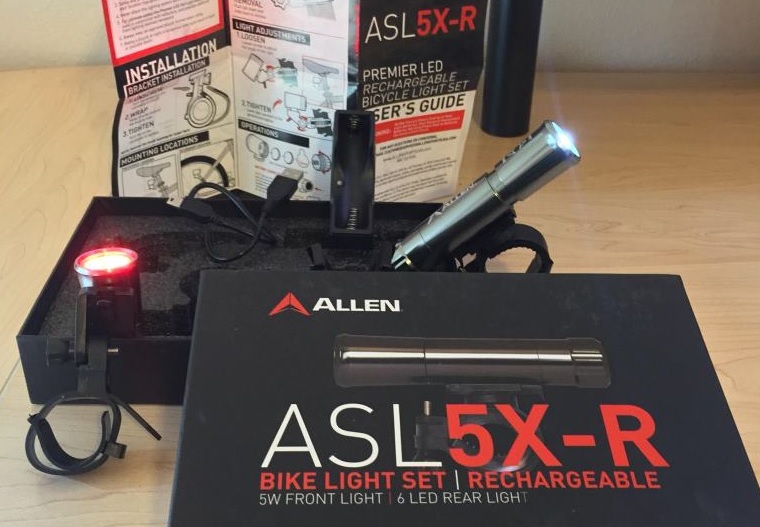
The HeadlightAllen Light Set - Front

The front Allen Sports Light – 5X-R Bike Light Set is encased in a sleek aluminum case and has 280 lumens of light that can be focused from a wide beam to narrow by sliding the front lens forward. The light has three modes which can be cycled through simply by pressing the on/off button. It has full power, half power, and a flashing mode. The light is mounted on an adjustable plastic bracket that is secured to the handlebars via a small bolt with a head that can be tightened with your fingers. Depending upon the size of your handlebars, the light comes with two rubber sleeves to act as spacers if needed to mount. The back of the bracket has a small clip that can be pushed down to remove the light. The removable battery is rechargeable and comes with a small docking station that uses an included USB cable to recharge it.

The Tail Light

The rear light of the Allen Sports Light – 5X-R Bike Light Set is also encased in aluminum for durability and has a similar look to the front. The light is a 5 lumen red light with 6 LED’s that has two modes: flashing and constant.  The light comes with an adjustable mounting bracket that the light can also be removed from. Its batteries are CR-2032 non-rechargeables but can be found wherever batteries are sold. Both the front and rear lights have rubber gaskets to make the lights waterproof.

Allen Light Set - Rear

The Opinion

The Allen Sports Light – 5X-R Bike Light Set are sleek metal lights that not only work well but look good also. Because the headlight is removable, it’s a light that you could use for an everyday flashlight off the bike because of its small size and brightness. Being able to adjust the focus of the beam simply by sliding the lens forward is innovative yet simple. The design and construction of the lights is actually above what you would expect in the price range that these lights fall.

The brackets for the lights are relatively straight forward to install but do take some time. The downfall of the Allen Sports Light – 5X-R Bike Light Set is the construction of the brackets particularly the front. The rear consists of a flexible enough plastic band that can be securely tightened with a cleverly designed plastic tightening screw. The front however uses a harder, inflexible plastic that must be opened to fit around the handlebar. If a product is limited by its weakest point, this is it. With repeated installations and/or excessive opening to install the bracket, this piece will probably break. If you are careful with it and only install it once and just remove the light from the bracket while on the bike instead of the whole mechanism, you will probably be fine.

Although not in issue when testing, the mounting of the light to the bracket had a bit of play in it due to a two piece mounting system. While riding however, this did not cause the light beam to bounce around.

Value Score of the Allen Sports Light – 8/10

The lights themselves are incredibly valuable for the price point. These lights not only do the job that they’re supposed to but do it well. The mounting brackets are their weak point but if you know this and you’re careful, you shouldn’t have to worry.

Functionality Score – 6/10

These lights have great functionality in that they can be used across spectrum’s from riding the road to commuting. They could be used mountain biking but because of the limits of the front mounting bracket, it may not stay in place on particularly bumpy trails. If you are doing some serious night riding you may like a few more lumens. Being able to easily recharge the headlight is not only easy but will save you in constantly having to buy new batteries. The rear light is small enough that the non-rechargeable batteries shouldn’t need to be replaced very often and when you do, it’s easy.

Durability Score – 4/10

The lights themselves are particularly durable being encased in aluminum while having rubber gaskets to keep them waterproof. What isn’t durable however is the mounting bracket particularly on the front light. With the proper care you could be sure not to brake it but if something were to brake on these lights, this would be it.

Pros

  • -Light Durability – Front and Rear
  • -Brightness – Front and Rear
  • -Rechargeable Front Light Battery via USB Cable
  • -Adjustable Beam
  • -Multiple Modes – Front and Rear

Cons

  • -Weak Front Plastic Light Mount
  • -Need a Flat-Head Screwdriver to Mount the Rear Light

Price: $30 – $55 

Where to Buy

You can purchase the Allen Sports Light – 5X-R Bike Light Set at this link.

An Update After Rugged Use

As stated originally, the lights themselves are durable and long lasting. The mounts however, particularly the front, are not. The plastic mount going around the handlebars broke which was a concern originally. In addition, the mount holding the light to the plastic piece that goes around the handlebars broke after hitting a large bump due to the heaviness of the light. The light however survived nicely after a couple of tumbles down the road.

The rear light and mount however are a different story. It has been mounted on the rear seat stay of my ‘cross bike for the past few months which included rides ranging from smooth roads, to gnarly dirt roads, to trails that were way to rocky and bumpy for a ‘cross bike but the light had zero issues. The original batteries are also still going strong. So in final, buy this light for rear light and mount and the front light for a nice rechargeable flashlight. Get another front light for your handlebars that you can rely on.

Female vs Male Cycling Joke

December 16, 2015 by Adam Farabaugh

Her vs. His Diary

Her Diary:

Tonight, I thought my husband was acting weird. We had made plans to meet at a nice restaurant for dinner. I was shopping with my friends all day long, so I thought he was upset at the fact that I was a bit late, but he made no comment on it. Conversation wasn’t flowing, so I suggested that we go somewhere quiet so we could talk. He agreed, but he didn’t say much. I asked him what was wrong; He said, “Nothing I asked him if it was my fault that he was upset. He said he wasn’t upset, that it had nothing to do with me, and not to worry about it.  On the way home, I told him that I loved him. He smailed slightly, and kept driving. I can’t explain his behavior – I don’t know why he didn’t say, “I love you, too.” When we got home, I felt as I had lost him completely, as if he wanted nothing to do with me anymore. He just sat there quietly, and watched TV. He continued to seem distant and absent. Finally, with silence all around us, I decided to go to bed. About 15 minutes later, he came to bed. But I still felt that he was distracted, and his thoughts were somewhere else. He fell asleep – I cried.  I don’t know what to do. I’m almost sure that his thoughts are with someone else.  My life is a disaster.

His Diary:

There’s this creaking on my bike that sounds like it’s coming from the bottom bracket … can’t figure out why.

Bike making weird noises? They can be a pain to figure out and even once you do they can be tricky to fix. This should help a little “Bike Noises — Don’t Let Them Scare You” Don’t let the noises get to you though.

Bike Stability – Physics 101

December 5, 2015 by Wade Shaddy

Bike Stability - Physics 101

You may have wondered about it while riding; it doesn’t feel like you’re balancing your bike yet, somehow, even though you’re only touching the ground in two 1/2-inch patches, the bike feels like it’s anchored to the pavement. The stability of a bike isn’t an accident, they’re designed that way.

Lateral Bike Stability

Road bikes in motion are incredibly stable, even though they’re incredibly top heavy. Other similar objects topple over sideways the minute you let go of them. Bikes also topple without forward motion. Bicycles lack lateral — side-to-side — stability, and only remain upright when moving forward. So it’s safe to assume that it’s forward motion that keeps them as solid as a rock.

Forward Motion

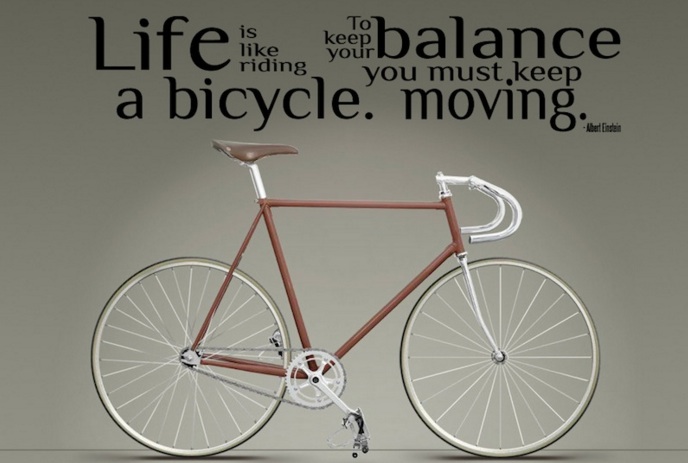
Albert Einstein was a cyclist, and was cycling when he realized the infamous formula, E=mc2. “I thought of it while riding my bicycle,” is reputedly what Albert Einstein said about his Special Theory of Relativity. Even though Einstein didn’t apply the theory directly to bicycles, he still knew that forward motion was likely the key to a bike’s stability. “Life is like riding a bicycle.” He said. “To keep your balance, you must keep moving.”

No Single Theory

Recent studies have suggested that no single theory is solely responsible for the stabilizing force of a bicycle, and that everything contributes to balance and stability. But designers rely on a few common, known theories such as the gyro effect, the caster effect, and calculations that include a bikes, trail, offset and rake.

The Gyro Effect

The gyroscopic effect of the wheels is the go-to explanation by some physicists as to why your bike stays upright. It basically means that spinning wheels tend to stay aligned in their original direction. The effect is used in navigation to maintain stability for all kinds of machines. NASA rockets rely heavily on the gyroscopic effect.

Center of Mass

But the gyroscopic effect is actually quite minimal. Studies have shown that a bike stays upright when it is steered to keep the center of mass over its wheels. The steering is usually done by the rider, but may also be done by the bike itself, completely without your assistance.

The Riderless Bike

You’ve probably witnessed a self-steering bike before by pushing or letting go of a bike in motion. The bike won’t travel in a straight line for long in an upright position. It’s constantly falling to one side or the other and then lurching back to an upright position under its own momentum. It’s due to what is called the “caster effect.”

Caster Effect

The caster effect describes what happens when a wheel has its contact point with the ground located at a different point from its steering axis. If the bike tips to the left, the trail or caster effect forces the bike to steer to the left. The bike steers into the fall, gets its wheels back under it, and stays upright. In other words, the fall becomes self-correcting because of the caster effect. The term “caster effect,” is a direct correlation to how caster wheels work on your favorite desk chair.

Rake, Offset and Trail

Rake, offset and trail more accurately describe what the caster effect really is on a bicycle. Rake and offset is the wheel axle’s offset from the steering axis. Offset determines how much trail a bike has. Think of trail as the tire patch “trailing” behind the steering axis. Industry standards for the average road bike offset has been roughly established at about 55 mm or 2 inches, which is regarded as a good combination of agility and comfort at low speed, and stability at higher speed.

More Trail

More trail equates to slower steering. Less trail makes faster steering. Increasing rake — it sounds contradictory  — decreases trail, therefore giving faster steering. More trail is good at high speeds, but at slower speeds it makes the bike feel sluggish.

Motorcycles and Mt. Bikes

Look at a motorcycle with a high degree of rake, and almost no trail, they’re extremely hard to steer and unstable at low speed, but fine on the freeway. Mountain bikes have less rake and more trail, and are one of the most stable bikes out there.

Confusion and Design

If that all seems confusing, it’s because it is. Even designers disagree with rake, trail and offset for one reason in particular, because it flip-flops or actually reverses when taken too far in one direction or the other.

The Most Stable Bikes

If you’re curious about bike stability, such as when purchasing a new bike, there are technical things that you can question to get the most out of your style of riding, or what you want to get out of a bike. For example, if you can determine the rake or offset of any given bike — the dealer may or may not know it — you can get somewhat of an idea of how the bike will handle by referring to the formula: Longer rake = less trail. Shorter rake = more trail.

Other Factors

Rake, offset and trail are just a few concepts that designers apply to a bike’s geometry to make it more or less stable. Bottom bracket drop, head tube angle — also know as the steering axis — and wheelbase are all figured into the equation. These geometry factors, work in tandem with tire selection, weight distribution, and other features on a bike.

Cycling Starting at 50

December 4, 2015 by Adam Farabaugh

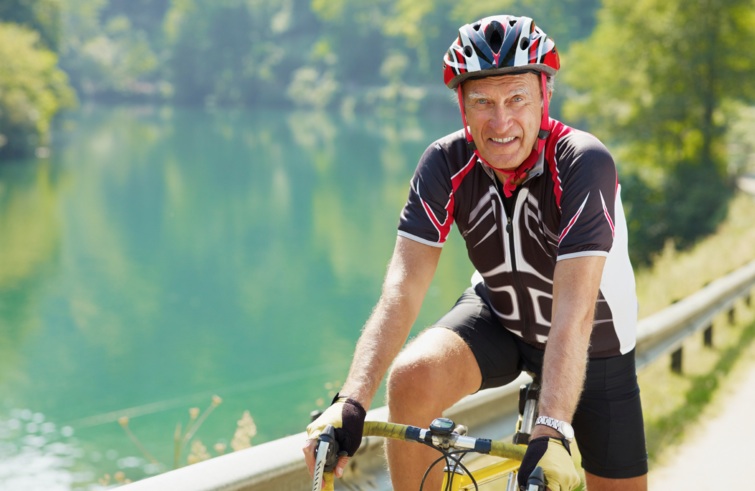
There’s never a wrong time to get into cycling whether at 5 years old or starting at 50 years old. We all do it for various reasons but it always comes down to the fact that it is fun and enjoyable. Age can be seen as a hurdle by many and it can be if you don’t know a few things to look out for going into it.

There’s a learning curve with everything, and with age you’ve probably figured out the best way to excel at something. Know the background and what you need to do ahead of time to best prepare yourself. Taking a few easy steps toward cycling starting at 50 will help ensure a smooth start keeping you safe, healthy, and riding well into your prime years.

Cycling Starting at 50

Conquering the Fear

There can be a healthy dose of fear when starting anything new especially something like cycling that has a number of variables. The biggest thing in conquering those fears in cycling is understanding the risks and your specific fears. A few big fears are as follows:

  • Afraid of not succeeding.
  • Afraid of the level of exertion.
  • Afraid of injury and crashing.

These are all valid fears that if you didn’t have you would be un-human. Cycling can be a difficult sport but it’s all what you make of it. If you go and try to do a long steep climb you might not succeed in your first week of riding. However if you begin slowly and set small, reachable goals you will not only succeed but also grow as a rider to be able to accomplish that climb and more.

With age, individuals do have to be more concerned with what their body can handle. The cardiovascular system, the thing that is taxed the most during riding, is incredibly robust and flexible. As you start riding more and more, it too will become stronger and more resilient. Riding at a higher intensity will strengthen your heart not only making you a better cyclist but also stronger in general as you age due to being able to pump more blood with less effort. Heart health is imperative with age and cycling is a great way to keep it healthy.

Cycling does have the potential to cause injury but the majority of injuries and crashes are due to an error in judgement by the individual. As you’ll see below, having a good bike fit will help to avoid injuries. The best way to avoid crashes is to be good at handling your bike and making quick, risk-averse decisions. Becoming a better bike handler will come with experience but you can do a few things to practice your skills. (“Bike Skills: Cornering-Techniques to Know and get Good At“)

What You Must Do First

As with any new endeavors, and cycling in particular, you must go see your doctor to see where you’re at physically to make sure you are healthy enough to indulge in the sport. Depending on history, they may look at a number of things but the one that they will most definitely look at is blood pressure. This is a good metric to not only make sure is within an acceptable range to begin riding but also to get checked on a regular basis to see how your riding is improving your health. Also be sure to ask your doctor any questions you may have regarding your cycling in particular.

Getting a Good Fit

Before you start riding you are going to want to make sure that you have a good fit on the bike. With age, everything isn’t as flexible as it used to be and injuries can occur more easily and definitely take longer to recover from. The best way to avoid this is to make sure you are in the perfect position on the bike to not put too much strain on any one area. A professional fit is a good idea or you can find more information here on (“How to Do a Proper Bike Fit“) to get the most out of fitting yourself.

One good tip on top of having a proper fit on the bike is having a comfortable saddle. Everyone is different in their preferences so make sure you try a few and get one that fits. You can find more on (“How to Choose the Best Bike Saddle“)on getting the right saddle for you.

Getting Started

As you start riding you want to make sure you don’t go overboard the first couple of rides. All of the cycling muscles and tendons are going to take longer to adapt to the stresses than they would in your twenties. Try and keep rides flat and if you do go over any climbs make sure you spin at a higher cadence. As you continue to ride more and more, a good metric to not overdo it is to not increase your riding more than 10% each week in volume, duration or intensity.

One of the big benefits to riding on top of the health side of things is the social aspect. Cycling is a great way to meet new people and continue the relationship with great friends. As you first start riding more however, you should do a few rides on your own to make sure that you’re comfortable doing things such as clipping in (if you’re riding with clipless pedals), turning, braking, as well as riding in traffic. If you are still struggling with these when you start riding in a group, you can pose a danger to others. A great way to learn and get good at these things is to ride with one other more experienced rider who can give you tips on what to do and more importantly what not to do.

The Importance of Recovery

With cycling past 50, your body is going to take longer to recover than it used to. A big ride is going to take longer to recover from as well as the smaller rides even. There are two big things here that are going to make a difference. One is not trying to do too much after you are already tired. The second is to focus on recovery.

Making sure you get enough sleep after bigger rides as well as eating properly and stretching will help improve your recovery time. Everyone is a little bit different so with a little bit of trial and error you will find what works best for you.

Cycling starting at 50 is a great time to get into a new and exciting sport that not only is going to be fun but will also help your health and well-being. Knowing these few things before you get into riding and as you first start out will help to make sure that it is a beneficial direction on all levels for you. Cycling is fun, enjoying, and rewarding regardless of age. It’s always better late than never. Start smart and you’ll be riding for decades to come.

105 Versus Ultegra – What’s The Deal?

November 29, 2015 by Wade Shaddy

105 Versus Ultegra

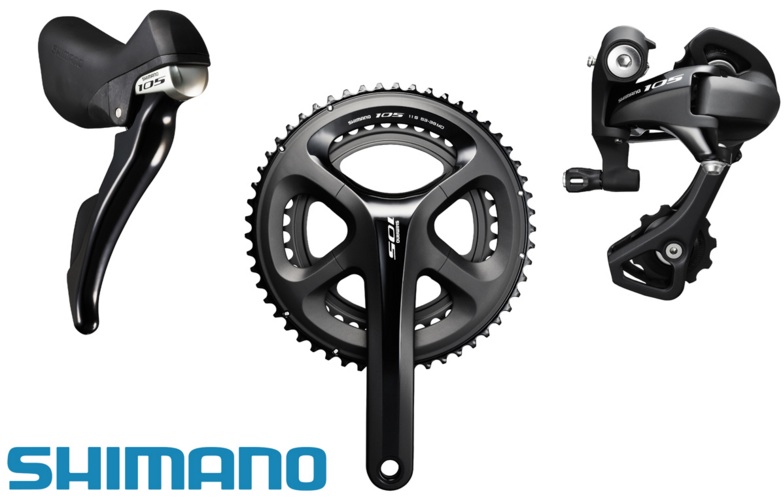
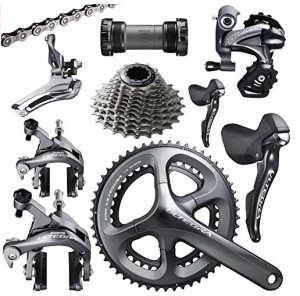
There’s lots of bike components out there, but walk into an average bike shop, and you’ll likely be offered a choice between two groups, the 105 and Ultegra, both of which are manufactured by Shimano. Bike shops often carry a majority of these two because they’re mid-range in price and entry-level, but still offer the status needed to compete and are reliable recreation riding.

Shimano is Everywhere

Shimano product sales constitute about 50 percent of the global bicycle component market. It’s the most prevalent supplier of bike components worldwide, but there are others. The hierarchy of brand names include SRAM, based in the United States, and Campagnolo, based in Italy.

It’s a Price Thing

Price is the biggest decision maker when choosing a bike. It’s one thing to say that you want the best. But the reasons to compare 105 and Ultegra go beyond that. The price difference between 105 and Ultegra is about $300 dollars. The price jump from the mid-range Ultegra to the high dollar Dura Ace is a whopping $700 or more.

Full Groups

You’ve probably heard bike shop salesmen state that a given bike is full Ultegra, or full 105. This means that the bike has been priced accordingly, and contains all the components from the stated group. In this case, a full 105 bike should be priced lower than a full Ultegra.

Recreational 105

Think of the 105 group as an entry-level component.  It’s capable of racing, but cheaper. Lots of first-time racers run their first races using 105. If they like racing, and plan on doing more of it, then moving up to Ultegra is the next step up. If racing was a one-time fling, the purchase of 105 was the right move.

What 105 is Not

The 105 group is not a department store component. Shimano produces cheaper components for department store bikes. Sora and Tiagra, both lower on the tier than 105, are targeted more for entry level bikes or even department store bikes.

Ultegra Character

Ultegra has the status and performance required to be on a racers list, but not so spendy that it’s not appropriate for recreational riding as well. It’s not the high-priced racing gear of the professionals, who might go with Shimano Dura-Ace, SRAM red or Campagnolo super record, but it’s still got what it takes to win races.

Differences are Valid

The performance differences between 105 and Ultegra might seem subtle to the average cyclist, but they’re valid. It comes down to weight, engineering, performance and maybe a bit of cosmetics.

Shifter Handles

Cosmetically, Ultegra boasts a carbon shifter blade, while the 105 sports an aluminum blade. On the inside, Ultegra’s lighter, harder parts, higher quality bushings and springs make for overall better feel when operating the brakes or shifting the bike.

Subtle Shifting

If you’re new to cycling, you might not notice the differences in shifting. Even though subtle, Ultegra shifts with a slightly cleaner feel than 105, which can seem to have a robotic click, instead of a smooth transition. Again, it’s subtle, and virtually unnoticeable to the untrained cyclist.

Brakes

Braking power on both models is more than enough to get you stopped fast. Neither one claims the top spot for reliability, but 105 may be noisier than Ultegra. Better quality springs on the Ultegra, and in this case, pivots, allow for more braking power than 105. Brake pad quality is another significant factor in the performance of Ultegra brakes over 105.

Drivetrain Specs

With chains and cassettes, the differences between 105 and Ultegra are slight but still affect performance. Ultegra has a nickel-like finish on the chain, and a stronger riveting process that allows for a stiffer chain. The chain on a 105 chains has a duller finish, and due to a different riveting process, are more stretchy than Ultegra. An Ultegra cassette substitutes the aluminum lock ring for the steel one found on a 105. The machining on the aluminum cogs of an Ultegra cassette are held to tighter tolerances than 105.

Up Front

The Ultegra crankset is hollow.  The Ultegra chainring shape blends nicely into the body of the Ultegra crankarm. The overbuilt structure of the crankset coupled with the chainring has better power transfer over the 105, which doesn’t sport a hollow outer chainring.

Trickle Down

It’s common for Shimano to introduce new engineering every few years. The previous years engineering advancements trickle down to the lower tier, meaning that the Dura Ace from last year, is now identified as a contemporary Ultegra. The trickle down engineering advantage is more likely to be found on Ultegra, than 105.

Basic Machining

New engineering means that Ultegra, for example, is machined to a higher degree than 105. The same goes for the brakes, shifters and drivetrain.

Stiffer

New designs and finer machining typically go hand in hand with new alloys that are stiffer, meaning that the parts on an Ultegra are lighter than the parts on a 105.

Lighter Not Always Better

It’s not always best to go with the lightest components. The lighter they get, the more delicate they are. In some instances, such as in dirty conditions, the 105 may be able to withstand more punishment, just because it’s heavier, and more substantial.

The Breakdown

105 vs ultegra105

  • Complete group weighs just under 6 lbs.
  • Entry level, recreational, but is race capable.
  • Reliable, maybe even more so when dirty or wet
  • Cheaper to repair or replace
  • Available in 11 speed, but more likely only 10.


ultegra vs 105Ultegra

  • Weighs in over a 1/2 pound less than 105 at 5.38 lbs.
  • Race level performance
  • Cleaner shifting and braking, subtle but noticeable.
  • 11 speed more likely than 105

Wheel Advantage

It’s already been established that that spending $300 dollars more for Utegra saves weight, and theoretically makes your bike faster and more efficient. But there’s another way to accomplish the same thing, and some cyclists say with better results. Cyclists on a budget can often save more weight on wheels.

It can make sense to purchase 105, and invest the $300 in racing wheels. It might even be possible to talk the bike shop owner into swapping out the wheels on the 105 before purchase. It’s an option worth considering.

Biking For One Hour Could Power Your Home

November 28, 2015 by Lee Agur

Biking For One Hour Could Power Your Home

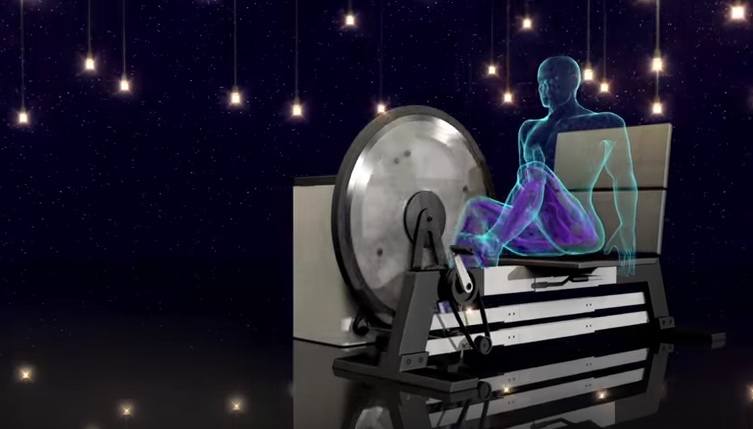
Imagine biking for an hour and being able to power your house for an entire day!

Access to electrical power is the first step toward economic advancement for billions of people living in poverty. Free Electric can light their homes and shops, make food storage possible, and usher them into the 21st century.


« Previous Page
Next Page »
  • Facebook
  • Tumblr
  • Twitter

Latest Articles

JOIN Cycling: A New Training Platform for Cyclists

May 27, 2024 By Eric Lister

cold exposure

The Benefits of Cold Exposure for Cycling & Life

June 13, 2023 By Eric Lister

hill climb

The Ultimate Hill Climb Training Guide

May 31, 2023 By Eric Lister

shoulder pain cycling

How to Treat & Avoid Shoulder Pain While Cycling

April 12, 2023 By Eric Lister

psoas stretch

The Importance of the Psoas Stretch for Cyclists

April 6, 2023 By Eric Lister

cycling neck pain

The Ultimate Guide to Cycling Neck Pain: Causes and Solutions

March 21, 2023 By Eric Lister

Useful Info

  • Contact
  • Finally, A Global Cycling Club That Is Focused On Community And Love Of Cycling!
  • Privacy Policy
  • Share Your Story!
  • Terms And Conditions Of Use
  • Welcome to I Love Bicycling
  • What Happened When I Stretched Every Day For a Month

Recent Posts

  • JOIN Cycling: A New Training Platform for Cyclists
  • How to Hang Bikes in Your Garage: 4 Inexpensive Options
  • Gravel Bike Vs. Road Bike: Which One Is Better For You?
  • The 6 Types of Mountain Bikes & How to Choose the Best One for You
  • What Is a Touring Bike Good For? 5 Benefits We Know You’ll Love

Search I Love Bicycling

Connect with Us

  • Facebook
  • RSS
  • Tumblr
  • Twitter

Copyright © 2026 · Magazine Pro Theme on Genesis Framework · WordPress · Log in