• Training
    • Injury Prevention
    • Training Tips
  • How To
    • Bike Fit
    • Gear
  • Nutrition
    • Nutrition Tips
    • Weight Loss
  • Repair
  • Reviews
  • Stories
    • Funny Stories
    • Jokes
    • Quotes
    • Videos
    • Funny Videos

I Love Bicycling

I Love Bicycling is a website that is geared towards cycling for beginners with road cycling tips, training articles, nutrition tips, weight loss, how to’s and bike repair articles.

Move Your Cleat Position

October 21, 2013 by Lee Agur

bike cleat position cyclingI went to a professional bike fitting and was surprised that one of the first questions that was asked was related to my cleat position:

Professional bike fitter while examining my shoes: So… why did you choose this cleat position?

My response: Because they came like that…

Embarrassing but true. I just thought the cleat should be positioned so that the ball of your foot was over the pedal axle; unfortunately, my position was a little forward of that.

What followed was a discussion of where the cleat position should actually be cycling and why. I took his advice, moved it back nearly 14mm, and found significant power and efficiency gains. Upon further reading and personal testing here is what I found.

Concept

The further forward the cleat position is, the harder your calf muscle has to work as a stabilizer muscle. The energy the calf is using does not actually go into driving the bike forward but rather is used to stabilize the foot and the ankle. However, with a forward cleat position cycling you are able to attain a higher peak torque.

The goal is to find the cleat position that gives you the torque you require without unnecessary calf fatigue.

Where to position the cleat?
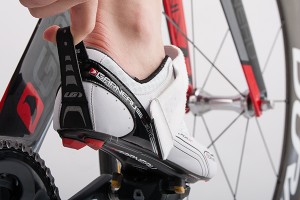
cleat positionSteve Hogg, a world-renowned expert on bike fitting, recommends the following cleat positions:

Shoe size 36 – 38: Center of ball of foot 7- 9 mm in front of the centre of the pedal axel

Shoe size 39 – 41: 8-10 mm in front

Shoe size 42 – 43: 9 – 11 mm in front

Shoe size 44 – 45: 10 – 12 mm in front

Shoe size 46 – 47: 11 – 14 mm in front

Shoe size 48 – 50: 12 – 16 mm in front


Before adjusting anything you should consider the fact that the type of cycling you do should dictate your cleat position.

Sprinter

If endurance is not a factor, say for instance you are a sprinter on a track, then ignore this post, as you will not care about calf fatigue and you require high torque.

Road Rider/Mountain Biker

I assume many of you fall into this category and the suggested cleat positions above are likely going to serve you well. If you are more focused on endurance then move the cleat to the high end of the spectrum (further back) i.e. century rides and road races. However, if you are more focused on sprinting move it to low end of the spectrum (further forward) ie. crit races and cyclocross.

Time Trials/Ultra Distance Biker

Steve Hogg and other big names such as Joe Friel (The author of The Cyclist’s Training Bible and many other great training books) have gone so far as to say that midfoot cleat position is optimal for individuals purely focused on endurance. Individuals focused on time trials and ultra distance would be the beneficiaries of this advice.

I have not personally tested this out but I must say I am curious. To me it makes sense, as I always found my calves cramping up, but you have to decide what is right for you.

Moving Your Cleat Position

If you do happen to move your cleat position back remember to lower your seat and your bars. Also, if you are thinking of switching your cleat position then read this more detailed article by Steve Hogg.

One thing to watch out for if you change to midfoot is your foot striking the wheel on a slow sharp U turn because your foot overhangs so much.

Make a conscious informed decision about the bike cleat position because it does make a difference!
The Perfect Pedaling Technique

October 19, 2013 by Lee Agur

Pedaling technique
Pedaling the bicycle is what cycling is all about! Why would you not want to be the most efficient at this one thing? It is what I have focused on the most this year! Testing what works and what does not work.

Quiet Upper Body

I believe one of the most important things (that is not stressed enough in the proper pedal stroke) is keeping a quiet upper body. You may have heard “keep a quiet upper body” but why?

Keeping a quiet upper body sets the rest of the pedal stroke up for success. I started by pedaling up a hill and as soon as I started to get sloppy (head moving back and forth – happened very quickly as explained in my previous post about hill climbing) I either turned around and went down or got out of the saddle to continue to climb. No sloppiness allowed!

After keeping a quiet upper body it all runs down from there…

Alignment

Have your hip, knee and ankle in a line, this is your most efficient and powerful position! Unfortunately, not all of us do this. It is a good idea to set yourself up on a trainer and either use a mirror or a spotter to watch your natural pedal stroke.

I think we have all seen the bow-legged cyclists heading down the highway; don’t let that person be you! This type of pedaling technique is inefficient and can even lead to knee injuries… trust me! (I used to be “that” guy!)

Pedal in a circle!

pedal strokeDoesn’t everyone pedal in a circle? No, they actually do not!
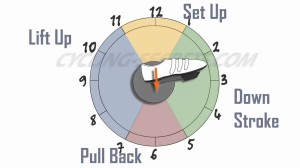
It is easier said than done! Your goal is to accomplish a smooth circle that applies force all around the pedal stroke. Let’s break it down…

Down stroke

Your down stroke happens between 1 and 5 o’clock, if we were comparing your pedal stroke to a clock.

This is where most of the power happens. Most of us do not struggle here, we all know how to push down. Your heel should be even to the ground or even slightly below your toe by as much as 20 degrees.

Pull Back

The pull back happens between 5 and 7 o’clock.

This motion should feel as if you are scraping mud off of your shoes. You will be engaging your calf here and pointing your toe down approximately 10 degrees.

Lift up

The lift up happens between 7 and 11 o’clock.

Your goal here is to lift the pedal up and start pulling toward the sky and later the bar top. Have your ankle at approximately 20 degrees. This is where your knee is going to want to push to the outside (bow legged). Do not let this happen, keep a strong core.

It feels as if you will be lifting the pedal up here and generating a lot more power than you actually are! What you actually are doing is lifting the weight of your leg and making it so your opposing leg is not lifting it up with the down stroke.

At a slower cadence you actually are generating power on the upstroke.

Set up

The set up happens between 11 and 1 o’clock.

Drive your foot forward. Your ankle should be transitioning from 20 degrees to 0 degrees here. It is a good idea to have someone film your natural pedaling technique.

Train Each Phase Then Integrate

Each of these phases mentioned above should be focused on separately and then integrated. It is very difficult to combine them all at once.

I have been focusing on perfecting my pedaling technique for an entire year and I am still not where I want to be. It is difficult! For me it is very quantifiable as I have a computrainer that rates me on efficiency. (If you do not know what this is do not worry I will explain it in a future post).

Improve Your Pedaling Technique

perfect pedaling techniqueThere are several ways to improve your pedaling technique.
  1. Spin on your way downhill – Try to achieve a high cadence in a small gear downhill without bouncing on your saddle. Again focus on a quiet upper body and a strong core.
  2. One leg drills – Pedal with one foot. This will force you to pedal all the way through and develop your “smooth pedal stroke” muscles.
  3. Rollers – When you feel like you have good balance try out some trainer rollers and this will do wonders for your pedaling technique. It will force you to pedal smoothly or you will fall! I do not suggest rollers for the beginner cyclist. They are difficult and frustrating and you should start on trainer.
  4. Fixed gear – Kid style! Fixed gear bikes force you to pedal in circles or you will get bounced around.

Focus

If you were to focus on one thing in the next few months this would be it! Your greatest efficiency gains are in your pedal stroke! In average human standings… I went from 0 to pretty awesome just by improving my pedaling technique.

I still focus on my cycling technique nearly every ride. When I began I could hold a good technique for 15 to 30 seconds before I started to get sloppy and my hip flexors were screaming. It takes time and focus to build up, but it is worth it! Your muscles develop faster than you would think and in no time you will be flying up hills and along the flats efficiently and with a quiet upper body.

Striving to achieve the perfect pedaling technique is worth the time and energy, I promise!

Subscription

If you liked this post subscribe to my newsletter at the top right of the page to receive more like it!

Proper Cadence Cycling!

October 16, 2013 by Lee Agur

Criterium Race Cadence - proper cadence cycling
A higher cadence during a criterium race is preferable to accelerate out of corners and respond to attacks (90 – 100rpm)

Finding your ideal cycling cadence can give you free speed! Yes… I said free speed! Who does not like to go faster with the same amount of effort?

What is Cadence?

Cadence is the amount of times your foot completes a full pedal stroke in one minute (also known as rpm). You can measure this by counting each revolution or you can buy a cycle computer. I personally love all things garmin.

Efficiency

From the month I started cycling I compared myself to a car. You may think that odd… but here is why….

In my car I have a gauge that measures current and average fuel consumption. Every time I drive, my goal is to see how little fuel I can consume. In order to do this, I have to find the “sweet spot” or the speed at which my vehicle travels the most efficiently.

Over thousands of miles I have discovered that my most efficient speed is 42mph in 5th gear at 1700rpm. So… how does this translate to cadence?

At your ideal cadence you will use less energy to travel the same distance at a certain speed. It can be broken down into simple science… Imagine you have to lift 1000 pounds over your head. If you try and do it all at once you will not be able to do it, if you lift it in one pound increments you are likely wasting energy just doing the motion. If you lift the 1000 pounds in 20 pound increments, that might be just right. Cadence is similar, you just have to find what is just right for you.

How do I find my ideal cadence?

It may be a bit obsessive, but you can test yourself with a heart rate monitor (that hopefully came with your cycle computer). I suggest you find a flat stretch of road that takes approximately 10 – 15 minutes to complete. Do a 20 minute warm up and then start one lap at 80rpm, on a different day do one at 85 under the same conditions then again at 90 and so on… try to maintain approximately the same speed and then compare your heart rates. The lap with the lowest heart rate is your ideal cadence.

When I began cycling I was quite obsessed with cadence, it was one of the only things I had showing on my cycle computer. As I continued to cycle and increase my fitness I focused on this less and less. If you listen to your body it will know what your ideal cadence is. I now know within a couple of rpms when I should shift up or down.

As you continue to cycle more and more your cadence will likely increase along with your fitness, so just because your ideal cadence was 85 two months ago does not mean it is your ideal now. Try to listen to your body.

TT Cadence - proper cadence cyclingWhat is the suggested cadence?

There is no hard set and fast rule on ideal cadence, and it actually depends on what kind of cycling you are doing, body type and fitness level.

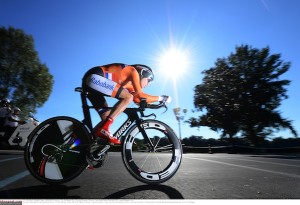
In a criterium race you want to have a higher cadence (90-100rpm) than in a time trial (80-90rpm). A higher cadence in a criterium allows you to accelerate faster out of a corner or respond to an attack, where as in a time trial you are focused on power and not on attacks. In mountain biking you want a low cadence because a high cadence causes you to get bounced around on rocky and uneven terrain.

Endurance Rides

If you plan on endurance cycling the suggested cadence is between 85 to 100. My first attempt at an endurance ride my cadence was an average of 78 for the entire ride… (actually… I didn’t finish… I got off my bike deflated my front tire and called my sister to come pick me up due to the “mechanical difficulties” I was having).

My cadence was low due to my fitness level and my dumb testosterone male thinking of: slower cadence = more power = faster. In reality the equation looked more like: slower cadence = using more energy and cooking the legs = bonking.

My last endurance ride of 112 miles was at an average cadence of 97. (This is on the high end of recommended cadence… but it is my ideal cadence) You will continue to adapt so do not feel discouraged if your cadence is low, as you can see, it will progress.

Find some free speed by finding your ideal cadence cycling and save energy!


Upset Stomach Cycling? Fix it!

October 9, 2013 by Lee Agur

Upset stomach cycling?

Upset Stomach Cycling? Fix it!

Painful stomach cramps and bloating can make it very difficult to continue cycling. Adjustments in nutrition, effort and position are the key to changing your enraged gut to a settled tummy.

The Stomach

The stomach is able to process approximately one gram of carbohydrate a minute or 60 an hour. If you eat more than this, it will not make the process go any faster, you will just get an upset stomach cycling.

If you mix sugars it is said that you can increase the carbohydrate intake to around 90 grams per hour. (Ie. mix glucose and fructose – I am still looking for this study)

So, per hour plan on having 45-60 grams of carbs if just from glucose and 55-75 grams if from glucose and fructose. (another reason I like honey stingers so much – glucose:fructose ratio of 1:1)

Note: Gels are approximately 23 grams of carbohydrate, energy bars are approximately 47 grams of carbohydrate and sports drinks are approximately 50 grams of carbohydrate.

Effort

At high levels of exertion most of your blood will be in your legs in order to maintain your effort… this means that your stomach is competing with your legs as your stomach needs the blood in order to digest food. Unfortunately, your stomach is going to lose the competition and it will slow digestion considerably.

As you continue to eat your belly is going to get full. Now you have three problems you:

  1. Have not been getting enough food digested into usable fuel
  2. Likely are starting to get dehydrated
  3. Are starting to get full AND feel like making a mess on the pavement is inevitable. (vomiting)

I used to think that this is just the way it is in cycling. You cram power bars and gatorade down until you feel like vomiting, and then you continue to eat and drink as much as you can until the ride is over and that is how you knew you did nutrition properly. Oops.

If you start to feel this way switch to water immediately… and if you can convince yourself to slow down to about 70-75% of your aerobic capacity that would be a great idea as well. The water is to decrease the sugar content as it is too high and difficult to process. Going forward you may need a mixture of sports drink and water. Slowing down will allow the blood to return to the stomach and help to digest.

Position

Perhaps the easiest thing to quickly look at is your position. If you continually get an upset stomach cycling it could be because your position is too aggressive (leaning over too much with a rounded back, or your hips are not open) and that can put undue pressure on your abdomen making it difficult to digest food.

I have tried all of this and still have an upset stomach cycling

Happy Stomach CyclingIf you have tried this already and still are having stomach/vomiting issues then it is time to look at what you are doing off the bike. Your esophagus has muscles that help push the food down and at the bottom is a sphincter that keeps the food from coming back up!

Now some of you may not want to acknowledge this part… but… caffeine, alcohol and smoking all relax the ever important esophagus muscles and sphincter. So if you continue to have problems look to cut these items out. Also, only eat 2 hours or longer before cycling, longer is better if you have a sensitive tummy.

Catch an upset stomach cycling early!

An upset Stomach cycling can destroy a ride, but if you know the signs and catch it early enough you can fix it without it slowing you down.

« Previous Page
  • Facebook
  • Tumblr
  • Twitter

Latest Articles

JOIN Cycling: A New Training Platform for Cyclists

May 27, 2024 By Eric Lister

cold exposure

The Benefits of Cold Exposure for Cycling & Life

June 13, 2023 By Eric Lister

hill climb

The Ultimate Hill Climb Training Guide

May 31, 2023 By Eric Lister

shoulder pain cycling

How to Treat & Avoid Shoulder Pain While Cycling

April 12, 2023 By Eric Lister

psoas stretch

The Importance of the Psoas Stretch for Cyclists

April 6, 2023 By Eric Lister

cycling neck pain

The Ultimate Guide to Cycling Neck Pain: Causes and Solutions

March 21, 2023 By Eric Lister

Useful Info

  • Contact
  • Finally, A Global Cycling Club That Is Focused On Community And Love Of Cycling!
  • Privacy Policy
  • Share Your Story!
  • Terms And Conditions Of Use
  • Welcome to I Love Bicycling
  • What Happened When I Stretched Every Day For a Month

Recent Posts

  • JOIN Cycling: A New Training Platform for Cyclists
  • How to Hang Bikes in Your Garage: 4 Inexpensive Options
  • Gravel Bike Vs. Road Bike: Which One Is Better For You?
  • The 6 Types of Mountain Bikes & How to Choose the Best One for You
  • What Is a Touring Bike Good For? 5 Benefits We Know You’ll Love

Search I Love Bicycling

Connect with Us

  • Facebook
  • RSS
  • Tumblr
  • Twitter

Copyright © 2026 · Magazine Pro Theme on Genesis Framework · WordPress · Log in