• Training
    • Injury Prevention
    • Training Tips
  • How To
    • Bike Fit
    • Gear
  • Nutrition
    • Nutrition Tips
    • Weight Loss
  • Repair
  • Reviews
  • Stories
    • Funny Stories
    • Jokes
    • Quotes
    • Videos
    • Funny Videos

I Love Bicycling

I Love Bicycling is a website that is geared towards cycling for beginners with road cycling tips, training articles, nutrition tips, weight loss, how to’s and bike repair articles.

Training

  • Injury Prevention
  • Training Tips
  • Training Camps

The 4 Best Explosive Exercises for Cyclists

September 13, 2022 by Eric Lister

Explosive exercises for cyclists are one of the most underused forms of training in our sport, this despite the fact that it’s actually one of the best physiological indicators of overall performance. If you’re wondering how to get stronger legs for cycling, then this is going to be the article for you!

You could define explosive training as any type of exercise that requires you to use maximal power or speed in the shortest time possible. The term plyometrics is often interchanged here, which can be defined as jump or sprint training. 

While you can certainly use weighted exercises to train explosively, today we’re going to focus on exercises that cyclists can do at home with zero equipment. But first, why should cyclists train explosively at all?


David Fuentes/Adobe Stock
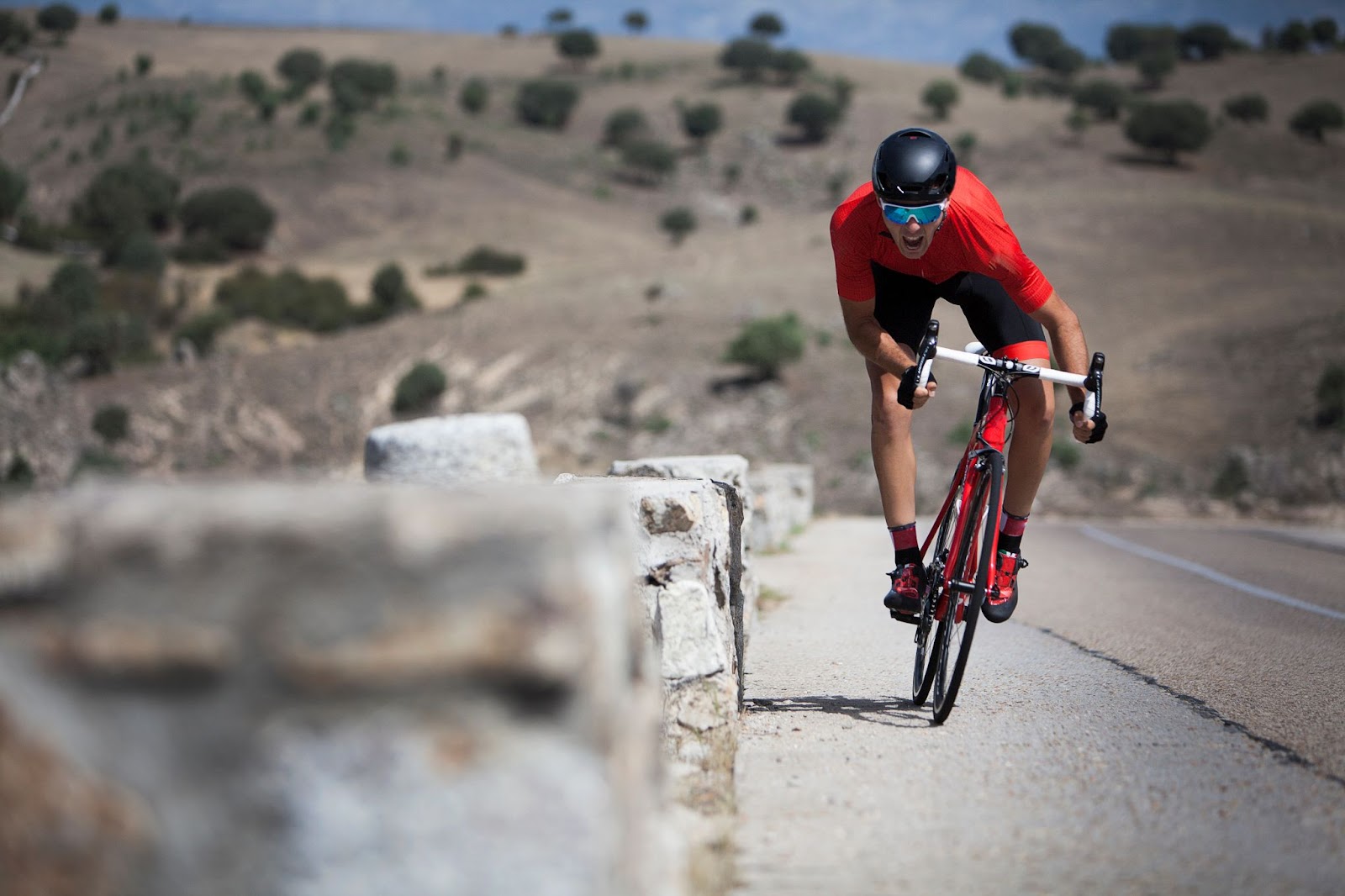
Why Should Cyclists Train Explosively?

Cycling performance is dependent on a number of factors. This is such a dynamic sport, and sometimes it can be hard to determine where we should focus our training. Beyond the influence of our ability to consume and utilize oxygen (VO2 max), additional variance in cycling success can be attributed to maximal strength, psychological factors (like perseverance) and power.

Any short-medium duration burst of speed while cycling – for example climbing a hill or sprinting for better position – is going to challenge your body in a different way than maintaining a steady pace on flat ground. This is something we need to train and build up as a part of our toolkit so that it’s a demand we’re capable of and have been exposed to.

Explosive training for cyclists is good not just for performance but overall health as well. Certain muscles, like the gluteus maximus (your butt) and rectus abdominis (your six pack), respond better to explosive training and are crucial to the overall strength and balance of your body. So let’s try doing it!

Explosive Exercises For Cycling Power

The following exercises are excerpts from some of our Advanced Strength Training programs at Dynamic Cyclist. We’ve built this online platform specifically for cyclists who want to ride pain free, get stronger, prevent injury, improve mobility and increase performance on the bike. If you like these, you might want to consider signing up and joining our community!

You’ll notice that each exercise is performed for short periods of time as part of a longer, more comprehensive circuit. That’s because you want to try to imitate the cycling environment within your workout for a higher direct carry-over to performance on the bike. We have to be able to explode for short bursts and ride for long periods all within the context of one ride.

Important Note: Explosive training is very demanding on the body, specifically your joints. In the videos below, our instructor Alisha gives a modified version of each exercise that you should consider starting with if you are overweight, have a low fitness level or have not tried this type of training before.

Squat Jack 

The squat jack mimics the same pumping power that lifts you off the saddle on a steep hill climb or speedy sprint. Your thighs and glutes will be screaming in glorious agony. One benefit of the squat jack is it takes us into a deep squat position that really stimulates the gluteal muscles. Try exploding off the ground as hard as possible for maximum effect!

Sprinter Skips 

Just looking at the sprinter skip you can probably see the cross-over it has to cycling. It’s almost like going through one pedal stroke but with bigger, more exaggerated movements that really challenge the muscles. The hip drive, knee extension and calf muscle activation at the end range of this exercise will help you produce more force as you’re pedaling. 

Single Leg Square Jumps 

Unilateral (one-sided) leg exercises are excellent for hip activation, balance and overall explosive power. By stabilizing the pelvis you create a stronger platform for your legs and core to work off of. These single leg square jumps are a serious challenge to your hips, knees and ankles that can help make those tissues more resilient to injury long term.

Running man (mountain climbers) 

Almost like cycling horizontally! This exercise trains your core to stay stable while your legs pump vigorously through a big range of motion (just like when you’re riding). Because the legs are attached to the torso through the hip flexors, your core muscles have to work extra hard to keep the lower back from extending (one of the causes of lower back pain in cyclists).

Strength Training For Cyclists

If you’re looking for more explosive strength training that will help you get stronger legs for cycling, try signing up for Dynamic Cyclist! Available at a fraction of the cost of seeing a physiotherapist, trainer or coach, this online training platform has a HUGE library of routines and exercises programmed just for cyclists. Try it out today for FREE! 

Lower Back Pain & Cycling: The Ultimate Guide

September 7, 2022 by Eric Lister

Introduction


More than half of cyclists report having low back pain, which should be reason enough for you to read through this article. Either you are one of these individuals, or in all likelihood will be at some point in your cycling career. Unfortunately, there are various things about our sport that almost guarantee an achy back with enough time and patience. 

If we are the ones to break this news to you, we apologize. But just the singular act of sitting on a bike can actually have serious detrimental implications for your lower back.

Today we will give you the information and guidance to eliminate cycling low back pain once and for all. A note before we dive in, ensure you have done (or have had a professional perform) a proper bike fit. Without this, all the following advice could be a non-starter. If that’s in order, then we hope you find this helpful. Here is a comprehensive guide to some of the most common issues relating to lower back pain in cyclists, and most importantly, how to address them.


Compression (Problems)

A famous study from 1970 showed that while standing you have (on average) about 100 kg of pressure on your lumbar discs. If you sit down, this pressure increases to 140 kg. If you bend forward while sitting, this pressure increases to 185 kg. 

Remind you of anything?


Unsplash

Constant compression of your spinal discs not only puts you at risk for disc herniation, it is often the cause of weakness, numbness, tingling and pain that can radiate out from the back and into your limbs through conditions like sciatica. This might help explain why some people experience back pain after cycling, resulting from the increased compressive forces sustained during the ride.

Many people think back pain originates from things like hard physical labour, but the evidence says otherwise. There is a far higher percentage of people with back pain in rich, developed countries where people are more sedentary. The same phenomenon is seen when comparing people in urban centers to others in rural communities. A lot of this comes down to sitting. 

There is a devilish trick at play here, because people think getting on their bike is going to make them stronger, more resilient and LESS susceptible to common problems like low back pain. As we’re starting to see, this is not exactly true. So we need to find ways to counteract the compression we experience on our bikes, and in so many other areas of our lives.

Compression (Fixes)

You may have heard the interesting fact that you’re taller in the morning than you are at night. This is a result of gravity acting down on you throughout the day. As we age, the repetitiveness of this effect on our spinal columns (among other things) can actually cause our spinal discs to lose fluid, dry out, become brittle, painful and injured. 

There are however ways to give our spines the love they need, and preserve their integrity throughout our lives. That is by actively taking them through full ranges of motion, and doing exercises to neutralize the excessive compression forces we subject them to. Here are two things to help that you’re probably not currently doing:

Hanging


Unsplash

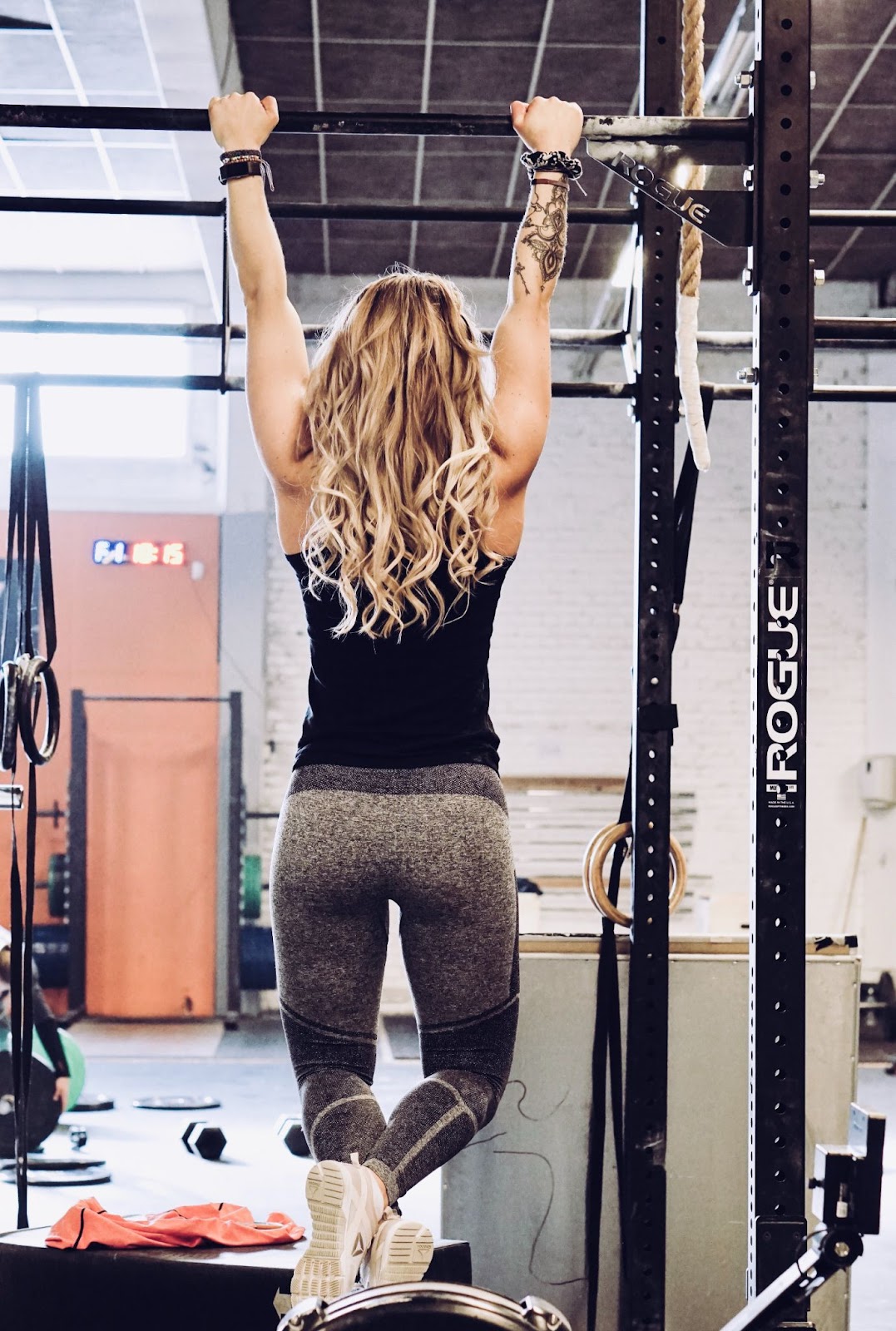
Our ancestors have been doing it for hundreds of thousands of years, children do it on the playground, but for some reason as adults we don’t do it at all. You don’t need an inversion table, fancy boots or medieval torture devices to decompress your spine…all you need to do is hold onto a bar – and relax.

Hanging has a number of incredible benefits. It expresses full shoulder flexion, increases grip strength and decompresses your spine to name a few. A door frame pull up bar is inexpensive and easy to use. Try doing intermittent sets throughout the day to help loosen things up, especially after rides. 

If you’re not strong enough to hold yourself, or can only hold for a few seconds, use your feet on a platform or the floor to take some of the weight off.  It’s important to give yourself time to gradually get stronger in this position. Our modern lifestyles and the sport of cycling rarely take our arms overhead. So take your time, start slow and don’t rush.

Full Squats (Resting)


Unsplash

Remember those lower income countries we mentioned? Their citizens often do something far better than sitting when eating meals, waiting for the bus or even just talking to friends. It’s the same thing every child does when they want to pick something up off the ground. Most of us know it as an exercise, but it’s actually fundamentally a resting position. The squat.

Sitting in a full squat is a natural position for our bodies; it helps us digest food, keeps our hips, knees and ankles mobile, and actually places our colons in the best position to poop (pooping in the woods, anyone?) It also has a gentle stretching and decompressive effect on our lower backs, with the force going through our feet and the ground instead of our backsides and a saddle.

This might be hard if you’re inexperienced, but you can use your desk or any other sturdy implement to hold onto while in this position. Placing a book under each heel can help as well. Try spending short periods of time down there, and you’ll be shocked at how mobile, supple and energetic you start to become. After the initial period of incredible discomfort, of course!


Core (Problems)

The core is grossly misunderstood, especially when it comes to cycling and lower back pain. Lower back pain is strongly associated with a muscle called the Transversus Abdominis (TVA), your deepest abdominal muscle. It wraps around your organs and entire midsection like a corset, and is your body’s equivalent to the weight belts you see people wearing in gyms.


The Role of the Pelvic Floor in Respiration: A Multidisciplinary Literature Review – Scientific Figure on ResearchGate

As you can see from this photo, the TVA shares an intimate relationship with your diaphragm, multifidus and pelvic floor muscles. All of them work together in a loop to create trunk and low back stability. One of the most notable differentiators between cyclists with back pain is that they have less TVA thickness than riders without low back pain.

When you activate your TVA, your belly button draws in towards your spine. This pushes your organs up against your diaphragm and down against your pelvic floor, creating a compressed cylinder around your low back. Because the tendons of your diaphragm reach down towards the L2/L3 vertebrae, the upwards pressure of this action actually lifts those vertebrae slightly, decompressing L4/L5 and L5/S1 below. 

L4/L5 and L5/S1 just so happen to be the two most common sites for disc herniations, and TVA weakness will almost undoubtedly be found in individuals with those injuries. 

Starting to see the importance of proper core function?

Core (Fixes)

Having a stronger, more supported core should start with learning how to use your TVA (as opposed to hammering your abdominals with excessive exercise, which is so often the advice given). This will increase the tone of your midsection and support your organs, while also adding support to the lower back even in the compromised position your bike puts you in. 

So, how do you do it?

Think about putting on a tight pair of pants, you know how you suck your belly button in to do so? That’s the action of your TVA. To practice, try taking in a deep breath of air. Now slowly exhale, and at the same time draw your belly button in towards your spine. The TVA assists in expiration, so timing these two actions together can help increase awareness of the muscle.


Adobe Stock

Every time you bend over, pick something up, push/pull something or MOVE at all – you should be activating your TVA first. Take a breath, draw the belly in and hold. Complete the movement, then repeat. Remember, if your TVA is engaged, your back is supported. With enough practice, your nervous system will learn to automatically activate it every time you move.

“Does this mean you should hold your tummy in all day and the whole time you’re cycling?”

Of course not! But by strengthening this muscle through regular use you will increase its resting tone. So even when not actively engaging it (like when you’re riding) it will be tight, strong and supportive. 


Poor resting abdominal tone versus good resting abdominal tone. Neither of these people are overweight, but the man’s belly is protruding because his organs are falling forward against a weak abdominal wall. 


Hips (Problems)

We now get to one of the most problematic areas in the body when it comes to low back pain and cycling, the hips. More specifically, the hip flexors. Even more specifically, the psoas muscle. The psoas is your primary hip flexor, and is indeed the only muscle connecting your upper and lower body. 

It attaches to your femur and all five lumbar vertebrae, so it has significant influence on your lower back. While cycling, your hips are always in some state of flexion, never reaching full extension. The hip flexors actually help pull your leg up through the recovery phase in preparation for propulsion in the power phase, as well. All this flexion can lead to tightness.

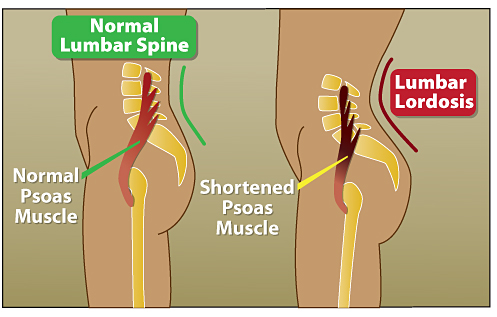
Tight psoas muscles will pull on the lumbar vertebrae. This tips the pelvis forward by creating an excessive curve in the low back (lordosis), causing the vertebrae to pinch together, compressing nerves and often resulting in pain. Tight hips also inhibit the function of their antagonists, the glutes, which are tremendously important for overall strength and balance in the body.


PhysioLogic

Hips (Fixes)

Static stretching in general can be a great way to improve flexibility. Doing it before riding however, is not necessarily recommended. When you hold stretches for extended periods of time, it has a relaxation effect on the muscles by decreasing their neural excitation, meaning they won’t be able to contract as hard as usual, leading to decreased cycling performance.

We can intelligently use this effect to our benefit, though. If we want to decrease the activity of a hyperactive muscle, such as our hip flexors, then doing a passive stretch on them before, and even intermittently during, our rides can be a handy tool for relieving back pain while cycling. 

Give this stretch a try before your next session:

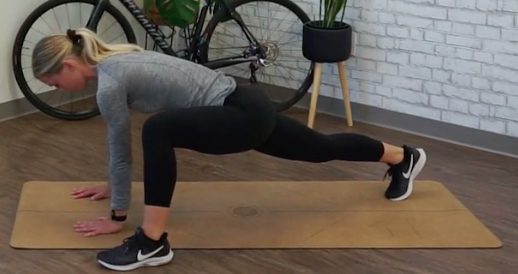
Lunge Stretch


Unsplash

Get into a wide standing lunge position, try not to arch your lower back (tuck your tail), and then lean into your front knee, opening up the hip on your extended side. You should feel a stretch in the front of that back hip. Hold for 30-60 seconds. Repeat on the other side. If this is too tiring, you can lower the back knee to the ground for support. 

This will have a “deadening” effect on your hip flexors and possibly provide some relief to the low back while riding. If you get some initial relief, and then feel your lower back pulling after some time riding, simply stop and perform this stretch again to see if it makes a difference. If it does, then you can start doing this stretch on rest days for a more permanent effect.


Back Strength (Problems)

Cycling basically does nothing in the way of strengthening your back, but paradoxically, you need a strong back to be a good cyclist. Being bent over on the bike forces our back muscles to work extremely hard to maintain some sort of rigidity and stability during that time, but if we lack the endurance to do so, the body resorts to other mechanisms.

There is something that takes place in your body called the flexion-relaxation phenomenon. When you sub-maximally flex your spine, your body will relax the muscles of the back to rely passively on deeper structures like tendons and ligaments for energy conservation. Increasing the strength and endurance of our back musculature can help mitigate the effects of the prolonged wear and tear this could have on our spines while cycling.

One revealing way to tell if a back is weak is just by looking at it. If you can see the spinous processes on somebody’s back (bumps along the spine) while standing, that is a screaming sign of an area that is at risk for injury. Having a strong back is not just beneficial in cycling but for every other part of life.


Spinous processes are noticeably visible on this woman.

Back Strength (Fixes)

Training the low back and back in general to handle heavy loads over sustained periods of time will dramatically reduce your risk of pain and injury while on the bike. Adding extra tissue to the area will create a strong, supportive environment that can do the activities you’re asking it to.

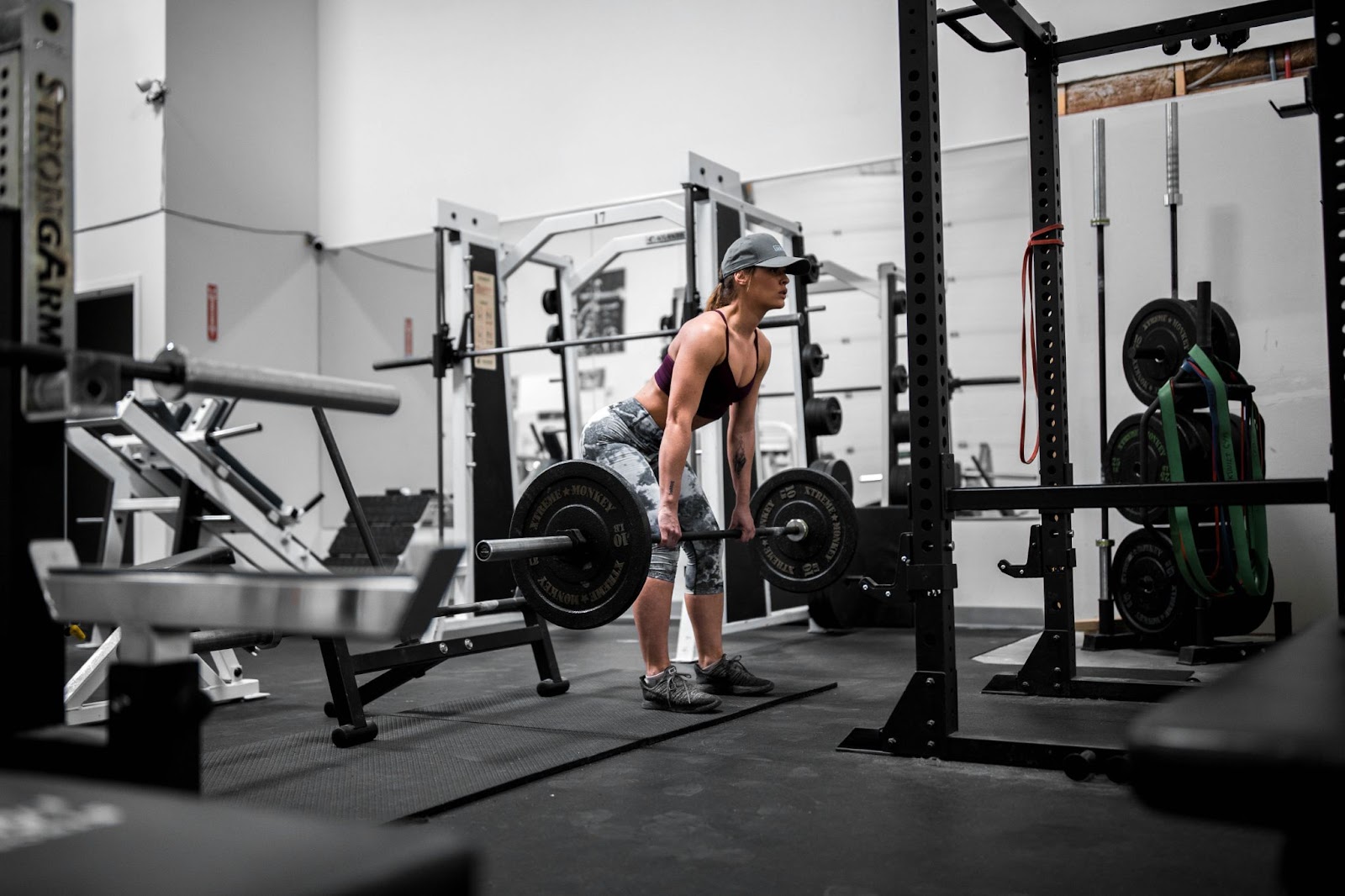
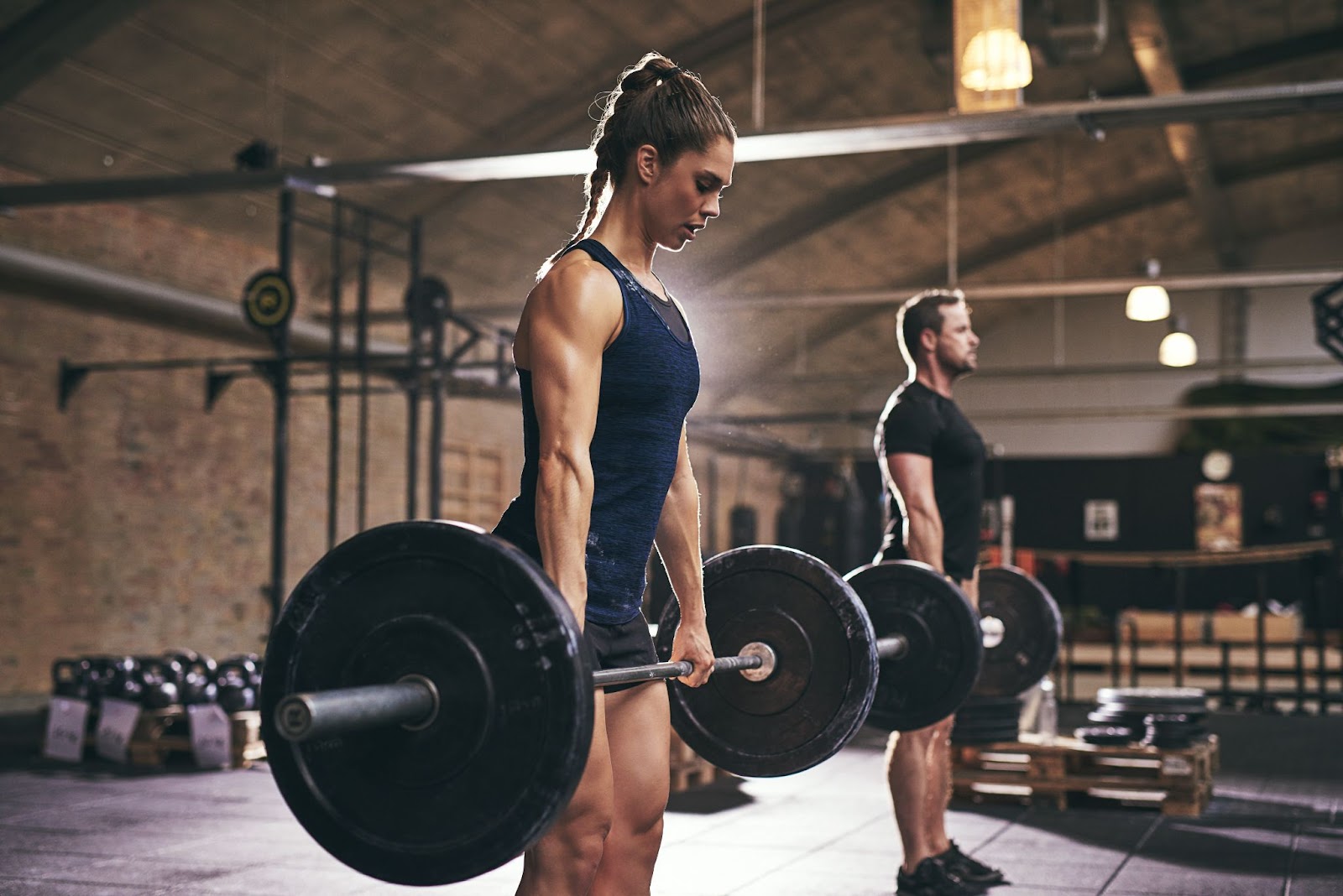
Any exercise where you’re picking something up off the floor, like a deadlift, is going to be the best bang for your buck. This is because your low back is going to be the pivot point for the load you’re trying to pull. Performing high repetitions with moderate weights is going to train your muscles to be strong over time (endurance), which is exactly what you want as a cyclist.


Unsplash

Interestingly, many cyclists complain of lower back spasms while riding. This is because the muscles are being overstretched, so they forcefully contract to try to bring you out of that position (i.e. your body is smarter than you!) If you want to avoid spasms, make your back stronger!


Ready To Ride Pain Free?

If you’re looking for a comprehensive, all-in-one training platform that combines injury prevention, mobility, strength training and more – you might enjoy training with our partner, Dynamic Cyclist. 

They built this program for cyclists, and are cyclists themselves. Physios, coaches and world class trainers. All at your disposal for a fraction of the cost – of ONE appointment! Their goal is to help cyclists ride pain free, and we want you to see the results for yourself. 
Sign up for a 7-day free trial HERE and join a community of cycling enthusiasts who are riding stronger, faster and better than ever before!

This Pre-Ride Warm Up Will Make You A Better Cyclist

August 24, 2022 by Eric Lister

Most people don’t even bother with a proper warm up before biking. They figure they’ll just ease into the ride and then kick it into high gear when everything starts to feel loose. It’s a common problem in all sports and recreational physical activity. As cyclists, we often take our bodies for granted and get ahead of ourselves before the rubber even meets the pavement.

This, is how injuries occur.

Knowing what to do before a bike ride can help settle nerves, set goals, reduce the risk of injury and improve overall cycling performance. A correct cycling warm up will address several things at once, so it’s important we integrate it into our race days, training sessions and even prior to an easy ride. 

This article will briefly teach you the importance of warming up before cycling, and then show you a simple 5 minute routine that you can have in your arsenal at all times!


Source: Andriy Bezuglov – Adobe Stock

Why Warm Up Before Cycling?

One definition of intensity is the amount of load being put through the body during an exercise or activity. For example, doing a 1RM back squat is more intense than doing 50 bodyweight air squats. The heavy weight on your back is putting more axial load through the body than you doing a squat with no weight at all. With this definition, cycling is a low intensity exercise.

However, another definition of intensity is how hard the body has to work to do the exercise. Depending on your level of fitness, those 50 bodyweight air squats might take your RPE (rate of perceived exertion) to a level 8 or 9. With this definition, we can see how cycling could span the spectrum of intensity from low to high.

All this to say that cycling has the potential to place huge demands on your body despite its reputation for longevity and low impact on the joints. Yes, the bike supports your body. Yes, you push against free moving pedals instead of the immovable ground. Nevertheless, it is probably more intense than the rest of your day’s activities, so we need to prepare accordingly.


Source: brizmaker – Adobe Stock

Benefits Of A Cycling Warm Up

By performing a pre-ride cycling warm up you will increase the temperature and blood flow in your muscles. This has been shown to increase performance outcomes and reduce the risk of cramps or injury by making your tissues more pliable (“limbering up” so to speak).

Something else not often talked about is the psychological benefits to a warm up routine. This time can be used not only to prepare your body but your mind as well. Western medicine and society as a whole tends to compartmentalize the body and mind as different (sometimes opposing) entities. In reality, you as an individual are a complex intermingling of both.

Pay attention to how you feel prior to riding. Set goals for the session whether it’s for enjoyment, recovery, training or performance. Visualize the outcome of your race or desired sensations during your ride. Calm your nerves and avoid an “adrenaline dump” early in a race or heavy training session. All things we can attend to and include in the space of a dedicated warm up.


Source: fifeflyingfife – Adobe Stock

Should You Stretch Before Cycling?

It depends on the type of stretching. You’ll notice that all our warm up routines at Dynamic Cyclist are…dynamic. This means that we are constantly moving through a range of motion as opposed to just holding an end position (which is known as static or passive stretching). 

A dynamic warm up is more productive in terms of increasing the temperature of your muscles and preparing them for movement. Static stretching also has a number of downfalls prior to exercise including the decreased neural excitation of your muscles. This means they won’t fire as quickly, won’t be as strong and won’t last as long.

Holding a static stretch means you’re asking the muscle to relax into a lengthened state. This is contradictory to what you want during exercise, which is for the muscle to contract forcefully for several repetitions. These opposing ideas are a recipe for injury. Best to save any static stretching for after your ride or a rest day.

Pre-Ride Warm Up

Now that you know a little bit about why a cycling warm up is beneficial, it’s time to actually do one! This is a full 5 minute warm up routine you can use before going out on any ride. We will show you the exercise, tell you how to do it and why it will contribute to better cycling performance. 

Each exercise has an accompanied link that will take you to a follow along video teaching each exercise, led by our Dynamic Cyclist coach, Alisha. Let’s jump in!

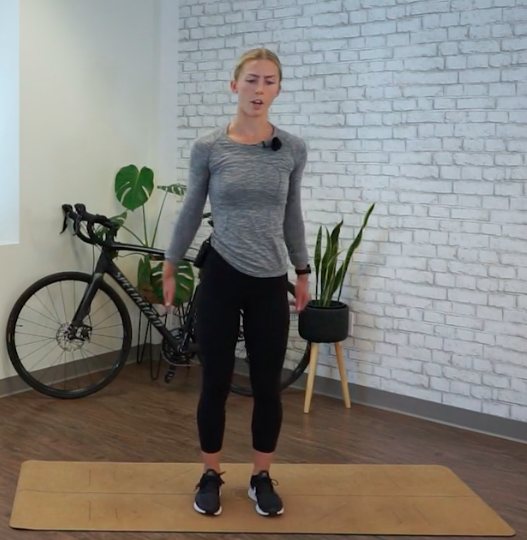
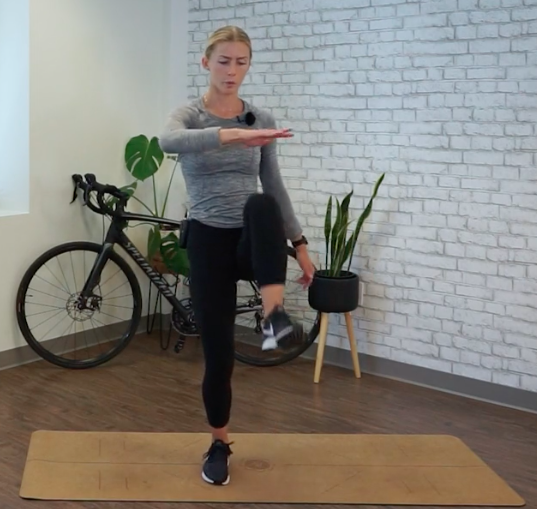
March In Place

Try this exercise with Alisha!

Why It Works

  • Warms up the hip flexors which play an important role in recovery phase of the pedal stroke; hip flexors tend to be dysfunctional in cyclists with lower back pain
  • Balancing on one leg works unilateral stability and fires all your glute muscles which is important for power initiation while cycling and overall hip health
  • Integrates hip and core musculature together; crucial for force absorption and production while riding
  • Large movement gets the heart rate up, circulates blood and increases the body’s core temperature
  • Cross lateral movement integrates your brains left and right hemispheres which results in better focus, peace of mind and improved motor functioning

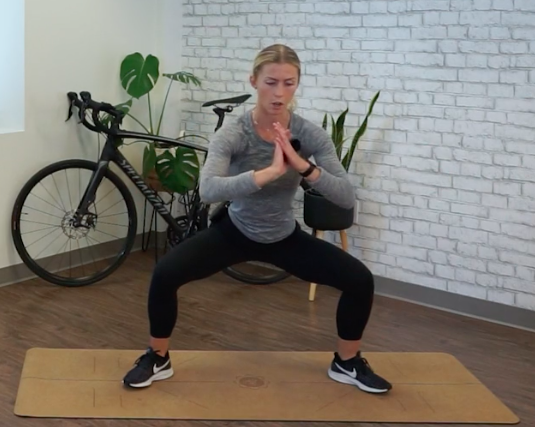
Pulse Squats

Try this exercise with Alisha!

Why It Works

  • Works all your knee extensors (quadriceps) which do the majority of the work while cycling
  • The wide stance works your adductors (groin muscles) who, in addition to adducting the leg (bringing it towards the midline) also have a secondary hip flexing function
  • Squatting deeply forces activation of the gluteus maximus, which is important for initiation of the power phase while biking
  • Alisha’s cue to drive the knees out helps engage all other glute muscles including gluteus medius/minimus; important for single leg stability and support of the pelvis while riding
  • Pressure from the saddle leads to several urogenital problems in cyclists (like numbness, infection and sexual dysfunction); this exercise opens up that sensitive area and stimulates blood flow to the surrounding tissues

Arm Circles

Try this exercise with Alisha!

Why It Works

  • Important for shoulder health; cycling limits the range of our shoulders and never takes our arms into an overhead position
  • Our shoulder joint is the most mobile joint in the human body, this exercise takes it through the full range of flexion and extension
  • Mobilizes your scapula (shoulder blade) which becomes stuck and stagnant staying in prolonged, fixed positions on the bike
  • Opens up connecting tissues in the chest and lats (under your armpit), both of which become compressed in a rounded, forward flexed cycling position
  • Bringing the arms overhead helps mobilize the thoracic spine (mid back) which cycling and several modern activities tend to stiffen

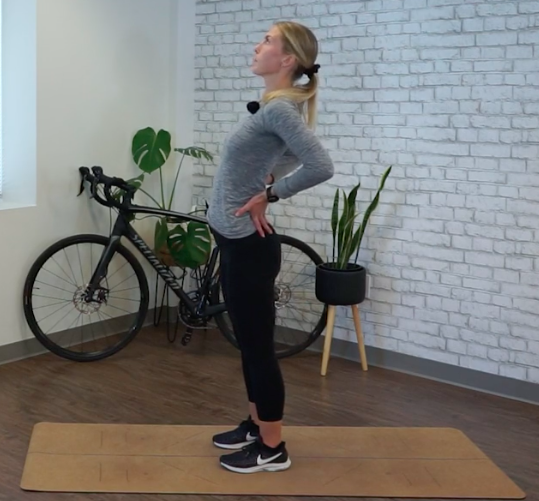
Dynamic Forward Fold

Try this exercise with Alisha!

Why It Works

  • Both strengthens AND stretches muscles on the front and back of your body through a large range of motion
  • Stretches hamstrings and back on the way down, contracts them on the way up; Stretches core, chest and hip flexors leaning back, contracts them folding forward
  • The core/chest stretch you get leaning back is great for maximizing your breathing capacity once you get on the bike where these tissues are crunched up and compressed
  • You get a pumping sensation in the low back as you hinge forward and backward which stimulates blood flow to this often injured area
  • Fluid movement that feels fantastic on the whole body; great for overall feelings of agility and nimbleness prior to riding

Dynamic Lizard

Try this exercise with Alisha!

Why It Works

  • Integrates the whole body and helps it work together as a single unit prior to getting on the bike
  • Great mobility exercise for hip health as you have to use your own strength to bring the hip into almost full flexion
  • Prepares you for mounting and dismounting, where you perform a large hip movement very much outside the range of normal pedaling; often injures bikers at the beginning of a ride when they’re not warmed up or at the end of a ride when they’re fatigued
  • Integrates loaded wrist extension into the warm up; it’s often overlooked that the wrists are under sustained load in different positions on the bike
  • Loads the upper body, particularly the front of the shoulders, which are going to be working hard when leaning forward on your handlebars

Take Your Cycling To The Next Level

This was just one of the many warm up, mobility, injury prevention and strength workout routines we have available through our Dynamic Cyclist training platform. Also available is 1-on-1 coaching for a more personalized approach.

We want to help you ride pain free and feel your best on and off the bike! We hope you join us and become part of our community of cyclists committed to riding pain free!

This Will Make You Faster On The Trails

August 17, 2022 by Eric Lister

Mountain biking is that unique brand of our sport notoriously responsible for its abrasions, broken bones, banged up shoulders and the odd concussion from time to time. Strength training for mountain biking should prepare us for what can sometimes be a winding trail of hostility and potential danger. That doesn’t, however, mean it’s something we should avoid.

The chance to get into nature, explore new technical paths and take in the beautiful scenery are what biking outside is all about. Preparing our bodies to handle the sudden drops, body jolts, jagged turns and unorthodox terrain means we can enjoy ourselves with a built-in insurance policy that protects us from injury and improves our cycling performance as a whole.

Becoming a better, faster mountain biker is always going to be a dynamic, ever changing goal. There are so many areas we can pay attention to for a sport that shifts focus quickly depending on where we are and how we’re riding. We have some universal tips to help and a special routine excerpt from our Dynamic Cyclist training program at the bottom for you to try!

Build Your Confidence

Source: Simona

It’s one thing to preach this idea, it’s a whole other to actually go out and do it. Especially when you’re careening down a mountain at God knows what speed, with every tree and boulder just waiting to stop you dead in your tracks. Exposing yourself to those situations though is precisely the way you get better at mountain biking.

The mitigation of fear is a competitive mountain biker’s innate advantage compared to the amateur rider. They have dealt with almost every situation, and understand how to control the forces that are going to be applied to them. They know their bike and they know their body, so they’re free to let go of the brake and use it all to their advantage.

Riding on different terrain, paths and trails will help educate your mind and body to be more comfortable amidst all the chaos. High confidence has been shown to be one of the few differentiators in downhill mountain biking performance. Other factors included hand grip endurance and aerobic capacity which, if you lack, could be significant performance detractors…

Improve Hand Grip Endurance & Aerobic Capacity

Source: marchsirawit/Adobe Stock

Surprise! In case that last sentence wasn’t a clue. Imagine the feeling of losing your grip on the handlebars or gasping for air with nature’s every creation flying by you at lightning fast speeds. That doesn’t sound to us like optimal conditions for the intense concentration required under such circumstances. 

One of the best ways to get direct functional cross over from your mountain bike training to the trails is with the use of cables. As you can see above, the woman has her arms angled similarly to the position you’ll find yourself in on the bike. Cable machines can challenge the hands, forearms and shoulders to stabilize in a similar way to biking but with progressive loading.

For aerobic capacity, making sure to challenge yourself with lots of uphill riding is a surefire way to get your heart pumping. It’s important to remember too that your aerobic capacity and overall cardiovascular health are the first variables of fitness to decrease upon taking a break from physical activity. Quick to gain, quick to lose, so make sure you train it regularly!

Adjust Your Gaze

Source: yanik88/Adobe Stock

Where you look actually has a significant influence on your overall body position, and this plays an important part in getting the most out of your muscles on the bike. Our eyes have a stimulating effect on the muscles in whatever direction we look, which is built into our nervous systems to help anticipate movement in that direction

The pelvo-ocular response is a reflex that orients our pelvis and lower extremities based on where our eyes are looking. Because of the positions we find ourselves in while mountain biking, there can be a tendency to crane the neck upwards to keep our eyes level with the horizon. This is indeed necessary sometimes, but not all the time.

Tilting the chin too far up will cause our lower backs to arch as a result of this pelvo-ocular response, this in turn will stretch the core muscles and cause them to disengage, which is not something we want. It is instead better, when possible, to keep the spine and neck in a neutral position, retracting the chin and letting your gaze fall naturally in front of you for a tight, stable core.

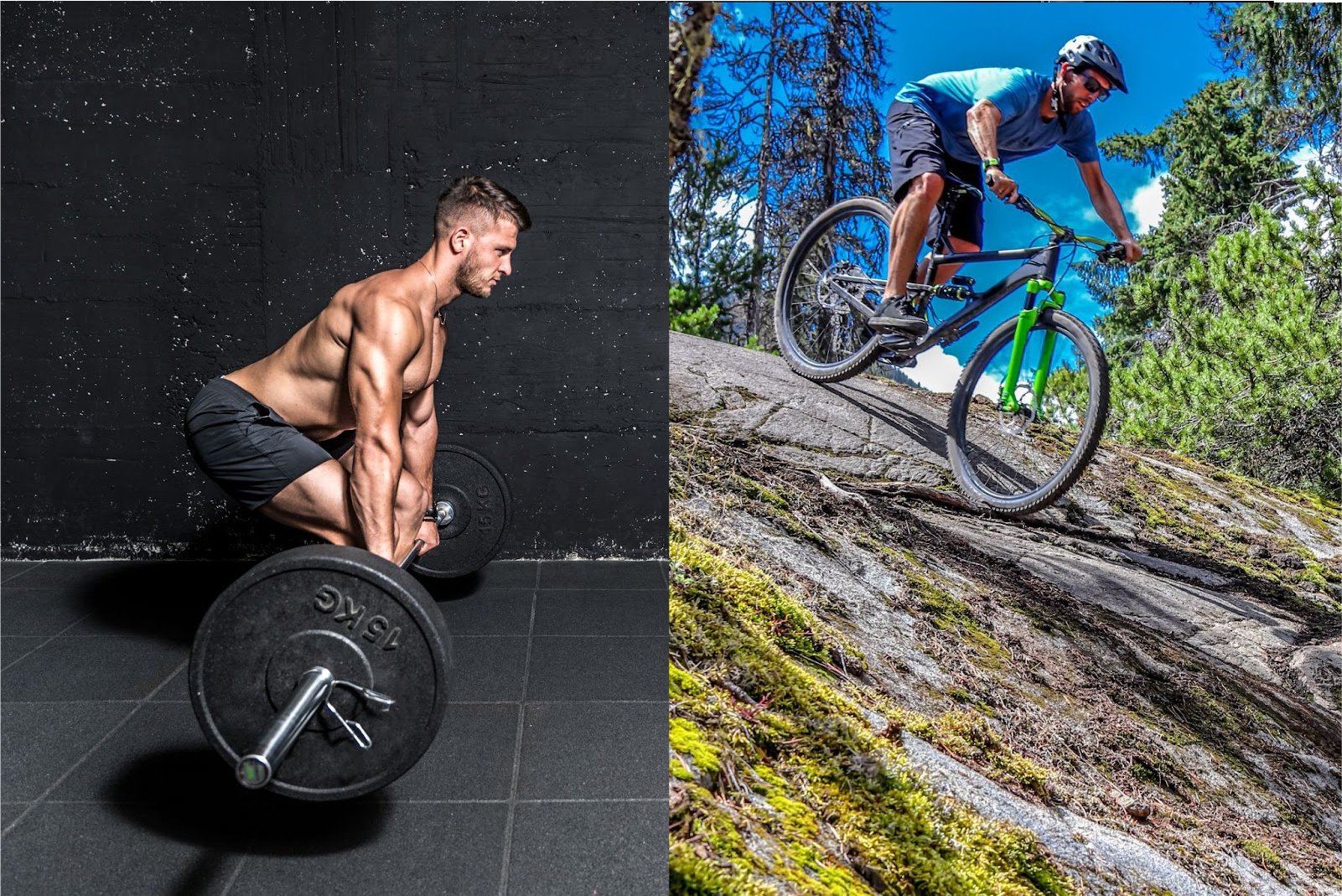
Deadlift Position & Mountain Biking

An interesting parallel to the fitness world is deadlift positioning in the gym. It has been shown that retraction of the neck and chin into a straight, neutral position helps a person to engage the erector spinae (back) muscles and exterior obliques in their core when lifting. Transferring this activation to the bike would result in far superior force production and absorption.

Ready To Get Stronger On The Bike?

Dynamic Cyclist offers an all around training platform for cyclists of all disciplines worldwide. We have comprehensive strength training workouts, injury prevention sessions, mobility and warm up routines all available with the click of a button! 

Give it a try by following along today with our coach, Alisha. This is just one of the hundreds of videos from our library that is available for a low monthly subscription. Our goal is to make you a better, stronger cyclist who enjoys being on the bike and rides pain free. You can sign up here for a 7-day free trial and see what you think! 

Strength Training Considerations For Different Types Of Biking

August 10, 2022 by Eric Lister

Whether you’re on the road, a velodrome or carving up mountain trails, your bike riding is going to be significantly improved with a proper strength and conditioning routine. Strength training for cycling is often overlooked because it takes you off the bike, but with a small shift in perspective we’d like to suggest it will actually pack more riding into your life over time.

Source: 24K-Production – Adobe Stock

Strength Demands of Different Rider Types

Depending on the type of bike riding you choose to participate in, the demands on your body will also change from style to style. While there’s certainly cross over amongst the three types we have categorized below, they all have distinct differences that are unique to that particular discipline.

 Mountain Biking

Source: yanik88 – Adobe Stock

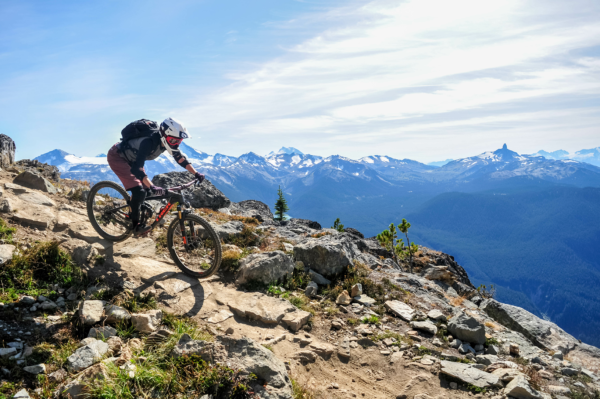
Diverse terrain, varying depths, hard corners, jumps, rocks, roots and everything the outdoors has to offer are factors that every mountain biker must deal with. The movement is much more dynamic than road or track cycling, and in terms of force absorption this is most definitely the hardest type of biking on your body. 

It is well known that adult road cyclists are typically at a much higher risk for osteoporosis than other athletes. Some studies actually show their bone density to closely resemble (and in one case, even be lower than) sedentary control groups. This is not encouraging news for the cycling community.

Conversely, related research has made note of mountain biking being a possible cycling alternative that doesn’t so negatively affect a person’s bone density. Operation of a heavier bike, turbulent jolts and violent carving all translate to more load being put through your body. Strength training for mountain biking should prepare you to handle these types of forces.

Road Cycling

Source: ibravery – Adobe Stock

As mentioned above, road cyclists tend to have a lower bone mineral density compared to other athletes and even the general population. This is because the bike is supporting you while you’re riding, so even though your legs are pumping hard and your heart is beating fast, your bones are sitting there wondering what all the huff and puff is about.

Another factor to consider with road cycling is the prolonged, folded over postures you’ll often find yourself in. The hips have to work in a less than optimal range, the lower back is in a vulnerable position and the neck gets craned back (only some of the issues unfortunately). Low back problems, faulty breathing patterns and tight hips are often the result.

Strength training for cyclists should focus on correcting these postural and functional shortcomings. Introducing load through the body off the bike will help you become stronger on the bike. Not only that, a properly designed program will actually make riding more comfortable and lower your risk of injury despite the less than optimal positions you might find yourself in.

Track Cycling

Source: AboutLife – Adobe Stock

Track cycling is a unique discipline within the broader realm of our sport. There are many types of events and formats, but for the purpose of this article we want to focus on the particular differences in sprint cycling. These are races performed over short distances where maximum power and force production is required. 

Athletes who are successful in sprint cycling tend to have a higher composition of type II (fast twitch) muscle fibers. Individuals with more fast twitch fibers are capable of producing quicker movements and generating more strength in a shorter period of time (power). There is a direct correlation between muscle fiber composition and sprint cycling performance.

Different muscle fibers react to different training modalities. An explosive athlete like a sprint cyclist will likely be doing a lot of jumping and sprinting exercises. Training with heavy weights for low repetitions will also be common in order to teach their body to produce as much force as possible in as little time as possible. Long, leisurely rides will be for nothing more than recovery.

Lifting Weights For Cycling

Source: Flamingo Images – Adobe Stock

Incorporating weight lifting into your cycling training plan is a great way to make yourself stronger on the bike, balance your pedal stroke and most importantly reduce the risk of injury. The #1 goal of any athlete in the gym (unless you’re a powerlifter, olympic lifter or bodybuilder) is injury prevention, because nothing else matters if you can’t actually do your sport.

Determining how to train, what exercises to do, in what rep range and at what weight can all be tricky variables if you don’t have much experience in the gym. This is where the help of a one-on-one coach becomes valuable, as they’ll be able to provide you with the guidance necessary to ensure you’re not wasting your time doing something counterproductive. 

As we’ve already seen, the type of riding you’re doing is going to determine the bulk of your strength training routine. You might be wondering though, is there anything I can do for strength training outside the gym? Regardless of whether I’m a mountain biker, road or track cyclist? The answer is yes!

At Home Strength Training For Cyclists

Dynamic Cyclist is our fully immersive training platform that combines mobility, stretching, injury prevention and strength workouts all into one, easy to use interface. We’ve taken care of all the programming, technical work and coaching so that all you have to do is follow along!

To give you a taste of the world class instruction and workout quality we provide, we’ve included below one of our FULL BODY routines that is going to work you from head to toe. Everything at Dynamic Cyclist is designed to make you better on the bike, regardless of what discipline you most participate in.

Follow along with Alisha, Dynamic Cyclist’s certified coach!

Here’s Why Cycling Recovery Is So Important

August 3, 2022 by Eric Lister

In our go-go-go society the focus always seems to be on working out and never on working in. This despite the fact that we actually get stronger, leaner and more fit in the times when we’re resting as opposed to training. Cycling recovery is no different, so today we’d like to share with you how to make the most of your rest and recuperation to be a better, stronger cyclist.

Source: kenopictures – Adobe Stock

Cycling Recovery 101

Your exercise choices determine the stimulus received by the body, and your recovery choices determine the response. With every workout on the bike, lifting session in the gym or cross training exercise through another sport, you are telling your body that you want to get stronger, faster, more coordinated, etc. What are you telling it in between?

Not allowing adequate rest time in between rides or ignoring the integration of other recovery methods will lead to one cranky, broken, bent out of shape cyclist. Some of us are addicted to giving ourselves away, and have never learned how to properly receive the care that we need. If you’re serious about cycling (or just want to improve) you need to understand the difference.

Mental Health & Cycling Fatigue 

It’s sexy to “push yourself”, “give it your all” and “never quit”, but trying to do that all the time is the exact opposite of health and balance. We are constantly caught up in comparing ourselves to other people, not realizing they lead a completely different life with their own unique set of gifts and misfortunes. 

Social media and every advertisement out there wants to tell you that you’re not good enough, but when it comes to your cycling recovery, you have to realize that isn’t true. Remember to take the performance and training regimens of others with a grain of salt; that you’re your own person participating in this sport for your own reasons.

Whether it’s for competition, recreation or just simple enjoyment, there are many wonderful things about jumping on a bike. A light perspective and pain free body goes a long way in reducing cycling fatigue, and that’s exactly what the rest of this article is designed to teach you about.

Tools For Cycling Recovery

Relieving our achy backs, painful hips and sore legs after cycling is a multifaceted and often complex, individualized issue. Posture, anatomy and various lifestyle factors all have a say. However, there are certain constants that, if adhered to (even loosely), can be a significant contributor to your post cycling recovery and overall improved cycling performance.

Source: Zinkevych – Adobe Stock

Warming Up

Incorporating a warm up into your bike riding routine is one of the most effective (though underused) methods for reducing soreness and promoting post cycle recovery. Warming up before exercise has been shown to mitigate the effects of delayed onset muscle soreness (DOMS), which is one of the worst nightmares for a cyclist.

Supple tissues that have been primed for movement with dynamic exercise perform better and are less susceptible to injury. It’s hard to imagine that a significant part of your cycling recovery takes place before you even get on a bike, but that’s just one of the many influences a pre-ride warm up will have on your performance.

Track Your Training

Simple journals that record your overall feelings before/during/after cycling, total distance, terrain and rate of perceived exertion are great tools to monitor performance over time. If you start to feel symptoms of overtraining, such as mental fog and reduced output on the bike, you can go back in your logs to determine where your recovery has gone wrong.

The truth is that you can have all the best resources at your disposal, but with no way to keep track of them it will be difficult to utilize the right one at the right time. Developing a stress-free journaling practice around your cycling will start to create associations between how different rides and periods of training work with your life and body. Without a plan, you plan to fail.

Recovery Rides

If you still want to jump on the saddle without the stress of a full blown workout, then integrating recovery rides into your training is a direct way of doing so. The recovery ride is, at its core, just reduced intensity riding that places the focus less on performance and more on movement and blood flow.

There is one significant benefit to recovery rides not often talked about in the cycling community, and that is learning to control your exertion. Forget the romantic and ego-fueled ideas about perseverance, grit and will. Our sport requires those things, but not all the time. A mature athlete knows when to attack and when to submit. 

Self Myofascial Release (SMR)

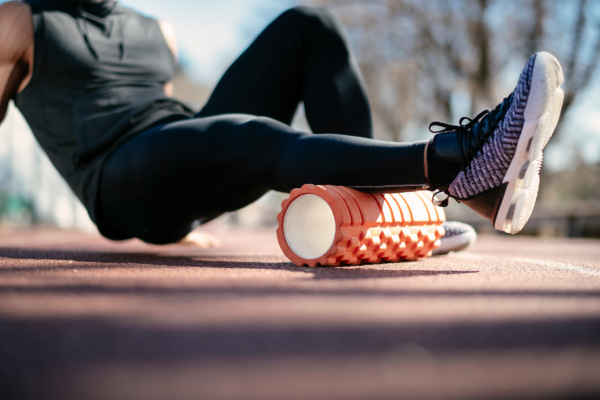
Using a foam roller or lacrosse ball to give your muscles a gentle massage is a low cost method for long-term health and bodily maintenance. They’re widely available and probably hanging out in the corner of your gym! These implements, when used correctly, have been shown to increase joint range of motion and reduce muscle soreness post exercise. 

Not only is this a relaxing practice that you can do almost anywhere, it helps to break up all those stiff, grouchy tissues in your legs and back from being on the saddle. You get to know your muscles in a new way by finding different pressure points (ouch!) and knots that you didn’t know were there, then giving those areas some much needed love and attention.

Source: JustLife – Adobe Stock


Today we wanted to give you a glimpse into our Roll & Release series here at Dynamic Cyclist! We are an all-inclusive training platform designed specifically to train cyclists and help them ride pain free. Our coach Alisha is going to take you through a foam rolling exercise you can do from home, designed to target the hip flexors!

Complete Recovery Plan For Cyclists

Dynamic Cyclist offers a completely integrated training and recovery experience for cyclists of all levels! Stretching, mobility, injury prevention and strength workout routines all in one convenient, easy to use online platform. We hope you join us in the journey to becoming stronger, better cyclists who RIDE PAIN FREE!

6 Ways To Immediately Get Better At Cycling

July 27, 2022 by Eric Lister

Becoming stronger on the bike is about more than wearing a speed suit and choosing the right kind of energy bar (despite what the manufacturers of such goods would have you believe). We want to delve into the more substantive aspects of how to become a better cyclist, and that involves looking at the sport from a personalized and wide-angle perspective.

The last thing we want as cyclists is to start feeling bogged down by the thought of getting on a bike. If you stop seeing improvement or the body begins to give you grief, all of a sudden the activity you used to love will become nothing more than another chore. You might already be there, but it’s never too late to change things up and reinvigorate a whole new routine.

It’s our goal today to give you six solid tips to improve your cycling, make you a better cyclist and help you feel good long-term on and off the saddle. These tidbits of advice will positively contribute to several other areas in your day to day life, so let’s start making a difference today!

Source: kunchainub – Adobe Stock

1. Slow Down

Source: insta_photos – Adobe Stock

Overtraining is a real and extremely detrimental condition that we in the cycling community are susceptible to. Your body doesn’t differentiate stress; stress from work, from relationships and from exercise. It’s all the same to the body. Having a cup that’s too full is a sure way to hurt cycling performance and eventually end up injured.

You wouldn’t think that to become a better cyclist you might have to stop cycling. Sometimes stopping completely, sometimes just learning to slow down. Try reducing the overall intensity of your rides by sticking to even terrain as opposed to hilly slopes. Or, have your goal be to enjoy the ride instead of focusing on performance, which is another way to calm a flared up system.

Look at it this way, cycling has been shown to improve executive functioning and mental health in older adults. This is evidence that our sport can be regenerative and medicinal with the proper dosage. Using it as a tool for recuperation and fulfillment (instead of punishment) is a way we can stay on the bike longer while feeling good about the choices we’re making.

2. Cross Train

Source: LIGHTFIELD STUDIOS – Adobe Stock

Cross training is one of the best ways to improve your cycling performance and make you an overall better bike rider. Not only do you get to explore other recreational and social opportunities, but it’s a physical necessity for any athlete participating in any sport. 

Proper cycling posture is a key factor in determining whether your rides will be efficient, comfortable and pain free. Even the most meticulous cyclist, however, will start to feel aggravated after too much time on the bike. Moving your body with different amounts of force through varying ranges of motion is a complexity that it constantly craves.

Integrating activities that use movements not found in cycling will provide the most benefit. Swimming is a great example; rotation, pulling, back extension, core extension, freeing of the legs and shoulders are all things cycling isn’t great at. An intelligently selected cross training activity will give your body that fresh new stimulation it has been waiting for.

3. Eat Better Food

Source: america_stock – Adobe Stock

The benefits of whole, organically grown, fresh fruits, vegetables and meats are far reaching within your own body, your community and the rest of the planet. Shopping at a farmers market is more than a nice day trip (but it is that too!). It supports local operations and people you get to meet face to face, making a connection between you and what you put in your body.

You literally are what you eat. Everything you digest breaks down to eventually form the cells of your entire anatomy. Organic food is more nutritious and contains less pesticide residues than commercially raised goods. By choosing whole, organic foods (not organic cookies) you’re supporting a sustainable ecosystem both inside your body and outside in the world.

When you eat poorly (and we all know what that means), your body has to try to build muscles, tendons, organs, blood and bone out of garbage materials. How do you think those structures will perform? A hint: They will be at high risk of injury and lacklustre on the bike. Not to mention your mental health, which your food choices have a profound effect on.

4. Implement A Strength Training & Mobility Routine

Source: Shutter2U – Adobe Stock

Unless you are a powerlifter, weightlifter or bodybuilder, your number one goal as an athlete in the gym (including cyclists) is injury prevention. When you get injured, it doesn’t matter how good you look or how strong you are or what your Vo2 max is…you won’t be able to do the activity you love. This often occurs as a result of a repetitive, improperly balanced program.

The implementation of a strength & mobility routine is how you make up for the shortfalls and detriments of your sport. There is no lack of those in cycling, so we have to be clever with the moments before we get on the bike, time actually spent riding, and off days dedicated to the health, pliability and strength of our bodies.

Dynamic Cyclist is a fully integrated training system dedicated to cyclists. It’s a fraction of the cost of a gym membership and can be performed at home with little or no equipment. They have follow along strength workouts, stretching routines, mobility exercises and injury prevention programs that are all designed to help you become a better cyclist.

5. Get A Training Partner

Source: Odua Images – Adobe Stock

Riding alongside a partner is one of the best ways to get better at cycling. Whether it’s your romantic partner, a long-time friend or someone you met at an event, cycling is a wonderful activity that should be shared and bonded over. 

Cycling solo certainly has its benefits, but we all need human connection. Shared experiences are the most memorable, and cycling offers us that opportunity to get outside together and explore. If you’ve noticed a lack of motivation lately, a training partner can help breathe new life into the sport you once fell in love with.

Nowadays there is ample opportunity to connect with local biking enthusiasts. Race events, Facebook groups and other online communities mean that if you want to find someone to ride with, you can! For the more competitive athlete, you’ll find grueling hills and long distance pushes far more enjoyable knowing someone else is going through it too!

6. Hire A Coach

Source: auremar – Adobe Stock

Commissioning the services of a qualified, experienced coach is one of the best returns on investment in any sport or activity. You’ll be under the guidance of someone who has been there and seen the problems you might be facing in themselves and other athletes. Not only that, they’ve learned ways to address those problems and figured out solutions to improve them. 

There is a plethora of information, training programs and advice that pervades the web on anything and everything cycling. Deciphering such information can be difficult and result in a lot of wasted time and effort. This is one of the main advantages to working with someone who can separate the wheat from the chaff and ensure you’re doing the right things at the right time.

Dynamic Cyclist’s dedicated 1-on-1 coach, Cory Krist, has over 20 years of experience helping people become better cyclists. He graduated with an honours degree in Kinesiology and uses his extensive knowledge to help people understand the why behind different training principles and techniques. You can learn about Coach Cory and set up a call with him HERE!

Become A Better Cyclist

As cyclists, we all know the importance of staying in top shape and maintaining muscle balance to avoid injury and ride pain-free. That’s why we’re excited to introduce Dynamic Cyclist, the program that offers daily stretching and strength training video routines designed specifically for cyclists. Created by industry professionals, these programs will take your cycling to the next level and help you reach your full potential. So, whether you’re a beginner or an experienced rider, Dynamic Cyclist has everything you need to improve your performance and keep riding for years to come. Experience the results for yourself, click here to try 7 days free. 

3 Core Exercises To Make You A Better Cyclist

July 13, 2022 by Eric Lister

When the cycling world gathers around to discuss what might be the best core exercise for cyclists, there tends to be an all too predictable bee-line for the plank. Most sports, most gyms and most parts of the world have this same problem. Trainers, physios and even your family doctor might suggest this exercise from time to time. But what is it actually doing for us?

Cycling is not a stationary movement (even if you’re on a stationary bike!), yet we train this stand-still exercise to death hoping for some sort of miraculous return on investment. They’re a great beginner exercise, but once a certain level of proficiency is achieved (two-minute hold), it’s time to put the focus onto something more functional. 

A core workout for cyclists should be dynamic, multi-faceted and tailored to each individual’s strengths, weaknesses and other physical activities. In this article we are going to teach you three unique exercises to make you a better cyclist. We’ll show you how to do them, what they’re working and why they’ll improve your performance. 

First, the muscles.

Core Musculature

All movement emanates from the core. It’s tempting to think that cycling is all about your lower body, but your legs are not isolated entities. They are attached to that huge housing of organs, muscle and power that, if working properly, will be the starting point for any force eventually exerted through the legs and into the bike.

“Does your body have 650 muscles or does it have one?” – Paul Chek

This is a quote that is all too relevant when it comes to the core. There is not a single cell in the body that is oblivious to what the rest of your cells are up to. Fascial casings, innervations, origins, insertions, ligaments, tendons, muscle and bone make for one unbelievably complex and sophisticated movement web. A universal organism, and that organism: is you.

For these reasons, defining the core can be a herculean task all on its own. Today’s exercises will focus on tissues in the trunk and torso, as well as some auxiliary influence from the hips. 

Specifically the following:

  • Transversus Abdominis
  • Rectus Abdominis
  • Internal Oblique
  • External Oblique
  • Erector Spinae
  • Multifidus
  • Gluteals 
    • Maximus
    • Medius
    • Minimus
    • Tensor Fasciae Latae

Core Workout For Cyclists

These exercises are from one of our Dynamic Cyclist strength training routines. Week one, day two of our 3-month intermediate strength training program focuses on Core & Stability. You’ll be able to watch our certified personal trainer and coach of Dynamic Cyclist, Alisha demonstrate each exercise in the links below!

Hip Hinge Reverse Fly

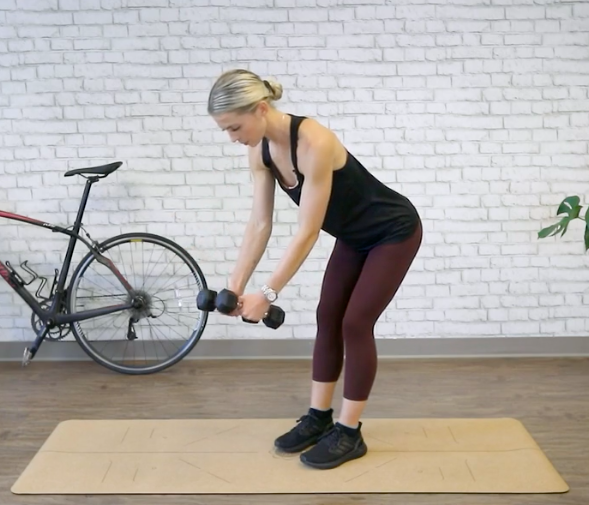
Standing with your feet hip width apart, push your hips back and bend forward at the same time while maintaining a neutral neck and spine. Keep a slight bend in the knees and elbows. Squeeze your shoulder blades together and lift the arms out wide until in line with your body. Slowly release back down. Repeat. Try this exercise with Alisha!

Why It Works

This is an amazing full-body and core exercise for cyclists. 

First, you’ll hear Alisha cue to draw the belly button in while maintaining the hinged forward position. This activates the transversus abdominis (our deepest abdominal muscle), which wraps around your body like a corset and is crucial to lower back stability. It’s your body’s own built in weight belt. Training this muscle has shown to significantly reduce lower back pain in cyclists.

Second, your erector spinae muscles are working hard to hold up your torso in the bent position. Having the ability to produce stiffness in these large, powerful back muscles will transmit force more efficiently to and from your legs every time you pedal. It will also aid in injury prevention of the low back and better posture (two things a cyclist desperately needs!).

Third, actually performing the reverse fly movement with dumbbells gives the posterior (back) part of your shoulders some much needed love. The hunched over position we find ourselves in while cycling tends to stretch the shoulders and upper back into a forward, rounded position. This exercise reverses that by strengthening and tightening those same areas.

Plank Hip Dips

Starting in a forearm plank position with your tail tucked (glutes squeezed) and belly button drawn in, drop your hips down to one side, then return to the start position. Rotate to the other side, return to the start position. Repeat. Try this exercise with Alisha!

Why It Works

This is how you turn the plank into a good core bike exercise! The strength of a person’s abdominal muscles is a reliable predictor of cycling performance, and this exercise (if done correctly) works all of them. 

You’ll hear Alisha say to tuck your hips down at the beginning; this not only engages the glutes, but also the lower and upper abdominal muscles. You’ll again be cued to draw your belly button in, activating the transversus abdominis. And finally, by twisting and dropping your hips side to side, you’re working the inner and external obliques.

By working your abdominals, hips, back and upper body in conjunction with one another, you’re teaching the body to work as an integrated unit. One thing you’ll see in cyclists that lack this ability is excessive movement and swaying in the hips and torso when they start pedaling hard. This bleeds force into unnecessary areas and increases the risk of injury. So let’s not do that!

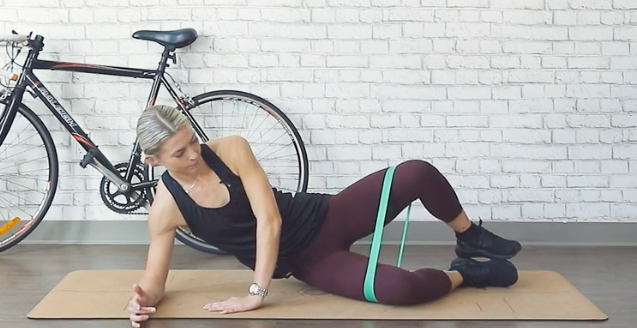
Clamshells w/Mini Band

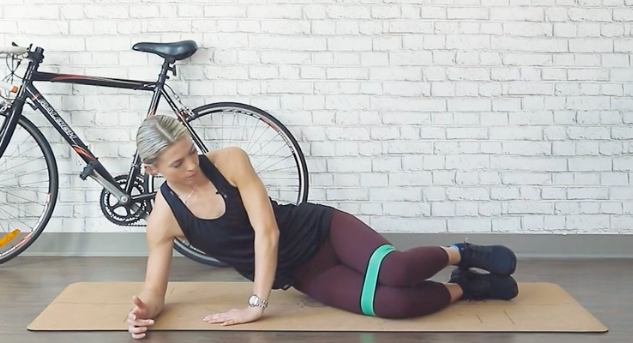
Place a mini band just above the knees and lie down on your side with your forearm beneath your shoulder. Your heels, butt and shoulders should be in one line. Open up your top leg, squeezing your glute, and then slowly lower back to the start position. Repeat. Try this exercise with Alisha!

Why It Works

Our gluteal muscles serve an important role in cycling. They share an intimate connection with the core musculature via their attachment to the pelvis. This exercise works all the gluteal muscles and also activates tissues in the lower back.

The largest and most powerful glute muscle is the gluteus maximus, and it initiates the power phase in our pedal stroke. Being able to forcibly extend the hip is key to any sort of speed or climbing work on the bike. Well developed glutes will align your pelvis for better posture, and training them helps to counter modern activities such as sitting or driving.

The multifidus runs along the whole vertebral column and has its main bulk in the lower back. Many people have a weak multifidus due to inactivity or improper training which leads to instability. The clamshell exercise stimulates the multifidus and makes a connection between the core and hip muscles for a strong back and efficient power transfer while riding.

More Core Workouts For Cyclists

By incorporating cycling core exercises into your program, you’ll be proactive in the prevention of injury and contribute to better overall performance on the bike. Our comprehensive Dynamic Cycling core strength training routines have helped countless people ride pain and injury free.

These were just a few exercises from the hundreds you will have to choose from in our extensive video library. Dynamic Cyclist offers instructional, follow-along workouts and routines led by world class instructors, and even 1-on-1 coaching for a more personalized approach. 

Remember, everything emanates from the core. So it’s important to train it to stay healthy and strong for many more years to come!

Hip Flexor Pain and Cycling: The Ultimate Guide

July 6, 2022 by Eric Lister

Introduction

Cycling is a sport that we and many others around the world take pleasure in as part of a regular exercise routine and healthy lifestyle. There’s nothing worse than being debilitated by an injury or pain that prevents you from doing the thing you enjoy, and that’s exactly the situation so many of our fellow cyclists find themselves in.

The hips are a major focus point when it comes to cycling as it’s where the bulk of our power first originates in the pedal stroke. Unfortunately, many people start to feel hip pain in the cycling position or afterwards when they get off their bike. 

This article will help to detail some of the hip flexor muscles that contribute to cycling, and how common causes of hip pain in cyclists can be remedied to continue enjoying the activity we all love.

What Are Hip Flexors?

The hip flexors are a group of muscles responsible for, you guessed it, flexing the hip (i.e. bringing the knee towards the chest). This group is mainly composed of the psoas, iliacus and rectus femoris muscles. Several other muscles have a ‘hip flexing’ quality to them, however when it comes to hip pain from cycling, we’ll primarily be talking about these three. 

Iliopsoas


Source: Physiopedia

Iliopsoas is a group of two (sometimes three) hip flexor muscles: psoas major, psoas minor and iliacus (the psoas minor is only present in a certain number of people). These muscles have distinct separation in the abdomen but consolidate as they move downward into the thigh, contributing to the same hip flexing function, and thus their common grouping in the term iliopsoas.

As we’ll see, the psoas in particular is a major player in anterior (front) hip pain after or during cycling. Being the most powerful hip flexor and the only muscle that connects your upper body to your lower body, it has a significant influence on the biomechanics of cycling.

Rectus Femoris


Source: Kenhub – Illustrator: Liene Znotina

The rectus femoris is a quadriceps muscle that runs straight down the middle of the thigh. It is the only quadriceps muscle that crosses the hip joint, which gives it its hip flexing function. Rectus femoris also crosses the knee joint, making it a forceful contributor to cycling in general through its dual action of knee extension (power phase) and hip flexion (recovery phase).

How Do Our Hip Flexors Contribute to Cycling?

Cyclists and runners have something unique in common. They tend to think about (and train) the downward forces applied into the ground or pedal far more than the ‘pulling’ forces that allow them to regain position for the next repetition. This can be detrimental in terms of injury risk and performance, because only half the movement is being trained! 


Source: Active For Life

Our hip flexors are mainly responsible for the last part of the recovery phase (10 to 12 o’ clock pedal position) during cycling. By using the hip flexors to ‘pull’ us through the final part of our upstroke, we can effectively utilize the force generated in the power phase and assist in creating an overall more efficient stride.

While cycling, many people are so focused on their thighs that they forget the entire leg is (or at least should be) working through the different parts of each pedal stroke. Fatigue tempts cyclists into relaxing during the 6 to 12 o’ clock position, but in doing so they leave a lot on the table in terms of output and will also overwork other muscles in the process.

Causes of Hip Flexor Pain During/After Cycling

There are usually several culprits responsible for the pain cyclists feel in their hip flexors during or after a ride. They tend to contribute to one another making the problem hard to diagnose and rectify. Though just as the issue tends to be multi-faceted, a given treatment protocol will often have overlapping benefits as well.

Here are some common causes of hip pain in cyclists and how best to approach them.


Source: Coen van de Broek

Poor Posture

Cycling puts your body into a terrible position. There’s lots of talk online about getting into a “good” or “better” position, and it is certainly something you can improve (with a proper fitting for example). Nonetheless, hunching over on a bike is not ideal for the following reasons:

  • Tendency to round the upper and lower back
  • Shoulders rounded forward, compressing the chest
  • Breathing is compromised
  • Neck is craned back
  • Hips stay in a flexed position and never fully extend
  • Pelvis is largely immobilized


Source: Jacek Dylag

While cycling, your hip is in a constant state of flexion, even when riding out of the saddle. The psoas muscle attaches to your femur and all five lumbar vertebrae. If the psoas muscles get tight and shortened from this constant flexion, they’re going to pull on these vertebrae and increase the curve in your lower back, creating what’s called lumbar lordosis.


Source: PhysioLogic

This leads to several problems. The lumbar discs are now compressed, your pelvis tilts forward (compromising movement of the femur head) and you’re likely to feel stiffness, ache and pain in the front of your hip from a short and aggravated psoas. 

An immobilized pelvis due to the sitting position on your bike also contributes to this problem. The pelvis naturally tilts back and forth as you move, as well as some slight rotation between its two halves. The seated position on your bike takes away the majority of this tilting and already minimal rotation, stagnating the hips.

Treatment

Alleviating the hip pain you feel from spinning or cycling could be as easy as doing some simple stretches! By targeting the hip flexors through stretching you’re proactively treating and correcting the poor position cycling puts you in. And if you’re already in pain, this might be a great place to start to get you back on the bike.

Here is a hip flexor focused routine for you to try. Or check out these easy hip stretches for cyclists that target the back, front and side of the joint. Stretching will help combat the tightness created through cycling and several other activities that have become a part of our lives, such as sitting and driving.

Weakness

On the bike, your hip flexors are trying to work in a mechanically disadvantaged position. Having the trunk folded over your lower body is not optimal for force production, and is basically the opposite posture than that of a sprinter (the athletes with the largest and most powerful hip flexors).  


Source: BBC

It’s almost unimaginable how many times your hips will flex while cycling. Thousands and thousands of repetitions. If the hip can’t fully flex as a result of weakness/fatigue, your body will compensate by looking for that flexion farther up the chain in your back and side. This can lead to overuse and injury of muscles trying to do an action they’re not designed for.

Treatment

There are several ways to strengthen the hip flexors and condition them for cycling. Any exercise that lifts the knee towards the chest will work the correct muscles. Many core exercises also train the hip flexors, particularly ones that move the legs. Knee raises and leg lifts, when done properly, are a great combination for core and hip flexor training.

Further, a number of factors could be inhibiting and weakening the hip flexors. Having the wrong size of bike could be putting your hips into a bad position, so it’s important that this is checked and fitted by a professional.  Stretching your glutes might also be helpful, as tight glute muscles will fight the pull of your hip flexors every time they try to fire.

Overuse

We as a cycling community often drift toward the masochistic when it comes to our training regimens and discipline towards recovery. Long hours on the road, early morning spin classes, and intervals all mix up a dangerous cocktail. Or how about the elusive “recovery ride” that promises to refuel but instead turns into a full blown workout. We’ve all been there.

Many turn to cycling because it has a reputation for being low impact. Fortunately or not, that allows us to do it…almost all the time. As previously mentioned, the positions we find ourselves in on the bike tend to compromise our bodies, especially the hips, potentially risking injury long term.

Treatment

Remember the rectus femoris? It’s the big quadriceps muscle that crosses both the knee and hip joint. It gets tremendous activity during cycling through its dual functions of knee extension and hip flexion, and is one of the tissues most vulnerable to the excessive nature of our sport. Light foam rolling or massage over this area could provide some much needed relief.

In general, just taking some time off. We know that might be the last thing some of you want to hear, but consider this: The more you like to ride, the more you need to learn to take care of yourself. Proper strength training, nutrition and rest. Luckily we have plenty of resources to help you do all those things and more.

So, Is Cycling Bad For Your Hips?

Well, it doesn’t have to be! Take this for example. It is common practice during physiotherapy after a hip replacement to integrate cycling into a person’s recovery. For the same reasons cycling leads us to pain (immobilized pelvis, hips don’t fully extend), we can use it as a regenerative practice that heals and restores function to the joint.

Finding balance is what’s important. Not just in your training volume, diet and rest, but also the length and strength of your muscles. Or the time spent folded on a bike versus being on your feet with your head up and shoulders back. 

Hip Rehab Program for Cyclists

Cycling is a great activity that can be part of a healthy, active lifestyle. However, if you are suffering from pain or discomfort while riding check out Dynamic Cyclist. This comprehensive resource addresses the most common muscle imbalances and adaptive muscle shortening that lead to pain and reduced performance on the bike. With just 15 minutes a day, you can follow along with the video programs to alleviate tension and improve posture, so you can ride pain free and reach your full potential on the bike. Don’t let muscle imbalances hold you back. Try out their 6 Week Hip Function & Rehab Program and experience the results for yourself. Click here to try 7 days free!

The Best Massage Ball Exercises for Cyclists

June 29, 2022 by Guest Post

If you are currently a Dynamic Cyclist subscriber the use of a ball, of some sort, has become one of your primary self care tools. Nothing feels better than TFL release, am I right?! But this little addition to your stretching and mobility programs can be something you take on trips and races as your own personal deep tissue masseuse.

I always bring a ball with me on trips and races. It’s relatively small, light and easy to pack and is the next best thing to a foam roller. At the end of a 20 hour riding day nothing feels better than to sit down and roll out the muscles and fascia. Here are some ways you can use one to help settle the legs down after a long day in the saddle.

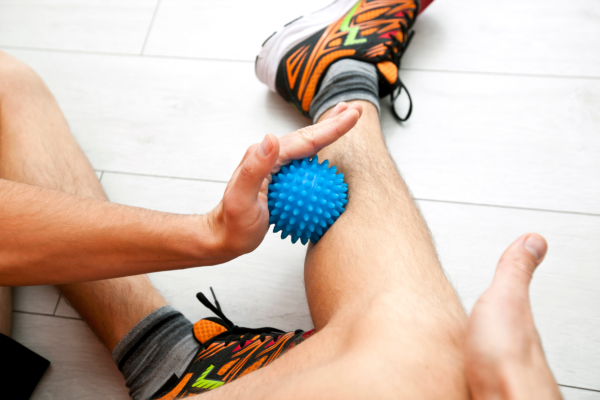
Rolling out the quads: Simply sit on the ground with your legs straight out in front of you. Take the ball in your hand, roll it up and down your quad, pressing deeply into the muscle. You can dig right into your adductors and IT bands as well. 

Shin and Calf: Still sitting, take the ball and roll it up and down the muscles on the outside of your lower leg. You can also place the ball on the ground underneath your calf and apply pressure to roll that area out as well. Spend time pressing on the more tender spots to facilitate release.

Glutes: Just like you would with a foam roller, place the ball on the ground, place your glute on top of it and roll around. This can be pretty gnarly as the ball applies a lot more pressure than the foam roller. Simply place more weight on your feet and hands to reduce the pressure. You can also do this against a wall to better control pressure.

TFL: Cyclists can really suffer here. To find the TFL, place your finger on the front of your pelvic bone.  Slowly move down and to the outside of the thigh until you feel a ropey muscle that is the width of a finger.  It may be tender to touch. You can roll the TFL with the ball by hand or you can use the ground or the wall to really dig in.

Shoulders, Back and Scapulae: Place the ball on the ground or use a wall to focus pressure on various knots in these areas.

Feet: Place the ball on the ground and while sitting, roll the bottoms of your feet from the heel to the ball to give yourself a lovely foot massage.

Arms: After being on the bars all day, simply rolling the ball over the muscles in the upper and lower arms can feel great and will get the blood circulating again.

For something so small and unassuming, the cork ball can really help in relieving tension in the body. It’s cheap, light, portable and really effective at finding those spots that need the most attention. Check your local yoga shop to see if they have them or you can pick them up on Amazon for less than $20.

Written by Steve O’ Shaughnessy – Distance Cyclist & Podcaster

A Bit About Steve

Hi, I’m Steve O’Shaughnessy, born and raised in the town of Deep River, Ontario. I first moved west in the early 90’s and made Whistler, British Columbia my home. Years later and after careers in retail, information technology and coffee roasting I’d find myself with a wife and family in Invermere, British Columbia.

I started cycling in my 20’s after moving to Whistler, and what a place to learn to ride mountain bikes. I was a guide on Whistler Mountain well before its absorption by Intrawest. I spent most of my time on singletrack and still love a rip on the trails every now and then, but lately, riding distances has become very attractive to me.

In 2018, I rode the BC Epic 1000 and finished in (4d 4h), in 2019 I rode an ITT of the Lost Elephant (2d 15h) then again in 2020 on my single speed, where I finished in 2nd (2d9h30m) behind Justin Hettinga. 2021 was the year of my BC Epic yoyo when I also raised a modest $2000 for the Masaka Cycling Club. A huge personal challenge for me that was also a great success. 

In 2018, after the tragic loss of Ryan Correy, I picked up the Bikepack Canada podcast and put out 23 episodes before branching out to start my own podcast, My Back 40. As a podcast producer and host, my mission is to bring listeners inspiring conversations about bikepacking, ultra endurance racing, training, nutrition and the mental health benefits of this awesome activity.

I enjoy writing and recording conversations with inspiring people. If I have learned anything after over 100 conversations I’ve had, it’s that everyone has a story and can inspire. I have also learned that we are all so much more capable than we give ourselves credit for.

Check out Steve O’Shaughnessy’s podcast ‘My Back 40’!

« Previous Page
Next Page »
  • Facebook
  • Tumblr
  • Twitter

Latest Articles

JOIN Cycling: A New Training Platform for Cyclists

May 27, 2024 By Eric Lister

cold exposure

The Benefits of Cold Exposure for Cycling & Life

June 13, 2023 By Eric Lister

hill climb

The Ultimate Hill Climb Training Guide

May 31, 2023 By Eric Lister

shoulder pain cycling

How to Treat & Avoid Shoulder Pain While Cycling

April 12, 2023 By Eric Lister

psoas stretch

The Importance of the Psoas Stretch for Cyclists

April 6, 2023 By Eric Lister

cycling neck pain

The Ultimate Guide to Cycling Neck Pain: Causes and Solutions

March 21, 2023 By Eric Lister

Useful Info

  • Contact
  • Finally, A Global Cycling Club That Is Focused On Community And Love Of Cycling!
  • Privacy Policy
  • Share Your Story!
  • Terms And Conditions Of Use
  • Welcome to I Love Bicycling
  • What Happened When I Stretched Every Day For a Month

Recent Posts

  • JOIN Cycling: A New Training Platform for Cyclists
  • How to Hang Bikes in Your Garage: 4 Inexpensive Options
  • Gravel Bike Vs. Road Bike: Which One Is Better For You?
  • The 6 Types of Mountain Bikes & How to Choose the Best One for You
  • What Is a Touring Bike Good For? 5 Benefits We Know You’ll Love

Search I Love Bicycling

Connect with Us

  • Facebook
  • RSS
  • Tumblr
  • Twitter

Copyright © 2026 · Magazine Pro Theme on Genesis Framework · WordPress · Log in