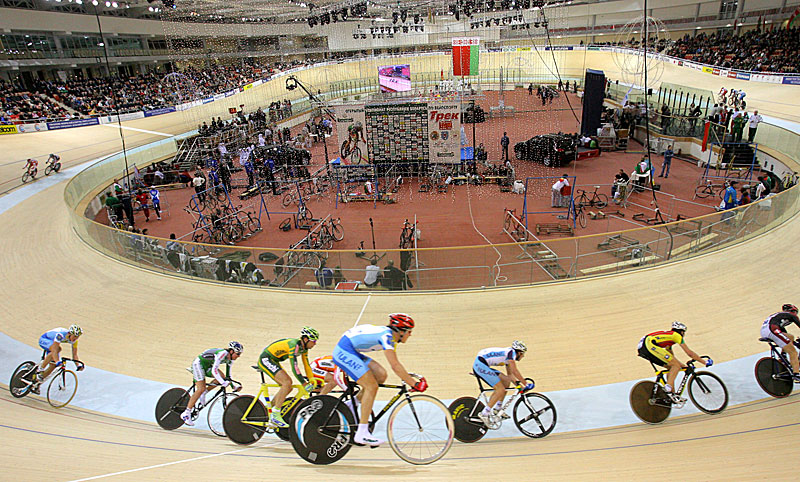
Everyone gets curious about track cycling during the Olympics. It is dynamic and exciting to watch and equally dynamic and exciting to participate in. A little knowledge of track cycling could be your jump start into true track cycling fandom and racing. You should not have to limit your track cycling to one week every four years.
The Velodrome
The velodrome is where track cycling takes place. It is a banked oval, ranging in length from 133 meters to 500 meters. The Olympic standard length is 250 meters. The length of the velodrome changes the dynamics of the racing along with the degree of the banked turns. Some multiple of whole and/or half laps should equal one kilometer. Most velodromes have turns steep enough that you have to maintain a certain speed to keep from sliding down the turns into the infield.
Velodromes can be indoors or outdoors. The benefits of an indoor velodrome is that races can run year round with no pause for weather. Records are set on indoor velodromes because there is no wind to interfere with an attempt. Indoor velodromes also generally have seating for crowds. Outdoor velodromes though are far cheaper to construct.
Track Bikes
As a rule, track bikes have no brakes and one gear that cannot coast. You must modulate your speed through the drivetrain. It is especially good training for bike handling because you have to react to the race around you without using brakes. There is a lot of contact in track racing and most of the time riders stay upright. A bicycle is inherently stable at speed.
There are two types of track bikes that cover a range of events. Sprint bikes are for shorter races of raw power and mass start races. These look like standard road bikes with drop bars. Pursuit bikes are for time trials, ranging from five hundred meters to four thousand meters. These look like time trial bikes with aerobars.
Track bikes will have the most aerodynamic wheels possible, based on conditions. Indoors for pursuit events, riders will use a disc wheel front and rear. This is not possible outside because of wind; it would make the bike difficult to handle. Instead riders will use a rear disc and some sort of spoked wheel in the front.
The Events
Mass Start Events
Mass start events have more than one rider from different teams taking the start line to race in as many different formats as you can imagine. Think of all of the races you came up with as a kid; there’s a corollary to match on the track.
The Scratch Race
This is your basic bike race. Sometimes you will even hear this term describing a race on the road. There is a set distance or time. The winner is the rider to cross the line first over that distance or time.
The Points Race
At declared laps, there will be points up for grabs. The number of points varies by race, as does how deep they go. In the Olympics it is five, three, two and one points for each points lap. Riders also get points for lapping the field. The rider with the most points at the end wins.
Keirin
Six riders start behind a derny, or motorized pacing bicycle, and jockey for position. They ride behind the derny at increasing speed for five laps (at the Olympics, this varies at other velodromes). After five laps, the derny pulls off and the riders race the last two laps. This is perhaps the fastest race in track cycling with speeds well over seventy kilometers per hour.
Madison
The Madison is named after the venue that made it popular, Madison Square Garden. Two riders team up, with one racing at a time, to cover a set race distance. When a rider needs a break, they hand-sling their teammate into the race, providing fresh legs with more speed. A good Madison hand sling will accelerate a rider faster than they would otherwise go.
Match Sprints
Two riders go head to head to get to the line first. The race is too long for it to be a full-on sprint from the gun, so they jockey for position, going very slowly for the first two laps. One rider will jump and explode with speed, hoping to catch the other rider off guard. This is a very powerful race, also with speeds over seventy kilometers per hour.
Miss and Out
Also called Devil Takes the Hindmost, on bell laps, the rider in last position is out. The winner is the last rider left at the end. It is a highly strategic race, where you can win by going faster than everyone, but also by sending riders out the back.
Pursuits and Time Trials
Pursuits and time trials are races for individuals and teams against the clock. There are a few different formats and a few different races that favor different kinds of riders.
Individual Pursuit
Generally between three and four thousand meters, two riders start the individual pursuit at opposite sides of the track. It is a time trial with the fastest time winning, although if one rider catches the other, it is also over.
Team Pursuit
The same format applies from individual pursuit, except it is run as a team time trial. It takes a well disciplined team to succeed in the team pursuit, riding very close to one another and synchronizing their efforts.
Half and One Kilometer Time Trial
These time trials are the balancing point between a long sprint and a full time trial effort, making them the pinnacle of suffering. Have you ever started a sprint and felt great, only to find out that if you hold it any longer you may fall off of your bike? This is that event, except they continue on. Individuals compete against the clock, with the fastest time winning.
Team Sprint
A team of riders races together, with each rider racing one lap and dropping out. Again, fastest time wins. For example, a team of three will do three laps, with the first rider only riding the first lap and the last riding all three, finishing with a huge sprint. It is almost like a leadout on the road, only it is on the track.
Track Knowledge
With a little more knowledge and understanding of track cycling, you can now be a more informed viewer (and maybe racer) of the myriad events on the velodrome. Have fun watching and racing!